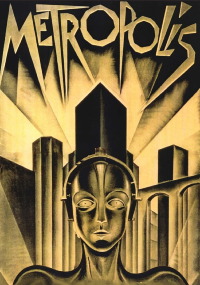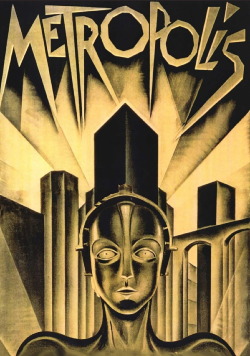
Review of Metropolis (1927) by Tjman09 — 22 Oct 2015
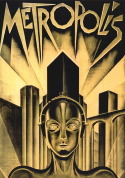
In 1927, during one of the harshest times in recent history, German Expressionist director Fritz Lang made Metropolis. Metropolis is one of the most historically important films ever made, because it was an artistic German Expressionist masterpiece, that boldly challenged the Nazi Party, and still has a massive impact on cinema today. It was an angry film pointed at its geographical time and place, but it also offered some major positives for the industry.
Lang used several techniques that have become recognized as key elements of German Expressionism, most noticeably lighting. A good example of this was the scene that introduces Maria for the first time, multiple times contrasting lighting techniques were used to highlight particular characters. This technique gave Maria an angelic look, when she spoke, as well as highlighting the reactions of particular characters.
Another element of german expressionism was. These lighting techniques were also used often with the presence of the character Rotwang, with this character various lighting techniques were used to make his rooms darker, and give Rotwang large shadows. Just by lighting techniques Lang told the audience how to feel about certain characters, something many filmmakers have since copied.
These lighting techniques are great examples of German Expressionism, but they also help shape the narrative, and tone of the film. The narrative of Metropolis leans in the direction of formalist, because it very heavily promotes a thematic point, has a scrambled sense of time, and is occasionally intruded with the director’s style. The film’s narrative has very clear religious parallels and a clear message, against the Nazi Party, and their regime. At a time when the amount of propaganda films were rising, Metropolis was able to send a message with clever subtlety.
The evidence that Lang was angry with the, at the time, new Nazi Party is evident through the religious parallels, especially with Israel. It’s no secret how the Nazi’s felt about members of the Hebrew religion, and the parallels often connected to the Hebrew religion. The catacomb scene in the film contains the best examples of this as the candles behind Maria resemble a menorah, the iconic candle that the Hebrew religion celebrates Hanukkah with.
Maria has a very close association with the woman in Revelation 12, it seems relevant to point out that in the catacomb scene the candles behind Maria, may represent the crown of twelve stars. The religious parallels combined with the well known fact that Fritz Lang didn’t like the Nazi Party, most likely because of his Jewish heritage, help reinforce that Metropolis was film with an angry anti-Nazi message.
Perhaps the most impressive thing about Metropolis is the powerfully real way that Lang showed us his apocalyptic vision. The world is scary, because it’s realistic, and powerful, because it resembled an interpretation of the world the Nazi’s preached about creating. The evidence that the world resembled a Nazi vision are, again, in the religious parallels, this time with the story of Exodus. The film is clear that the world has three divisions, the hand (the egyptian slaves/the poor), the brain (the pharoah/Joh Frederson), and the heart (Freder/Moses), it is noteworthy that the story of Exodus is about Hebrew liberation.
The film was powerful, because of it’s message, but is also one of the most influential of the classical Science Fiction films, and still has a massive impact on films today. Visually the Metropolis was made to be a beautiful paradox that is magnificent, yet equally hellish, this look has been copied numerous times throughout the years. Examples of this are in Blade Runner, Dark City, Escape From New York, and the Matrix. The dark yet beautiful apocalyptic world would become a staple of futuristic Science Fiction films.
Another visual staple of Metropolis was the look of the citizens, specifically the poor, who are a bland, uniform set of people, beaten to submission. This has been used in films like THX 1138, and more recently films like Snowpiercer, and the Hunger Games. Another impactful aspect of the film is Rotwang’s metal hand, which has been copied famously in Dr. Strangelove, and Star Wars. There are many more things that Metropolis has inspired over the years, these are many more things that Metropolis has inspired over the years, these examples were just a few examples of the impact of Metropolis.
Regardless of one’s opinion toward the film itself, it seems self-evident that Metropolis remains one of film’s shining moments, as proof that art can reflect and even criticize culture. Metropolis also remains timeless, because it offers viewers the opportunity to enter the mindset of a skeptical German during the rise of Nazi power. Metropolis’ footprint still heavily affects films today, that, and considering the message’s enduring relevance, make Metropolis one of the most influential films of all time.
This review of Metropolis (1927) was written by Tjman09 on 22 Oct 2015.
Metropolis has generally received very positive reviews.
Was this review helpful?