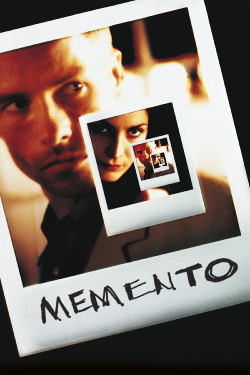
Review of Memento (2000) by Miguel R — 04 Jun 2016
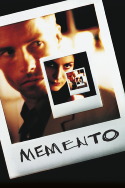
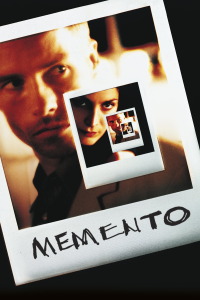
The DVD menu for Memento captured me. Literally not a second into the movie, and I was already quite interested. The menu has a long list of single words, surely each with their own meaning. I eventually had "Watch" selected, and instinctively, I chose that. There weren't that many clues, but given what I know about DVD menus, it felt right. The movie Memento is like that too, only Leonard Shelby (Guy Pearce), our protagonist, is dependent on what he knows to make these instinctive choices. Shelby has a memory loss condition, which started from when he was knocked out by a man, John G, who was accomplice to or simply was the person who raped and murdered his wife. By the time he regained consciousness, he can only remember happenings of the past five minutes or so before his clock resets. That is ripe for confusing trite, right? Well, Christopher and Jonathan Nolan, director and screenwriter respectively, somehow tell the story in a comprehensive and fascinating way by playing it backwards. By backwards, I mean that we see the chronological ending of the tale at the very beginning, where Shelby kills John G/Teddy (Joe Pantoliano), thanks to the help of Natalie (Carrie-Anne Moss), someone who, "has also lost someone." Scenes are divided by memory blocks. Whenever Shelby is suddenly clueless about what is happening, that's when a scene begins. That means, as the movie moves forward, we see how one scene led to the one we previously saw. If you're looking for a genre to call this movie, I would use "psychological mystery." I think it's cool to watch scenes like this, as it helped me in relating to Shelby's mental condition.
Between these memory blocks are B&W scenes that are chronologically earlier than the coloured memory block scenes, and are played in normal, forward fashion. Shelby is on the phone with someone about a man named Sammy Jankis (Stephen Tobolowsky), a con man who faked the same condition that Shelby now has. Sammy's type 1-diabetic wife (Harriet Sansom Harris) was not totally convinced, and hoping to snap Sammy out of this mindset, she asked Sammy for several insulin shots in the span of a few minutes. She went into a coma and died. It's a depressing story that only becomes sadder by the end of the movie. Watching the wife overdose was traumatic enough as it is, but with all context into consideration, Memento came damn close to bringing me to tiny tears.
With Shelby's condition, how does he ever know what he is doing? Sometimes, he has to use context clues, such as, when a tall man is shooting a gun at you, you are running away, not towards, from said man. Starting scenes like that feels like we are entering the middle of the scene, with much credit to cinematographer Wally Pfister. For the important facts, however, he takes a photograph, and writes the name of what he photographed and facts that he could easily forget by the next block. He also gets tattoos for the especially important notes. By watching the story in a choppy, backwards fashion, I initially trusted whatever Shelby wrote. Scene by scene, note by note, his memory loss continuously proves him to be a very unreliable narrator. He is adamant about his distinction between memories and facts, yet his notes are skewed by what he supposedly remembers. Guy Pearce's stubborn action star attitude is perfect for the character, and since Memento is not primarily an action movie, that attitude is more pitiful than honourable.
TL;DR: It's a Christopher Nolan movie. Your mind will be blown, at some stage. This may very well be his best, due to an offbeat narrative structure and how that narrative allows a great gut-blow payoff by the ending.
This review of Memento (2000) was written by Miguel R on 04 Jun 2016.
Memento has generally received very positive reviews.
Was this review helpful?