Review of Melancholia (2011) by Johnnyhollywood — 16 Jan 2012
Happy New Year Indeed.
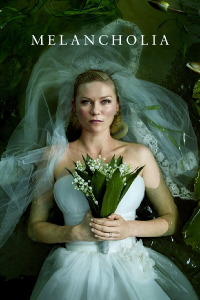
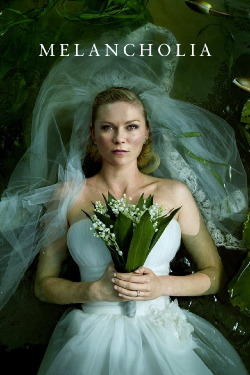
It's the holiday season again, and with it comes the usual slate of talking-animal Christmas movies and lame rom-coms set on New Year's Eve. I feel it's my duty to counterbalance this overt cheerfulness with just a little bit of morbidity. So, to open 2012, I'm going with my favourite film of last year bar none: Lars von Trier's Melancholia, a film about a newlywed bride's severe depression and crumbling relationship with her caretaker sister. Sounds none too festive, right? It gets better. The story is set during the last days on Earth, before a foreign planet collides with ours and all life is obliterated forever. Yeah.
Before anyone becomes too concerned with the end of the world, though, we are treated to Justine's (Kirsten Dunst) wedding, an extravagant affair paid for by her sister Claire (Charlotte Gainsbourg) and Claire's husband John (Kiefer Sutherland). After everything that could go wrong does go wrong during the evening, Justine does not leave the party with her new husband (Alexander Skarsgard), but stays at Claire's castle where the reception took place. The next day, as John and son Leo (Cameron Spurr) become increasingly giddy at the chance for a firsthand glimpse of the planet expected to simply 'pass us by', Claire's anxiety peaks and Justine's depression consumes her.
The film exists in two distinct parts: one covering the wedding night, and the other the aftermath. Surprisingly, Part One makes for such a well crafted, engaging story that the whole 'world is ending' angle almost seems like an unnecessary gimmick. It is an intriguing, intimate look into the mind-numbing array of family dynamics at play during what should be Justine's special night. Much of its brilliance must be credited to a tight script and, subsequently, the characterisation of the act's central figure. Rather than being lazily written as a 'woe-is-me' sad sack that finds no joy in the night's proceedings, Justine draws audience sympathy nice and early through her efforts to make the best of things despite the social disaster unravelling around her. One gets the impression that she does have a genuine love for some people, but the vexing truth is that, in spite of the seemingly significant ramifications of this night, things are about to get far more sinister. We know this because von Trier leaves the viewer in no doubt as to how this film will end. The opening act is an incredible collection of surreal scenes depicting the Earth's destruction, set to the chilling prelude to opera Tristan und Isolde. So when Claire's fears are temporarily relieved towards the end of the film, it feels devilishly cruel to lead on this fearful individual when the audience is already aware of what is still to come. Put simply, it could be said that Part One is the cinematic masterclass, with heavy emphasis being placed on all things that make a quality film (beautiful imagery, well-structured dialogue and purposeful character interaction) while Part Two is the thematically charged intellectual piece, where the audience is not spoon-fed, but rather challenged to find personal meaning in the events unfolding on screen.
Certainly, by the time the second half comes around, the security blanket separating caged fiction from terrifying reality has well and truly been removed. In the morning after the wedding, the world has become a much darker place, in both a literal and metaphysical sense. Justine's condition has degraded from a person battling with flashes of doom, to one that has become sedate and eerily calm in her total submission to the illness. In contrast, Claire, who has lived a balanced, comfortable life up until this point according to universal standards (big house, married, young son, et al), and who therefore has so much more to live for, refuses to accept the inevitable. It is through this polarising pair of characters that Melancholia offers the foundation of many different interpretations regarding the film's true meaning. Personally, it appears to be not only an exposition of universal perception and understanding one's significance in the context of all things, but also an assertion of how human beings might act in times of inescapable disaster. It begs the question: 'How do you think you would react in this situation?' But perhaps more importantly: 'How would you like to react?' This notion is hammered home when, in the film's heart-pounding and visually spectacular closing moments, the seemingly soulless Justine still finds time for one last act of utterly selfless heroism, even in the face of certain death.
*There's nothing I love more than a bit of feedback, good or bad. So drop me a line on [email protected] and let me know what you thought of my review.
This review of Melancholia (2011) was written by Johnnyhollywood on 16 Jan 2012.
Melancholia has generally received positive reviews.
Was this review helpful?