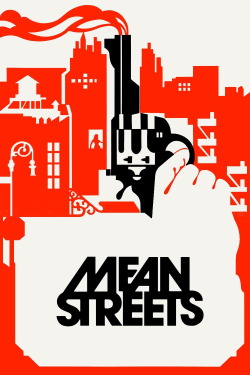
Review of Mean Streets (1973) by Edith N — 06 Jul 2011
Quintessential New York Filmed in Los Angeles.
I'm beginning to think that a lot of people who claim to be Robert De Niro fans have never actually seen most of his early movies. It strikes me that he didn't really play tough guys. Mostly, he played guys who thought they were tough, guys who wanted to be tough. Guys with something not quite right about them, generally, who just wanted to be somebody. I have felt since the first time I saw [i]Taxi Driver[/i] that Travis Bickle had a lot in common with De Niro fans. Adolescents ones, at least. After all, in that movie, he's standing in front of his mirror, practicing how to sound tough. Consider that. He wasn't actually as tough as he wanted to be, so he was pretending to be someone who was. It seems to me that De Niro also played guys who were trying too hard to fit in with people who were cooler than the De Niro characters. I can't help wondering if De Niro thinks about it that way. Or even Scorsese.
Our focus here, however, is Charlie (Harvey Keitel). He is a minor mob functionary. The trailer describes him as an honourable man, and that's true enough. He does his job, and he's good to his girlfriend, Teresa (Amy Robinson). And because he's good to Teresa, he's good to her cousin, Johnny Boy (De Niro). The problem is, Johnny Boy owes money to everyone in town, including loan sharks who are quite enthusiastic about the prospect of breaking his legs. Charlie is basically running interference for him, trying to make payment arrangements and in various other ways keep Johnny Boy from getting maimed, killed, or jailed. However, as is so often the case, Johnny Boy sees this as Charlie's being domineering, and everyone else sees this as Charlie's being a sap. Even Teresa is about to the point of telling Charlie to let Johnny Boy sink or swim under his own power, and he's family. Charlie can't do it, though. He has taken on a responsibility.
Arguably, this actually does make him a sap. There are some people you just can't help. In many ways, Charlie is a tortured soul. He loves Teresa, but he knows his family disapproves of her--she has epilepsy. He tells her of his admiration of Saint Francis of Assisi, and her automatic response is that Saint Francis didn't run numbers. His, of course, is that he doesn't run numbers, but her point is still valid. There's a limit to how much you can be like Saint Francis and actually work for the mob. However, there is a certain amount of "respect for dumb animals" involved in taking care of Johnny Boy. In fact, you might argue that Saint Francis had it easier. Squirrels don't talk back. Deer don't declare that they can shoot out the light on the Empire State Building. Birds don't get in deep to bookmakers. And after all, Saint Francis did start out as a soldier, though most people--probably even most Catholics--don't realize that. Perhaps it's just that Charlie can't take the next step.
Of course, Scorsese himself probably added that deliberately. The whole story is set in Little Italy, that tiny section of New York where he himself grew up. Scorsese was a seminarian in the '50s. Therefore, it is reasonable to assume that all religious references in his movies have the subtext taken into consideration. It's also true that the reasonable assumption is that the feel of Little Italy is authentic, even if the actual filming locations are not. I'm not the world's greatest expert on the subject, of course. I've only been to New York once, and it was for five days in 1991. My schedule was mostly taken up with rehearsals and concerts, too. However, I do know Los Angeles, and the movie does not feel like Los Angeles. It may be that it's set in Mythic New York, of course, as I've no doubt a lot of other films are, but on the other hand, Scorsese certainly knows Real New York from Mythic, so I'm reasonably sure any variations from the former to the latter are on purpose.
There are several kinds of gangster movie. Indeed, Scorsese has made several of the kinds himself. This is the one I like. It is true that Charlie is in the mob, but it doesn't matter. He wants out, of course, because that it traditional in movies where Our Hero is all mobbed up. More to the point, he is at heart a good person, which is much more rare. It's never made completely clear how he ended up in the mob, but it's probably because that's just the kind of thing that was open to him, given who and where he was. Charlie is stuck, and half the time, he doesn't even know it. He dreams of opening a restaurant, but if I've worked things out, he's planning to take one over from someone who owes his boss a lot of gambling debts. It's still the mob connection, really, and he's never going to be his own man that way. For some reason, a lot of people I've read who referred to this movie seem to think Johnny Boy is the main character, and he's really just one more stumbling block in Charlie's drive to be a decent human being.
This review of Mean Streets (1973) was written by Edith N on 06 Jul 2011.
Mean Streets has generally received very positive reviews.
Was this review helpful?