Review of Mean Streets (1973) by Brandon W — 14 Mar 2012
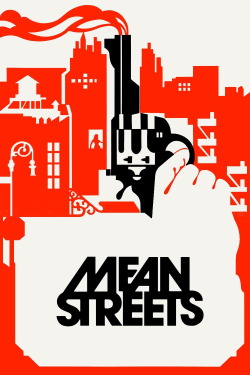
You can tell more about a Director from their films made with a low budget, than anything they make with a big one not to say these movies are better but just that they're almost always more personal. When every scene counts and their future in the business could depend on it, a Director will put everything they have into a project and so it is with Martin Scorsese's third film Mean Streets which was also his breakthrough. This was Scorsese's first feature film that was his own idea and conception, after spending an entire year on the flop Boxcar Bertha he decided to try again with a movie about what he'd seen growing up in Little Italy in New York City. So Scorsese set about writing this passion project with Mardik Martin, driving around Little Italy together, finding places to park and than writing in the car while immersed in the section of the city. Martin with the help of actress Verna Bloom managed to scrounge together a meager $300,000 dollar budget and hired Harvey Keitel who had previously starred in his student film "Who's That Knocking at My Door?" to play the main role of Charlie and he in turn convinced fellow Little Italy native Robert DeNiro to play the major supporting role of Johnny Boy, the first of numerous collaborations between the Director and Actor Duo. The film was met with resounding success at the time, praised for its authentic representation of Italian American life in New York and was hailed by some as the most original American Movie of all time. However it was quickly overshadowed by the likes of Taxi Driver, Raging Bull and countless others which I suppose would leave the question of where the movie stands in today's film world? Is it a heartfelt and real representation of New York life, or a comically dated film that's only real significance is propelling the career of an undeniably great director? I was gonna take a look but I got distracted! Tell him I'll do it next week.
Mean Streets follows street level mob goon Charlie (Harvey Keitel, who for once plays a nuanced character and not an archetypal badass, not that he isn't one of the best at playing an archetypal badass) a film loving, devout Christian who's job mostly entails collecting protection money for his mobster Uncle Giovani (Cesare Danova who has a very aloof mysterious manner about him while still making it obvious his character's a thug). Charlie desires to move up in the New York Mafia and has the ability and connections to do so but his religion which puts him at odds with the things he does weighs heavily on his mind, with him spending a large amount of time in Church repenting and reflecting on his eternity in hell he feels is destined for him. That and his sense of loyalty to his best friend Johnny Boy (Robert Deniro in one of his more fun movie roles where he dances the line between hilarity and annoyance but masterfully and very much intentionally), a snappy dressed, fast talking notorious local Gambler who owes money to everyone and his brother in Little Italy. Meanwhile Charlie is also balancing a relationship with Johnny Boy's cousin Teresa (Amy Robinson, she laughs, she cries, she pretty convincingly fakes a seizure all in all a good performance) who is treated with contempt and ostracism by the community for her epilepsy especially by the Mafioso. As his responsibilities both to Teresa and the mob become more serious so too does Johnny Boy's outrageous behavior and eventually it all comes down to his friends, Johnny Boy and local bar owner Tony (David Proval, one of the most distinctive and underrated Italian American Actors) and the mob as represented by an increasingly annoyed loan shark Michael (Richard Romanus he has a lot of venom but also overblown pomp in this performance it's a shame not much more was heard from him). What Charlie chooses will shape his future and his soul.
Mean Streets is definitely dated there's no denying that, it's very much a low budget movie from the early 70s but that certainly doesn't it's a trivial movie of little importance. It captures something very few other movies can claim they have, as Easy Rider captured Midwest biking culture of the 60s this movie is a veritable time capsule of 70s New York life in Little Italy. Everything is shot on location many of these places (especially the restaurants Charlie meets Giovanni meet at) still existing today and proudly boasting the fact part of the movie was shot there (on a trip to New York I ate at a place in Little Italy that claims the scene where Giovani and Charlie meet to talk about Johnny Boy and Teresa took place there). Scorsese lived this and that's something you can't replicate so it's fortunate than that such a talented filmmaker be the one who decided to capture it on the screen. For Scorsese fans this does not disappoint, with visceral and very real feeling fight scenes (real mind you not realistic), smart dialogue (though admittedly especially with Charlie's narration the script can get a little sloppy) and long continuous shots that would continue to define the Director throughout his career. Sometimes the movie analyzed itself a little to much for its own good when it probably should have just left the interpretation entirely up to the audience but these flukes as well as the less than perfect picture quality and fact that on occasion the voices don't really match up to the people just further lend that air of grainy authenticity and earnest story telling more credibility. Because it's not perfect you believe it more though mostly because it does other things extremely well. The movie is at times rather funny and entertaining but other times especially for its day is rather brutal and harsh depicting in its young Italian American Protagonists unattractive traits of abrasiveness, racism, homophobia (I'm amazed the scene where Johnny Boy and Charlie ride in the car with the gay couple was made) and proneness to violence and general rude dickishness but in the end it's these traits that elevate above other wannabe Godfathers of the day. Martin Scorsese once said his entire life is about religion and making movies. Both of these certainly come into play with Charlie, and themes and scenes he would revisit throughout most of his career including the characters actually going to view a movie and showing them in the theater (Taxi Driver, The Departed and Hugo) and a character with extreme religious overtones (The Last Temptation of Christ, The Departed) are introduced here that support this assessment of himself. But this movie highlights what makes Marty so special, he doesn't just try to emulate movies that have come before him, he attempts to make a different and truly unique film experience and this was something he would also continue throughout his illustrious career never doing very many things in the same style and always innovating and allowing himself to be changed with the times while still having a distinct voice in all his work. It may not have been his first movie, but Mean Streets was the first great Martin Scorsese film and set the gold standard for all that followed and it did it on a 300,000 dollar budget.
Though certainly flawed this is a truly beautiful movie, for all it's darkness and cynicism it's ultimately about a young man in a fucked up situation trying to make the most of it through his friends and faith in a higher power a high power I don't believe in but a faith I respect nonetheless. Some of the shots are beautiful and you never for one second doubt or forget that you're in New York for the film and there was one scene in particular that was brief but I found really kind of breathtaking where we see a festival taking place in Little Italy on a street where lights are wrapped across all the telephone poles and overhanging arches, that zooms out to reveal the tunnel of light superimposed over the night-line of the city and it's really quite a shot. But more so than the brilliant direction, perhaps a bit too wordy but still spectacular script and the reality of the setting one thing I thought really made these complicated at times unlikeable characters work were the actors playing them. Harvey Keitel plays a young badass but while normally his characters just kind of are bad asses here for once we feel an air of vulnerability we sense he's not such a tough guy under the shouting, cursing and use of his fists and that makes it a pretty great and significant point in Keitel's career. But who really shines here is of course Robert Deniro this was the beginning of the era where he could do no wrong and this is one of my all time favorite roles of his. Not to much tough guy bullshit, not too much eye squinting and slack jawed slurring but a real performance as a loveable ne'er do well who is also a total piece of shit to rank up there with his turns as Jake LaMotta and Travis Bickle. I appreciate why someone might not like this movie but I personally love it and moreover what it signifies, the electrifying true beginning of a wonderful career that would help to redefine Hollywood in the 70s. It's well worth checking out for that reason alone.
This review of Mean Streets (1973) was written by Brandon W on 14 Mar 2012.
Mean Streets has generally received very positive reviews.
Was this review helpful?