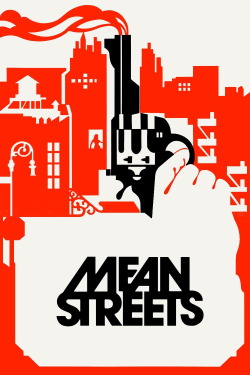
Review of Mean Streets (1973) by Paul Z — 08 Aug 2008
The soundtrack is forcibly at the forefront of one's mind after watching Mean Streets, even several days after. Scorsese's films, especially his gangster movies and generally later movies, are typically scored with an eclectic and constant jukebox of a soundtrack, playing under scenes of dialogue and over jump-cut-loaded montages. It adds an enormous amount of charm to them. Mean Streets uses music differently. It has an overpopulated, blaring, nonstop soundtrack, and actually serves as a sort of narrator. There are a few scenes wherein the music adds a particular amount of charm in a way that it hasn't done in Scorsese films quite the same since. For instance, in the first scene where Keitel sees De Niro, or in the wonderful sequence wherein the camera is mounted to Keitel in a closeup as he stumbles drunkenly, or during the bloody climax.
There are several moments in Mean Streets that prove Scorsese very early on to be a wonderful filmmaker because of the chances he takes. So many elements waver on the borderline between messy and realistically effective, a lot of them involving the purposely sloppy and attention-drawing editing, replete with uneven reverse cuts, abrupt cutaways, and rocky captions and spotting. Taking the great chance of being too technically choppy and disheveled, that grungy, fast-paced, sleek, squalidly elegant style of his muscles through.
Though I'm not a die-hard fan of Keitel's, there are some films where I find him very likable, this being one of them. He understands the fine line between the sympathy towards his character's amiability and the atrocity of his flaws. De Niro, who no matter how powerful he can potentially be cannot help but always take advantage of the extroverted nature of any of the characters he plays and inflate them into swaggering, brash hotshot wiseguys, is always incredibly infectious and entertaining. David Proval and Richard Romanus are diamonds in the ruff in Mean Streets, both affecting completely different kinds of sympathy as characters. The doosey is Amy Robinson, who aside from not absorbing the audience even in any contrast to the rest of the cast, speaks with an accent that eludes to a region far far far away from the iconic, atmospheric New York that the film focuses on so feelingly.
This film is a landmark in film because on a filmmaker's mind it has great influence. In 1973, no movies had such intense editing and shooting style, and no movies had such an aggressive and loud rock soundtrack. The movie doesn't truly have a plot. There are points when it seems as if the story is languishing in time, but the movie is about the atmosphere of surroundings, the self-inexplicable provocations of the characters, and the way these people feel their way through life. It's a cinematic impressionist painting, or a stream-of-consciousness narrative.
This review of Mean Streets (1973) was written by Paul Z on 08 Aug 2008.
Mean Streets has generally received very positive reviews.
Was this review helpful?