Review of Me and Orson Welles (2008) by Michael H — 26 Apr 2014
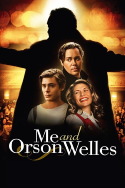
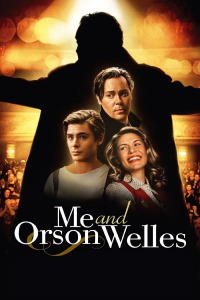
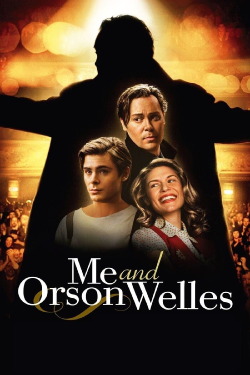
"Me and Orson, Orson Welles, we've got a thing goin' on". Well, as this film displays, Welles was quite the player, so I reckon everyone had a thing going on with him, including Zac Efron, I'm sure, seeing as how he's pretty enough to pass for a girl. I never would have imagined that the Richard Linklater film that features Efron would be one of Linklater's anti-commercial films, but hey, I'm glad to see that Efron has some artistic integrity and taste, even though Linklater probably just got him because Ethan Hawke is getting too old to play the promising youth roles that Efron sees here. Well, it's not like Linklater isn't trying to compensate for Hawke's absence, because this is more-or-less "Training Day" for theatre geeks, as it too is about a bright up-and-coming whose dreams go plagued by harsh realities and a mentor whose corrupting power makes him harsh, unforgiving, promiscuous and vulgar. I only mention the "vulgar" part because I like that this film at least taught me that Welles was about as profane as he was profound, and that he was a big jerk, which I don't mind too much, because as much of a genius as he was, he could get away with being Hannibal Lecter. Look forward to the next origin film about Welles titled "Orson Rising Cholesterol Levels", but until then, we have to settle for this Orson Welles biopic for teenagers. Seriously, it stars Zac Efron, and the Shakespearean actress it was able to get is the one who played Juliet in "Romeo [u]+[/u] Juliet", but don't let that scare you, folks, because I'm more than willing to settle for this film before "Orson Rising Cholesterol Levels", for it is about as killer as it can be as a film starring Zac Efron, which isn't to say that its questionable aspects end there.
Among the biggest shortcomings behind the film are natural ones, because as extremely well-interpreted as this minimalist story is, there's no getting around the minimal dramatic depth which limits potential in this lighthearted period piece, fulfilled about as thoroughly as it can be by inspired storytelling, and ironically further limited by fictional touches that are intended to beef up the narrative. On top of being a dramatization of the true story of the early days of Orson Welles' Mercury Theater, the film tells the fictional tale of an aspiring actor who sees his first intimate experience within the theatre in all of its glory and grime, and although Zac Efron and the writing surrounding his Richard Samuels character's story charm enough to endear, the young lead in this film is of limited intrigue compared to the other figures portrayed in this drama, to the film's understanding, reflected by too much attention to fleshing out supporting aspects in this narrative over the central one. While all around compelling, the film has trouble crafting a fictionalized medium for real subject matter that is nearly as intriguing as the subject matter it's supposed to actually support, yet it's not like intrigue isn't limited throughout the narrative by a lack of originality, because even though this is a particularly well-done interpretation of a formula of this type, it's a little too faithful to its tropes as a period melodrama, as surely as it is too faithful to its setting as a period melodrama. A large part of the fun in this film derives from the passionate celebration of the era and themes, yet at the same time, all of the overt dialogue snap and romantic happenings that characterized the theatre scene of the 1930s gets to be too much for you to ground yourself in the context of the film, no matter how much compellingness goes compensated for by sheer entertainment value. Of course, even then, perhaps the fun factor would be a little more prominent if the film wasn't so overlong, flirting with a two-hour runtime with a story of only so much consequence whose interpretation goes dragged out by fun filler and interesting material that, while certainly thoroughly engaging, further shake a sense of dynamicity. There's really not much to complain about in this film, because there's really not much to really get into to begin with, thus, we come back to natural shortcomings, challenged solidly by entertaining direction, charming acting and dynamite writing, but made hard to ignore when joined by such consequential shortcomings as conventions, histrionics and questionable pacing. The film stops just short of being truly excellent, but hey, it's still mighty strong, have its problems, but only so many compared to strengths that entertain, compel and immerse, at least through visual style.
If nothing else, the film is a delight to simply look at, largely because of cinematographer's Dick Pope's crisp, almost lightly golden palette which makes the brighter scenes stunning, the darker scenes rugged, and joins impeccable shot framing in drawing you into a setting which art directors Bill Crutcher, David Doran and Stuart Rose, joined by production designer Laurence Dorman and costume designer Nic Ede, rebuild marvelously, intricately nailing the look of New York City, circa 1937, in a fashion that is both transporting and good-looking in its distinction. The visual style of the film is sharp, to the point of being both aesthetically transcendent and immersive, yet style wouldn't be so effective if it wasn't orchestrated so well by Richard Linklater's airtight directorial performance, which may rank among, if not stand alone as the strongest in the filmmaker's career, utilizing impeccable framing, smoothly snappy editing and tastefully thoughtful pacing to craft a subtly entertaining and respectable atmosphere which endears thoroughly, with the help of cast from which Linklater salvages solid performances. The film boasts a reasonably sizable cast with material that, while not too dramatically weighty, remains challenging, and just about every last member delivers on electric chemistry and exceedingly charismatic individual performances, with leading man Zac Efron being convincing enough in his spirited portrayal of a charmingly ambitious talent whose confidence goes tested by challenges as he fulfills dreams and comes of age to carry the central fictional plot as compelling, despite its limited intrigue. In a big way, Efron is revelatory, but by no means is he the most soaring discovery in this impressive acting vehicle, because even though it can be argues that this film focuses a touch too much on Orson Welles' side of the story, you can completely understand why the spotlight sticks with that layer so intensely, not just because Welles himself was such an intriguing figure, but because newcomer Christian McKay is nothing short of sensational as Welles effortlessly capturing the distinctive mannerisms, behavior, attitude and, for that matter, presence of the legend with such flawlessness that he seems to bring Welles back to life, and captivates every time he steps into view, just as the genius artistic did. Visual style, direction and acting are all subtle strengths, but that's only because they're realized to the point of feeling naturalist, carrying an intriguing narrative that, while lacking in dramatic consequence and in originality, still offers quite a bit of potential as a study on the challenges to meeting ambition, as well as on the brilliance and sleaze within the artistic mind of Orson Welles and the theatre scene of the 1930s. Though limited, potential in this subject matter stands, and as much as it can be, it goes fulfilled by the aforementioned sharp direction and acting about as much as it goes fulfilled by a relatively stellar script by Holly Gent Palmo and Vincent Palmo, Jr., whose layered focus is a little uneven at times, but generally successful in providing extensively intimate characterization to many a memorable figure, both real and fictitious, while nailing the traits of the setting, - arguably a touch too much for you to completely buy the romanticism of the time - providing enough tightness and flare to certain set piece to make up for limitations in storytelling dynamicity, and, of course, delivering on absolutely amazing dialogue, whose sharp humor, crackling wit and overall memorability is so consistently mind-blowing that simply listening to people talk is a delight. There may not quite be enough meat to this story concept to make a truly upstanding final product, but on top of being tasteful and intelligent, the film is thoroughly entertaining, being a fun and memorable opus that at least borders on excellent, and certainly stands firm as Linklater's best film, by a long shot.
When the curtain falls, some unassured story aspects, plenty of conventions, some melodramatic devices, and some aimless spells, all behind a narrative of only so much consequence, obscure bona fide excellence, but just barely, as the handsome visual style, immersive art direction, slickly realized directorial storytelling, solid acting - especially from the show-stealingly revelatory Christian McKay - and a thoroughly well-characterized, extensive, cracklingly clever and all around outstanding script by Holly Gent Palmo and Vincent Palm, Jr., drive "Me and Orson Welles" as an inspired and intelligent period drama that comes close enough to brilliance to endear as, if nothing else, a lot of genuine fun.
3.25/5 - Strong.
This review of Me and Orson Welles (2008) was written by Michael H on 26 Apr 2014.
Me and Orson Welles has generally received positive reviews.
Was this review helpful?