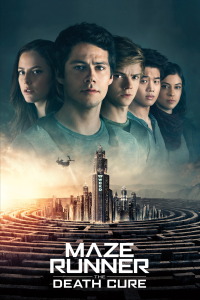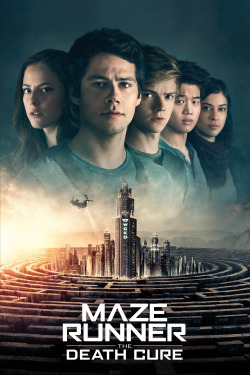
Review of Maze Runner: The Death Cure (2018) by Kevin F — 14 Apr 2018
A maze which may have had many other exits.
I still remember that time. It was 2015, a period in which my commitment to the cinema was solidified, one dream was born. I can visualize in my head a cute kid checking several cinema showtimes, as always, indecisiveness didn't allow me to decide in short order. At the beginning of October, I debated between three appealing offers: "Annabelle" by John R. Leonetti, "Gone Girl" by David Fincher and "The Maze Runner" by Wes Ball. I must confess that I chose the first one due to my love and constant curiosity for the horror genre, I was wrong, I found no love there. The problem with the second proposal was that I wasn't old enough to assimilate the story, and with the third one was that I wasn't related to the world of James Dashner's books at all so I simply saw it as a feast of exciting set-pieces. Luckily, later I discovered that the second flick was undeniably a perverse jewel that came back the Oscar-winning writer-director of "Zodiac" to the media and cinema spotlight, announced a promising Rosamund Pike - an actress who had not been able to find another good role until the most recent "A United Kingdom" and "Hostiles" - and proposed the return of the actor was once called Batman, Ben Affleck. As for the third movie, I had the pleasure of watching a production so youthfully magnetic that even I read the book, as the film was a mosaic of charming characters inside a labyrinthine prison that formulated engaging plot measures and high-powered action scenes leading to unexpected twists. Just one year later, the second book-to-screen adaptation played in theaters with a suggestive handful of fresh ideas and new characters that would serve as an important narrative device in the storyline. Personally, this flick was the best of the series due to a frenetic pace, successful plot twists and the progress to a better adventure that used thriller and action in comparable levels, "Maze Runner: The Scorch Trials" left the bar very high, becoming one of the best studio adaptations of a trilogy of YA stories. Thus, a successful film saga had been established. So, only the conclusion was missing, one that had to be 'worthy' in a forced way, and 'worthy' meant not to split it into two installments in order to get more money from this "rentable" idea. It seemed that 20th Century Fox was pleased that the same filmmaker was the one to give a proper farewell, so, without hesitation, it gave the green line to start the production of the third and last story about Thomas' odyssey. As planned, 2016 would be the year demarcated for the premiere of the film, however, after a now-usual-terrible-set-accident on a shooting day, the male leading actor had to be taken to hospital for a leg injury. He needed a long road to recovery, an event that caused cessation of activities until the protagonist would be in a better condition to return to the shooting. Because of the foregoing issue, the release date had to be postponed up to two full years, a maneuver which ran into some bad luck for the studio because it provoked that the already formal-fanatical legion it got year after year lost interest in the progress of the project, ending in a not-impressive box office sensation. Despite the aforementioned, "The Death Cure" began its commercial run as one of the first offers of the year as it was the month of January that served to enjoy the last adventure into WCKD's roots for long-time fans who were still true and curious moviegoers who wished to overlook the first two films - an unhealthy decision. - Briefly, the film returns seasoned as usual with dangerous-action scenes, two of all them at the level of its predecessor, with some surprising sacrifices plot but with an incompetent and illogical resolution that leaves a rather bitter taste on the world of this franchise. It was supposed to make a big name for itself, which, sadly, did not happen that way.
I can imagine screenwriters and executives, avid for more but willing less, sitting at the same table discussing the different - absolute? - closing possibilities to this treacherous trilogy. They were of course conditioned by the book written by Dashner from which they had to adhere their ideas, however, it's perceptible the dependent additive has managed to balance the degree of honesty and divergence with the inspiration source, screenwriters' narrative additions and executives' postulates, in a comparable amount, are even praiseworthy at certain times, but not fascinating and even jarring and laughable. At first glance and although the writers could not move freely at all - although in Hollywood times we see that this isn't an impediment -, betting to go back a place from they just get out seems incoherent, a simple mechanism setting up more action and ostentatious moments, only voided sporadically by tools that blind for a limited time extremely melodramatic lines or melancholic dramatic scenes. The story is commonly designed, that is to say, we follow the fight of the hero, he's defeated several times, but finally wins, the interesting and peculiar thing is that on the way loses important supporters, ergo there are two significant heart-breaking moments that take a vital role in main character's personal development that boost the purpose of destroying WCKD. Both of them are packed with a correct dramatic charge, the abrupt farewell of two characters serves to give even more weight to the ceaseless trots of our savior, who finally finds the exit, but realizing that the really exciting thing was inside the walls of the maze. As for the conclusion of the trilogy, it again falls in that optimistic air in which the evil of the story has been faded, now there is only hope, union and salvation. It's hard to find ways to turn a standard ending into a memorable one, but not impossible, and I don't mean pessimistic conclusions, just, getting something different, something the spectator doesn't expect, sadly, this feature film chooses common solutions, falling into also habitual cinematographic oblivion.
It's already a custom that over-the-top set-pieces offer good-approach choreographies, which, although are not at the level of those present in the second installment, excite and provide a dazzling experience as soon as a cohort of infected arises. These moments are acceptable and even enjoyable, however, there are a couple of sequences that go beyond. I'm afraid of heights, within me rises up an uncomfortable adrenaline just imagining I'm on the edge of a high column, so before action scenes that take place in this kind of scenarios in which it's difficult to differentiate what's reality or fiction, such a feeling also helps me to evaluate the quality of some feats of such a kind. Precisely that fear was what made "The Scorch Trials" an exciting visual journey, as one of the best sequences is developed in a skyscraper about to collapse. On this occasion, the first one shares the setting of one of the previous installments, with the daring young runners jumping, as if they were superheroes, from the top of a building. The second and personally the best-sketched-and-accomplished sequence is starring Rosa Salazar and an autobus full with innocents, and despite it doesn't get a completely true result, it made my hair stand on end for the fate of the kids in that unstable bus; an excellent moment, the only one I'd say.
Aesthetically, it does not become a focus of praise either. Keeping a predominant place for darkness and a little presence of vivid colors, the film becomes a little dull, no different settings or racking focus are used, simply, the camera follows or remains static to the actions of the characters. This doesn't mean that it is lackluster and anodyne, it's just one more rescue in which the colors don't have the role they should, leaving expectant to the spectator by a much better visual splendor. Of course, special effects used to get this futuristic city are fantastic and complex, they never feel synthetic or manipulative, as in the compendium of buildings or whitish laboratories take place two key moments.
Thus, the conclusion of film trilogy "Maze Runner" at the hands of Wes Ball, the same filmmaker of all the three movies, provides an independent film, endless, but dynamic, laughable but entertaining, cliché about the hopeful fate of its characters. "The Death Cure" shows a good handful of set-pieces and won't mean a tortuous or incoherent time for those who decide to buy a ticket, however, for the most loyal fans and readers will be an idea that relegates great opportunities to stick an ideal conclusion, predicted and lack of the surprise factor. Even so, as a whole, the saga, despite being below Katniss Everdeen's tetralogy but far above "Tris" Prior's unfinished tetralogy, is worthy of a Sunday afternoon to enjoy run-of-the-mill Hollywood adaptations brimmed with action, where what matters is not how getting out of the maze, but, ironically, looking for a way to get back in.
This review of Maze Runner: The Death Cure (2018) was written by Kevin F on 14 Apr 2018.
Maze Runner: The Death Cure has generally received positive reviews.
Was this review helpful?