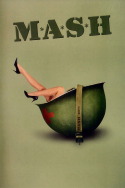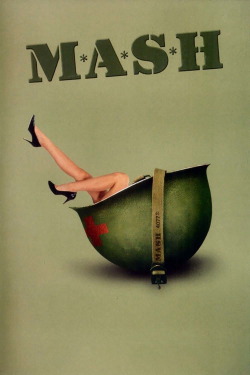
Review of M*A*S*H (1970) by Lorenzo V — 24 Feb 2010
"I wonder how such a degenerated person ever reached a position of authority in the Army Medical Corps.".
The staff of a Korean War field hospital use humor and hijinks to keep their sanity in the face of the horror of war.
REVIEW.
Once that now famous and haunting opening theme song, "Suicide Is Painless," has finished playing, "MASH" bursts on to the screen in a blaze of sound and movement. It's a typical Altman film, and that's a huge compliment. It may not seem like anything special now, because his style has been so influential on all manner of present-day filmmakers, but at the time, audiences had never seen a major studio film whose ordering principle was mass chaos.
Altman films have forever spoiled for me just a tiny bit all other carefully framed, carefully constructed conventional films, because his movies feel so alive in a way that other films don't. "MASH" is gloriously crazy, with all of the actors talking over one another and no apparent thought given to the framing of scenes. Altman has said that he wants his audiences to have to work at his movies. You have to decide what you want to listen to and who you want to watch, because virtually every character in the frame at any given moment is doing or saying something that's no less important than what some other character is doing or saying. But don't be fooled. Altman may have claimed innocence in imposing any kind of directorial hand on his material, but his films are as craftily constructed as any other. "MASH" begins with a montage of wounded soldiers being delivered to the medical unit for treatment, and one of the last shots of the film shows a dead body wrapped in a bright white sheet being driven through the MASH unit while in the foreground a group of doctors play cards, pausing only momentarily to glance at the sight. The message is clear. This casual framing approach that in a sense brings the story back to where we started tells us that there is an organizing principle to the lunacy and madness, and that principle is death.
This review of M*A*S*H (1970) was written by Lorenzo V on 24 Feb 2010.
M*A*S*H has generally received very positive reviews.
Was this review helpful?