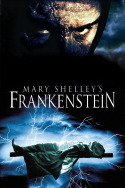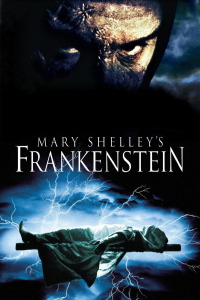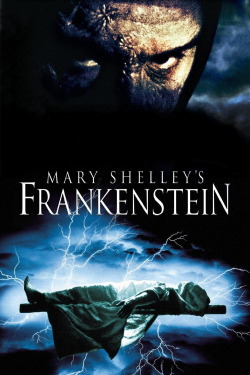
Review of Mary Shelley's Frankenstein (1994) by Gareth R — 15 Nov 2009
The tagline for Mary Shelley's Frankenstein is the best thing about it. Be Warned. You might like it for its hilariously unintentional irony. Maybe it hooks your interest dramatically. But I like to think it's a cry for help. Someone, be it director/star Kenneth Brannagh or whatever thankless schlub came up with it, knew they'd made an absolute floater of a film, and made the noble effort to give the audience a head start. Be Warned. Run For It. Fire In The Hole!
Of course, the words "Produced by Francis Ford Coppola" would have worked just as well, as he was also behind the execrable Bram Stoker's Dracula, and this bloody stab at reworking Frankenstein gets similarly laughable results. No, having the author's name in the title does not lend it an air of authenticity. It just makes you falsely believe that Mary Shelley wrote dialogue like "What have I done?", "Did you ever stop to think of the consequences of your actions?" and "Nooooo!".
Kenneth Brannagh's Frankenstein - which would surely have made a more appropriate title - is bad in so many ways, reviewing it is like shooting fish in a barrel. And if you think that's a cliche, you should try making a mental note every time the film does something unbearably done-to-death. A couple run into an embrace, as the camera twirls around them; a monster's presence, along with most of the dramatic moments, is announced by lightning; our heroes discover the body of a loved one in the rain, and they drop to their knees as one of them cries "Nooooo!"; speaking of some ill-fated hounds, Frankenstein says "Leave them - they're already dead"; despite his obvious size and clumsiness, the Creature is able to spirit himself in and out of rooms with the magical finesse of Michael Myers, and on learning that the Creature is in the vicinity Frankenstein curiously leaves his wife alone and unprotected, so guess what happens. Honestly, it's like the cutting room floor of all bad period movies.
The cliches are not, of course, the only thing working against it. The tone is practically bipolar, particularly in the first half hour. A rushed whistle-stop tour of Victor Frankenstein's youth, we barely have time to catch anybody's name before his sainted mother is dead, followed by an awkwardly self-serving "Three Years Later" bit where he stops by her grave to randomly announce his plan to cheat death. Who wrote this? (Alas, it was co-written by Frank Darabont, for which I don't have any kind of witty retort. I am open-mouthed.) This sequence is happy, sad, facetious and then grisly. It is difficult to get a real handle on any of it.
The same can be said for the character of Frankenstein, whose motivations would appear to be obvious - he doesn't want his loved ones to die - but still don't make much sense. Isn't there rather a big difference between reviving a dead person and creating a super-strong zombie out of dead body parts? He obviously makes the mental leap at some point, but it certainly isn't on screen. Also baffling is the character of Doctor Waldman (John Cleese), Victor's tutor in the ways of reanimating dead tissue, who apparently got too close to the end result and decided never to go back. So why on Earth is he helping Victor?
All these confuddlements are nothing, however, compared to the handling of the monster himself. Robert DeNiro is probably a good enough actor to bring the Creature to life - one feels more confident trusting him than Kenneth Brannagh's doomed doctor, anyway - but the writing hampers all his dramatic moments. He's supposed to be sympathetic, right? There's a sequence with Richard Briers as a kindly blind man that would seem to prove it. And the whole core of the story is the Creature's sad father/son dynamic with Victor, and the fact that Victor wants nothing to do with him. Instead our Creature kills and gloats about killing, and has no regard for Victor beyond his need to be paired off with a zombie mate. A moment at the end, when strangers allow him to visit his father-figure's funeral, seems awkwardly ill-informed. Is everybody on the same page? We're all aware that this is essentially this movie's Jason Vorhees, right?
Besides the Creature - who complains, too late, that he was never given a name, despite the fact that he neglected to ask - there really is nothing of interest going on. Victor's wife/sister (euw), played by Helena Bonham Carter, is a nonentity, and her relationship with Victor is forced. Their romantic scenes are more annoying than moving, and the only thing Carter really brings to the role is her characteristic bad hair day. The whole movie is edited together in such a cobbled fashion - complete with needless framing device - as are the scenes themselves so poorly-written, that the whole film could be viewed as a gigantic piss-take. It would certainly explain the presence of John Cleese (who admittedly acquits himself well, although he mostly just looks surprised).
The entire film is grossly unpleasant, uproariously silly and thuddingly obvious. It is not an experience you'll want to repeat, and the only nice thing I can think of to say about it is that I hated it less than Francis Ford Coppola's Dracula, which mucked up its antagonist in the precise opposite way to this one. Perhaps if you took the two movies, chopped them up and swapped bits, there might be some hope for them. Alas, I fear all the electric eels in the world couldn't reanimate the results, and indeed, the frantic editing and grisly beats of violence in Frankenstein would indicate that Kenneth Brannagh has already tried. I imagine him in the editing room, standing back from this opus and uttering the time-honoured "What have I done?" And then, perhaps, jotting a few notes for a possible tag-line.
This review of Mary Shelley's Frankenstein (1994) was written by Gareth R on 15 Nov 2009.
Mary Shelley's Frankenstein has generally received mixed reviews.
Was this review helpful?