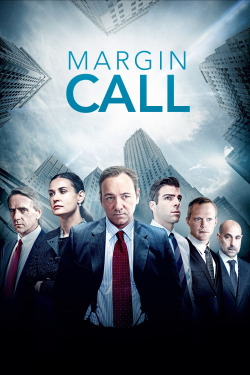
Review of Margin Call (2011) by Reid V — 25 Sep 2012
Have you been to a dinner party recently & overheard somebody begin a sentence with, "well in this economy..."? Of course you have. As long as we live in economically tough times, there will remain a gaggle of pompous oafs ready to wax eloquently about it. This is not to say the problems aren't serious. They are. The collapse of the housing bubble, the shuffling of toxic assets, and the failure of financial service firms such as Lehman Brothers due to cosmetic accounting and the such, has severely crippled the American economy.
But this isn't news to you.
Not only have your annoying party guests been keeping you well informed on all of the dips in the DOW, but there has also been a slew of popular films regarding the crisis as of late. Films such as 2010?s The Company Men & last year's Larry Crowne have done their best to remind Americans that we as a nation are collectively hurting. While these films use pathos to reach the viewer, others jump right to teasing out the source of the problem. This is evidenced by movies like the Academy Award winning Inside Job, which methodically exposes how an event of this magnitude took place and even dares to point some fingers at those responsible.
These images - in conjunction with those of the occupy movement and various other grassroots organizations - have helped to fashion a modern American narrative of "us vs. them." Us being the typical (predominately caucasian according to these films) middle-class Americans. Them of course being the Wall Street fat cats who relish the thought of extracting every last dime out of John Doe's wallet.
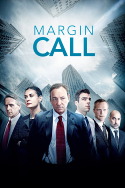
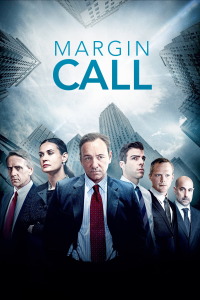
So when last year's Margin Call was making the festival rounds, my mind supposed that it would adhere to this established narrative. I assumed it would feature a wide variety of pallid faces, all donning Valentino suits, concocting new ways of leeching more money out of the masses and consequently knocking over the first of many cards that will soon bring the entire house tumbling down. However, when I finally decided to give it a chance due to its appearance on Netflix, I was startled to find that I had underestimated writer/director J.C. Chandor. Margin Call is an expertly crafted ensemble piece. A nuanced look at a group of individuals standing at the precipice of a meltdown, wholly culpable & regrettably unable to halt the impending catastrophe.
The film follows a rather taut 24-hour period inside a high profile investment firm. When the protege of a recently fired division head makes a discovery that will soon change the company's fate, along with the fate of many others, he quickly informs his superiors. This continues up the ladder until the top brass catch wind & are given the unenviable task of selecting which egg shells to step on next.
Margin Call is an experience that is akin to watching a film about the sinking of the Titanic. But instead of carrying a polyglot community of immigrants & various other people groups, this ship is schlepping around mostly white-collar businessmen. And rather than just 100,000 pounds of steel being dragged down to the bottom of the sea, it is America's financial system. Also, in keeping with the Titanic theme, Chandor shows how various personalities respond to the approaching calamity. There are your Edward Smiths, the captain of the ill-fated cruise liner, who are prepared to go down with the ship if they must. Other men wish only to cut their losses and find the nearest lifeboat. And much like the apocryphal story of the orchestra playing "Nearer my God to Thee" as the ship sank into the Atlantic, some men are seen busy shaving & adjusting their expensive attire as if it were an ordinary day, going about the banalities of everyday life before heading out to face their own music.
Margin Call is not only successful in demonstrating Chandor's filmmaking prowess - which is especially notable since this is his debut feature - but it also features of wide variety of talent including Kevin Spacey, Jeremy Irons, Paul Bettany, & Zachary Quinto, who all bring their A game. The dialogue is sharp, well-written, and is given even more power by the actor's body language. Chandor frequently shows these individuals gazing out of their windows at New York as it sleeps. They are silent, crestfallen, and appear to be concurrently wondering, "What have we done?".
While it would be easy to place all of the blame on the shoulders of these bankers, Chandor wisely shows that some of the American public should be held accountable as well. Paul Bettany's character Will Emerson states that in reality, people don't acually want a system in which everyone is treated fairly. In fact, most people play dumb, but they know all too well that the only reason they can afford their luxury cars and gaudy mansions is because certain fingers are tipping the scales in their favor. Bettany's character has the prescience to know that should everything go down the tank, then bankers will surely be crucified. But until then most Americans are content to sit idly by, seldom concerned about the system that allows them to take out mortguages that know they cannot rightfully afford.
This isn't a film that sits easily on the tongue. It deftly dramatizes the crisis, one of the most severe to take place in my lifetime and one that has brought about the ruin of many American families, all while refusing to moralize. This dispassionate approach to a subject so wrought with emotion is quite a marvel, and an essential step toward ameliorating the damage done by the simplistic "us vs. them" narrative that has so consumed the American mind.
This review of Margin Call (2011) was written by Reid V on 25 Sep 2012.
Margin Call has generally received positive reviews.
Was this review helpful?