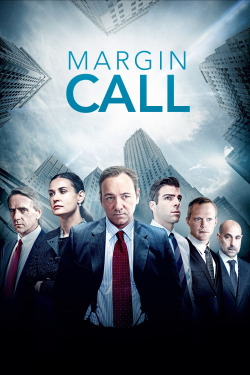
Review of Margin Call (2011) by Edith N — 13 Feb 2012
Not the Cause, Merely a Cause.
We always seem to want a single answer. We want an easy solution. This movie presents neither. There is someone to blame, but there is no sense that the people here are to blame for everything, and certainly they are not evil in a conventional sense. (My personal morality holds that a total lack of consideration for others [i]is[/i] evil, but these people are at worst putting themselves first, which isn't [i]as[/i] evil. Certainly no one is cackling.) As such, this film will be inherently disappointing for many who expect a more conventional narrative. But the harsh secret of life is that the only way to have a happy ending is to stop telling the story at a happy place. Real humans only get a single ending, and real stories don't even get that. The characters this movie is about go on and keep influencing the financial scene even after the end of what we see here, and we only think it's the end because it's fiction.
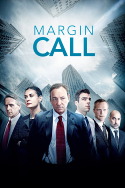
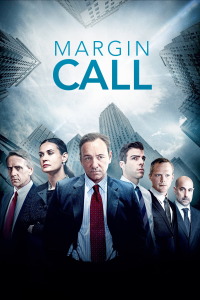
One day, Eric Dale (Stanley Tucci) is laid off from an unnamed investment firm. He has been working on a project which he passes on to Peter Sullivan (Zachary Quinto). Unfortunately, that project shows that the company has so many bad investments that their floor's trading alone has the possibility to drive the company into bankruptcy. Peter spends several hours after work looking it over, and starting at ten that night, people up the chain of command start getting called in to look at it. First, it is Will Emerson (Paul Bettany). He calls in Sam Rogers (Kevin Spacey). He calls in, among others, Sarah Robertson (Demi Moore). And finally, in comes John Tuld (Jeremy Irons), so high-powered that he arrives by helicopter. What they are now left with is the decision to either sell the toxic investments as quickly as they can, thus impoverishing all their investors and poisoning the well for the future, or keep them and basically commit financial seppuku.
It's generally hard to feel sympathy for people higher up the financial ladder than you yourself are when it comes to money problems. But the real problem is that we're all hoping to be higher up the financial ladder than we are; it's one of the things which causes financial bubbles in the first place. Seth Bregman (Penn Badgley) cleared a quarter of a million dollars the year before, but of course he wants more. Peter Sullivan is an actual honest-to-Gods rocket scientist who has moved into the financial field (it's all numbers, after all), largely because the money is better. You presumably start by thinking that you could live a bit better than you do now, and "a bit better" keeps going up and up until you're thinking, "I should have a helicopter like he does." Of course, it's not just these characters who are thinking that way; the bubble wouldn't have been possible had not people far lower on the financial spectrum been trying to get rich quick as well.
I, for one, actually got the dog thing. Sam Rogers had nothing. He had his job, and he had his dog. He had nothing else. And then suddenly, his job was falling out from under him and his dog was dying. What did he have left to live for? He sacrificed everything--including, in the end, his morals--and there was nothing left. His company had no loyalty to him or to anything. It was all about the money. And now, he learns that money does not obey your rules even if someone got a Nobel Prize for setting them out. His son is said to be a nice person, but he has not spoken to his son in some time. His wife (Mary McDonnell) has kicked him out. In the end, he can only take the dog to a home he cannot himself stay in. The dog's story is over, but the sad truth is that Sam's will go on. Whether he wants it to or not. The dog was the last living thing on whose love he could depend, and of course the great problem with pets is that they don't live as long as humans; I've outlived half a dozen cats.
I'm not sure if it's a coincidence that the person to be thrown under the bus on this is also the only woman we see actually working for the firm. I strongly suspect, though I cannot say for sure, that the two women who lay off Eric Dale (Ashley Williams and Susan Blackwell?) are more along the lines of George Clooney's character in [i]Up in the Air[/i]--I don't think they work for the company, whatever company that is. But Sarah Robertson is fairly high up in the company's echelons, and it is she and not anyone else who is to be the sacrifice. This despite the fact that she passed a warning up to her superiors some time before the day's events. Of course, they can't ever acknowledge that. They can't ever acknowledge that it was wrong and they knew it. They can't acknowledge anything which would make it anything other than a simple decision. The only woman is Sarah Robertson. The only person who isn't white is Ramesh Shah (Aasif Mandvi). In order to keep power centralized, equality remains unimportant.
This review of Margin Call (2011) was written by Edith N on 13 Feb 2012.
Margin Call has generally received positive reviews.
Was this review helpful?