Review of Manhunter (1986) by Ola G — 07 Mar 2014
Will Graham (William Petersen) is a former FBI criminal profiler who has retired because of a breakdown after being attacked by a cannibalistic serial killer, Dr. Hannibal Lecktor (Brian Cox). Graham is approached at his Florida home by his former FBI superior Jack Crawford (Dennis Farina), who is seeking help with a new serial killer case. Promising his wife (Kim Greist) that he will do nothing more than examine evidence and not risk physical harm, Graham agrees to visit the most recent crime scene in Atlanta, where he tries to enter the mindset of the killer, now dubbed the "Tooth Fairy" by the police for the bite-marks left on his victims. Having found the killer's fingerprints, Graham meets with Crawford. They are accosted by tabloid journalist Freddy Lounds (Stephen Lang), with whom Graham has a bitter history. Lounds' paper had run photographs of Graham taken secretly while he was hospitalized. Eventually Graham pays a visit to Lecktor, in his cell and asks for his insight into the killer's motivations. After a tense conversation, Lecktor agrees to look at the case file. Lecktor later contrives to obtain Graham's home address by deceit. Graham travels to the first crime scene in Birmingham, Alabama, where he is contacted by Crawford, who tells him of Lounds' tabloid story on the case. Crawford also patches Graham through to Frederick Chilton (Benjamin Hendrickson), Lecktor's warden, who has found a note in Lecktor's personal effects. Reading it, they realize it is from the Tooth Fairy, expressing admiration for Lecktor-and an interest in Graham. Crawford brings Graham to the FBI Academy at Quantico, where a missing section of the note is analyzed to determine what Lecktor has removed. It is found to be an instruction to communicate through the personals section of the National Tattler, Lounds' newspaper. The FBI intended to plant a fake advertisement to replace Lecktor's, but they realize that without the proper book code the Tooth Fairy will know it is fake. So they let the advertisement run as it is, and Graham organizes an interview with Lounds, during which he gives a false and derogatory profile of the Tooth Fairy to incite him. After a sting operation fails to catch the killer, Lounds is kidnapped by the Tooth Fairy (Tom Noonan). Waking in the killer's home, he is shown a slideshow of William Blake's The Great Red Dragon paintings, along with the Tooth Fairy's past victims and slides of a family the killer identifies as his next targets. Lounds is forced to tape-record a statement before being set on fire in a wheelchair and killed, his flaming body rolled into the parking garage of the National Tattler as a warning. Graham is told by Crawford that they have cracked Lecktor's coded message to the Tooth Fairy-it is Graham's home address with an instruction to kill the family (ending with "Save yourself. Kill them all," revealing that Lecktor believes Graham would find the Tooth Fairy). Graham rushes home to find his family safe but terrified. The time is ticking to catch the "Tooth Fairy" before he makes his next move...
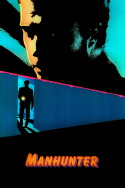
Michael Mann´s "Manhunter" focuses on the forensic work carried out by the FBI to track down the killer and shows the long-term effects that cases like this have on Graham, highlighting the similarities between him and his quarry. The film features heavily stylized use of color to convey this sense of duality, and the nature of the characters' similarity has been explored in academic readings of the film. This was not the first adaptation of a Harris novel for the screen-the 1975 novel "Black Sunday", a story of a terrorist attack on the Super Bowl, was made into a film in 1977-but it was the first film to feature serial killer Hannibal Lecter, who would later appear in The Silence of the Lambs, Hannibal, Red Dragon, Hannibal Rising, and the 2013 television series Hannibal. Opening to mixed reviews, "Manhunter" fared poorly at the box office at the time of its release, making only $8.6 million in the United States. However, it has been reappraised in more recent reviews and now enjoys a more favorable reception, as both the acting and the stylized visuals have been appreciated better in later years. Its resurgent popularity, which may be due to later adaptations of Harris' books and Petersen's success in CSI: Crime Scene Investigation, has seen it labelled as a cult film. Visually, Manhunter is driven by strong color cues and the use of tints, including the hallmark blue of Mann's work. Dante Spinotti has noted that these visual cues were meant to invoke different moods based on the tone of the scenes in which they were used: cool blue tones were used for the scenes shared between Will Graham and his wife Molly, and unsettling greens and magentas were used for the scenes with the killer Francis Dollarhyde. Steven Rybin has observed that "blue is associated with Molly, sex, and the Graham family home", while green denotes "searching and discovery", pointing out the color of Graham's shirt when the investigation begins and the green tone of the interior shots in the Atlanta police station. John Muir suggests that this helps identify the character of Graham with the "goodness" of the natural world, and Dollarhyde with the city, "where sickness thrives". This strongly stylized approach drew criticism from reviewers at first, but has since been seen as a hallmark of the film and viewed more positively. In the scenes where Will Graham is interviewing Lecktor in his cell, the director Michael Mann took care to set up the shots so that the position of the bars of the cell do not move when the point of view switches between Graham and Lecktor. In a featurette included with the DVD version of the film, Tom Noonan (Dollarhyde) said that he avoided all contact with cast members in order to heighten the isolation and tension between himself and other people, particularly William Petersen (Graham). On its release, "Manhunter" was met with widely mixed reviews. At first, it was seen as too stylish, owing largely to Mann's 1980s trademark use of pastel colors, art-deco architecture and glass brick. A common criticism in the initial reviews was that the film overemphasized the music and stylistic visuals. Chicago Tribune writer Dave Kehr remarked that Mann "believes in style so much that he has very little belief left over for the characters or situations of his film, which suffers accordingly", adding that the film's focus on style serves to "drain any notion of credibility" from its plot. Sheila Benson of the Los Angeles Times was critical of the film's visuals and soundtrack, comparing it unfavourably with Miami Vice and describing it as a "chic, well-cast wasteland" that "delivers very little". The film's stylistic similarity to Miami Vice was also pointed out by Film Threat's Dave Beuscher, who felt it was the chief reason for the film's poor box office results. Writing for the San Francisco Chronicle, Steve Winn derided the film, claiming its lack of a strong lead role caused it to "fall apart like the shattered mirrors that figure in the crimes". Time was more favorable in its review, praising the "intelligent camerabatics" and "bold, controlled color scheme". Leonard Maltin gave the film three stars, calling it "gripping all the way through and surprisingly nonexploitive", although adding that "the holes start to show through" if looked for "too carefully". "Manhunter" was, however, nominated for the 1987 Edgar Award for Best Motion Picture. I saw "Manhunter" at the movies when it came out and I was instantly gripped by the mood, stylistic approach, the colours, the intensity of William Petersen and Tom Noonan plus the focused direction from Michael Mann. I liked the movie very much back then, and when reseeing it now, doesn´t change my opinion. But, my reaction this time around was that I felt the movie was slightly uneven in the editing and maybe the mood wasn´t that terrifying as it was back in 1986. I do think that Brian Cox makes a far better Dr. Hannibal Lecktor then Anthony Hopkins and it´s a shame he didn´t get to explore the role further. And the end scene between Graham and Dollarhyde is great and rememorable. "Manhunter" is a 80s neon drenched gripping drama/thriller that is unique in many ways and I do look back at the film with a great nostalgic feeling.
This review of Manhunter (1986) was written by Ola G on 07 Mar 2014.
Manhunter has generally received positive reviews.
Was this review helpful?