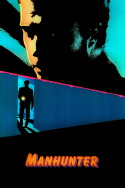
Review of Manhunter (1986) by Harry W — 15 Apr 2015
Being a critically acclaimed adaptation of the Thomas Harris novel and directed by Michael Mann, Manhunter sounded like a thrilling experience.
The novel Red Dragon was not such a great novel to me. I enjoyed the characters and the way that the titular antagonist was portrayed, but the protagonist was not an interesting character to me. But I knew what Michael Mann was capable of and so I welcomed a film adaptation while hoping that his role would compensate for some of the less entertaining narrative elements.
It is a fact that a film can never capture the same level of insight that a novel can due to being limited predominantly to its tangible qualities. I was easily ready to accept that for Manhunter, but what bothered me was how the film treated some of the characters. Upon its original release, Manhunter was criticized for being too focused on stylish elements instead of narrative, and though the style of the film is appealing the narrative is also somewhat dull. The story in Red Dragon did not always grasp me, but I really liked the way that it characterized Francis Dolarhyde while the film failed to do that. For such a stylish film, Manhunter fails to use that in the scenes with the titular antagonist. The first scene with the Red Dragon killer Francis Dollarhyde lacks the intense musical score that dominated the atmosphere in so many other scenes. For some reason it just stops here which is severly detrimental to the atmosphere. I found Francis Dolarhyde to be a really good character when I read Red Dragon, but the film failed to make him the same threatening figure that he really needed to be. The novel went between focusing on protagonist Will Graham and antagonist Francis Dolaryhyde while occasionally touching upon Hannibal Lecter, but the most interesting scenes came from Francis Dolarhyde. Not only does the film fail to give him good scenes, but it cuts his relevance down significantly. Instead of evening out the focus, Manhunter goes straight after protagonist Will Graham in a series of slow dramatic scenes, and though they are captured stylishly and well acted, the film just defies its potential. Manhunter cuts out much of what made Red Dragon a decent read by eliminating so much focus on Francis Dolarhyde, and though depicting his inner thoughts and his past cannot be captured as effecitively by the screen, it just seems like Manhunter barely tried. Also, in the scenes where the characters describe Hannibal Lecter, the novel explained very well how Hannibal Lecter is a man with psychology so disturbing it is beyond diagnosis, while in Manhunter the film just suggests that psychologists simply label him a psychopath as they can't think of a better word. This oversimplifies the complicted nature of Hannibal Lecter, and though he plays a rather small role in the story he remains the most iconic character. When the novel got to him, that was the turning point where I became really interested in the stiry and so the fact that the film did not exactly do justice to that failed to entertain me. The one character that Manhunter was able to do justice to was Will Graham because I found him more interesting in this film than in the novel as his scenes were dramatized very well while the depiction of his hunt for Francis Dollarhyde really seemed intense, proving that there were certain plot devices which Michael Mann was able to improve upon. Simply put, Michael Mann's directional style compensates for the less than stellar moments from the original novel but at the same time many of its best elements are eliminated for the film.. But even then, the screenplay maintained the language of the novel really well which carried most of the characters over, and Michael Mann makes himself an asset by asserting a strong visual style over the film. The visual style of Manhunter is considered its most iconic element, and it is easy to see why as Michael Mann's keen eye for imagery is of a major benefit to the film in the way that he plays with colour schemes, cinematography techniques and shadowing. This makes the film interesting to look at, and it effectively establishes the atmosphere of the film as an unsteady darkness which is then made even stronger by the integration of the soundtrack. Manhunter may be a slow burning feature, but it is a stylish and atmospheric one. And the cast of the film elevate the film much of the time.
William Peterson makes a very strong effort in the lead. William Peterson's stare constantly conveys a sense that he has seen some horrible things in his life, and this is key to the character Will Graham as his experiences with Hannibal Lecktor are supposed to be severly detrimental to his psychology. From then on he builds upon the role with the addition of an intense line delivery and powerful chemistry with Brian Cox. William Peterson manages to bring levels of complication to his character that I could not pick up on when I read the text, so he is a strong protagonist.
Tom Noonan evokes a mixed response from me. In the role of Francis Dollarhyde, Tom Noonan does not capture the intense and intimidating character that I was intrigued by when reading Red Dragon. I captures a someone creepy creation and he characterizes Francis Dollarhyde's obsession with Reba McClane very well, but he does not balance creepiness with intimidation like he should. And as the film does not show the character biting and stabbing people, it does not support him all that well. Tom Noonan does what he can with the part, but he is limited by the film's script and his lanky physical stature which fails to match what was described in the text.
Since Anthony Hopkins would go on to be the one to make Hannibal Lecter such an iconic character when he won the Academy Award for Best Actor for portraying the role in The Silence of the Lambs, Brian Cox could never compare. But what I really liked about his performance was how different it was. Brian Cox lacks the firm confidence over his words that Anthony Hopkins maintained, but he does convey a sense of intelligent understanding of all the narrative concepts as they come to him. But the main thing that makes him ideal is the fact that his facial expressions really capture the interest of viewers. His face has a lot of character, but more of it is in his eyes because as the viewer stares into them they see nothing but evil. His cold stare of death is intimidating, and when this combines with his dark smile and tone of voice, it makes for a really powerful performance. Brian Cox doesn't have to do much to capture the character Hannibal Lecktor because it comes to him so naturally that it is disturbing, and it is excellent to see an actor taking the role on from before Anthony Hopkins.
Joan Allen also does a good job as Reba McClane through her depiction of the blind state of the character, capturing the part with a myopic stare into the distance.
So Manhunter benefits from a talented cast and a strong visual style thanks to Michael Mann, but it ignores a proper path of characterization for its antagonist and therefore betrays the best part of its source material in the process.
This review of Manhunter (1986) was written by Harry W on 15 Apr 2015.
Manhunter has generally received positive reviews.
Was this review helpful?