Review of Manhattan (1979) by Keaton P — 05 Oct 2009
One moment in "Manhattan" tells you all you need to know about where its head is, and that's the first kiss shared by Isaac (Woody Allen) and Mary (Diane Keaton). There's nothing romantic to it whatsoever because these are characters who can't think their way into loving another person unconditionally. Isaac tells Mary to ignore her brain, but he can't follow his own advice. It's too big a part of both of them.
Because Allen only ever plays one role, his performaces either work for his films or they don't. Whiny, neurotic and smart as a whip, every sentence out of his mouth is a plea for the listener to believe what he says. Another man with these traits could lead troops into battle; with a frame, look and voice like Woody's, he's lucky that cars stop for him at crosswalks.
Sometimes a person can find themselves in a group of friends who seem to swing in and out of relationships with one another until couples finally emerge. "Manhattan" is about that process of settling after a brand new person comes along and changes the dynamic. The new person is Mary, a journalist and writer from Philadelphia, where people don't make trouble for themselves.
Isaac's friend Yale (Michael Murphy) brings her up in conversation. For the past two months, he has been seeing her behind his wife's (Anne Byrne Hoffman) back. "She's nervous, high-strung and elusive," he says. "You shouldn't ask me for advice," Isaac returns. "When it comes to relationships with women, I'm the winner of the August Strindberg award.".
Strindberg was a Swedish playwright, known for his neurotic behaviour and torrid relationships with women. The people in "Manhattan" can rhyme off endless pieces of information such as this about high art and philosophical thought as though they are discussing the weather. Those in the know will laugh in recognition. However, Allen is also perfectly aware of what these discussions mean beyond their sometimes hard-to-penetrate exteriors of intellectualism.
This awareness is exhibited in two terrific scenes, both of which get at the director's fascination with existential themes. Isaac and Mary walk through a planetarium to escape a rain storm and discuss their views on relationships. The characters walk on the surfaces of planets and at points look as though they are floating in space. Isaac observes: "You rely too much on your brain. The brain is the most overrated organ, I think.".
The other scene shows Isaac lying on his couch, dictating thoughts for potential use in a book that he is putting together. Alone with his thoughts, he comes up with "an idea for a short story about people in Manhattan who are constantly creating these real, unnecessary, neurotic problems for themselves because it keeps them from dealing with more unsolvable, terrifying problems about the universe.".
In a big city like New York it can be hard to look a stranger in the eye, which is why the moment a stranger is introduced to you carries extra significance. Moments of attraction are few and far between when a bustling crowd prefers to keep their heads down. How else are we going to be able to catch a glimpse of our place in the grand scheme of things if we don't jump at chances to connect with other people?
As art prematurely imitates life, Isaac finds himself in a relationship with a 17-year-old girl named Tracy (Mariel Hemingway). She represents a reservoir that needs filling with all of Isaac's insights. That Mary and Isaac don't work as a couple is in equal parts testament to Isaac's need to be able to teach his lovers a lesson. Compared to Mary, Tracy is a blank slate.
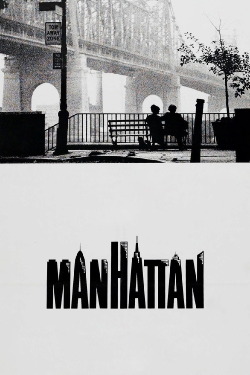
"Manhattan" is shot in glorious black and white and is backed by an exploding Gershwin score. This is a sincere portrait of Allen's efforts to not only confront his approach to relationships but to an entire city, filled with life and love and lying in wait to be conquered with his powers of observation. His script crackles with paranoid energy and witty anecdotes.
The film closes with Isaac attempting to convince Tracy that they belong together. Of course they don't, but what else is he going to do? His ex-wife (Meryl Streep) has exposed every negative aspect of his identity as a romantic partner in a tell-all book. Every other woman in New York is wise to his tactics and hangups. Spoiling Tracy is a brand new way to settle down. It creates the illusion that the way-too-big universe can be controlled. Sometimes that's all we need for a little while.
This review of Manhattan (1979) was written by Keaton P on 05 Oct 2009.
Manhattan has generally received very positive reviews.
Was this review helpful?