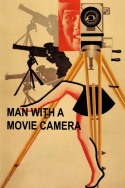
Review of Man with a Movie Camera (1929) by Peter H — 09 Dec 2011
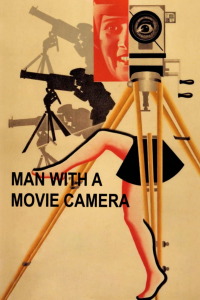
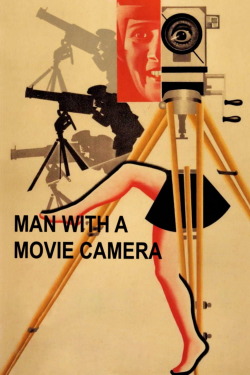
Dziga Vertov's MAN WITH A MOVIE CAMERA [1929]: "The film Man with a Movie Camera represents AN EXPERIMENTATION IN THE CINEMATIC COMMUNICATION Of visual phenomena.
WITHOUT THE USE OF INTERTITLES (a film without inter titles).
WITHOUT THE HELP OF A SCENARIO (a film without a scenario).
WITHOUT THE HELP OF THEATRE (a film without actors, without sets, etc.).
This new experimentation work by Kino-Eye is directed towards the creation of an authentically international absolute language of cinema - ABSOLUTE KINOGRAPHY - on the basis of its complete separation from the language of theatre and literature.".
- Extract from the opening title cards to Dziga Vertov's MAN WITH A MOVIE CAMERA [1929]-.
Along with the 1928 Silent short film by Spanish Surrealists artist Salvador Dali & director Luis Bunuel, UN CHIEN ANDALOU; the 1929 silent film MAN WITH A MOVIE CAMERA by Russian/Soviet director Dziga Vertov introduced an new aspect to the then developing art form of cinema, the art film. Made amidst the revolutionary Russian Avant-Garde art movement [circa 1890 to 1930], occurring in the then U.S.S.R at the time, this truly bizarre, bold, odd, farfetched montage of experimental near abstract images took documentary filmmaking to its most artistic extremes. The director Vertov's motives behind this film were to liberate cinema from the traditions of conventional narrative theatre (which is explain in the manifesto title card at the start of the film)and with this film this revolutionary concept is for filled. Hailed as one of the greatest movies, this unorthodox approach to documentary filmmaking makes it one of the most bizarre silent films in existence.
MAN WITH A MOVIE CAMERA as far as silent films go really does offer a challenging view for most modern viewers. With an Average Shot Length (ASL) in parts of the film lasting no longer between 2.5 to 3 seconds and its bombardment of juxtaposed imagery of a Soviet city over the course of one day makes it difficult for one to comprehend what one had just seen (or thought they had seen) in this film. It's also for this very reason why it makes this film revolutionary extremely difficult to review however the lack of comprehending the film once its speed accelerates doesn't damper this films standing as a truly great film.
OVERVIEW: At this point in my reviews I give a rough overview to the plot of the film I'm reviewing but with this film to give a plot summary seem utterly pointless. In fact the entire purpose for why this film even exists in the form it doses is due to the director Denis Abramovich Kaufman or Dziga Vertov philosophy to make a film that liberates cinema from a narrative structure with actors and acting which by 1929 had become deeply interwoven into the fabric of cinema. Free from a traditional narrative the film documents the people of one then contemporary Soviet Union in a very surreal fashion.
The film opens with one of the films "characters" or "Figures" a humble camera man emerging with a camera from behind another cinema camera. The film cuts to a Soviet Cinema showing the camera man filming the scene while the film-with-in a film begins. The film shows the camera man shooting life in a city with people on transport (like cars, trams, trains and buses), at work, at play while it's all intercut with the appearance of the films editor cutting the film together while the cameraman films it all.
OVERALL THOUGHTS: with the use of double exposed images, fast motion, slow motion, freeze frames, split screens, stop motion animation and jump cuts left, right and centre, MAN WITH A MOVIE CAMERA is a truly wild visual rollercoaster of a film. The use of creative shots and being much like UN CHIEN ANDALOU another film free of a real plot, this film is quite literary a feast for the eyes. Unlike UN CHIEN ANDALOU a film free of any idea behind its imagery, this film reflects the directors' philosophy about cinema and is of course an Avant-Garde propaganda film with emphasis upon Karl Marx and Vladimir Lenin. This abstract documentary depicts life under Communist rule in the city being depicted with in this film as being shown as peaceful and prosperous; Vertov himself (like most Russians in the wake of the 1917 revolution) was a firm believer in Communism which is reflected by the fact of his work on numerous writings, propaganda newsreels and other propaganda films such as THREE SONGS ABOUT LENIN [1934].
However despite the underlying ideologies of the director in a sense much like that other great film made in the U.S.S.R, Sergei Eisenstein's 1925 classic film BATTLESHIP POTEMKIN; despite the then contemporary messages and pro-communist ideologies of the era being present within the makeup of the film, what doesn't change is the fact this movie standing a truly great work of art. Much like Vertov's desires to create a revolutionary film, MAN WITH A MOVIE CAMERA (along with UN CHIEN ANDALOU) made it possible for filmmakers to not make a narrative film. Filmmakers such as David Lynch & Alejandro Jodorowsky and other Art-house filmmakers, the film students' abstract short film, music videos and the mere notion of montage in movies might have never existed today if it were not for this pioneering film taking the potential of cinema to its extremes. Despite being such a perplexing view at certain points within the film, MAN WITH A MOVIE CAMERA gets a much deserved 100% from me. Here is another great film that suits its title as of one of the greatest films of all time.
This review of Man with a Movie Camera (1929) was written by Peter H on 09 Dec 2011.
Man with a Movie Camera has generally received very positive reviews.
Was this review helpful?