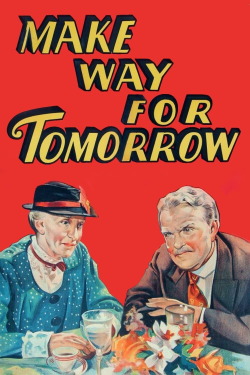
Review of Make Way for Tomorrow (1937) by Max M — 19 May 2010
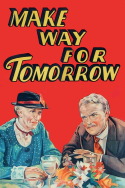
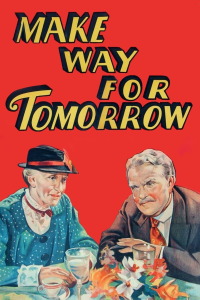
Orson Welles said of this film, "It would make a stone cry". Boy, he wasn't kidding!
Director Leo McCarey had been associated primarily with comedies up to the point he made this picture- he started out as a silent filmmaker, directing two-reelers for stars like Charlie Chase as well as many of the great Laurel and Hardy shorts (he was responsible for pairing the two in fact) and then moved onto features, directing The Marx Brothers' masterpiece Duck Soup and my personal favorite Carey Grant comedy, The Awful Truth. For this picture however, he decided to switch gears and tell the story (based on a novel by Josephine Lawrence, with a screenplay by Viña Delmar, who also wrote The Awful Truth) of an elderly couple (Victor Moore and Beulah Bondi, in two of the most astonishing, touching and heartbreaking performances I have ever seen on film) who, after the bank takes their house, are forced to separate and move in with two of their middle-aged children who live 300 miles apart.
This film is about many things; the effects of the Great Depression on a particular couple, the generation gap, demonstrated by the couple's children who try to pass each parent off on one another, none of whom wishes to deal with them or try to put them back together under one roof, or even how we treat our fellow humans in general. But really what this film is at its core is a love story. It's about a couple who despite losing their house and being forced to spend their few remaining years apart, still manage to absolutely adore one another as though they had fallen in love for the first time, as the second half of the picture so wonderfully shows during an afternoon jaunt through Manhattan.
One of McCarey's strength's as a director is to capture little humanisms in an actor's performance, giving the scene a stronger air of spontenaity and realism (watch the scene toward the end of the picture where Moore and Bondi, while conversing with a amiable Hotel manager, playfully argue about on which day they were married and on which day they left for their honeymoon. Both performances are so real and wonderful I forgot I was watching a film). These moments of naked honesty grew out of his penchant for improvisation, and though they may be little moments they make the characters flesh-and-blood real thus making the story all the more effective and honest and real.
Real enough that it literally left me in tears by the end of the picture. Orson Welles was right.
This review of Make Way for Tomorrow (1937) was written by Max M on 19 May 2010.
Make Way for Tomorrow has generally received very positive reviews.
Was this review helpful?