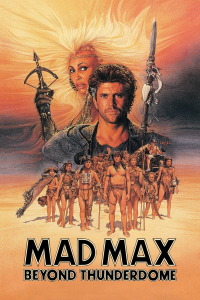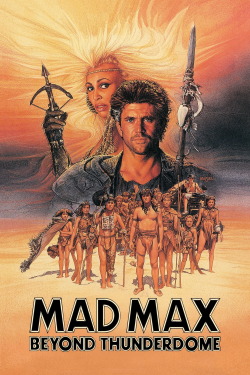
Review of Mad Max Beyond Thunderdome (1985) by Daniel M — 14 Apr 2010
When it comes to making a threequel, three outcomes are possible. Firstly, as in Prisoner of Azkaban or Return of the Jedi, they are the best of the bunch, expanding the themes and characters in ways which are both faithful and original. Secondly, as with Last Crusade and Die Hard with a Vengeance, they match the quality of the first film and bring balance to the franchise, refining what has gone before. Or thirdly, and commonly, they are a big disappointment, sacrificing quality for mainstream appeal. Spiderman 3, Superman III and Army of Darkness all went down the road to goofiness, and none returned with their dignity intact.
Mad Max 3: Beyond Thunderdome definitely belongs in the third category, though it is not an abject failure like the other examples. There are interesting ideas in it, and on a technical level it is the most accomplished of the trilogy films. But each of its successes belies an equal and opposite failure, making it a frustrating experience for fans and only a reluctant success in its own right.
The first interesting idea which the film attempts to address is the nature of how post-apocalyptic society would function. There are hundreds of films about humans descending into chaos in a crisis, from The Dark Knight to The Thing and everything in between. But there are very few non-dystopian works which address in detail how society might be rebuilt or restructured.
Bartertown is an intriguing vision because it appears so radically different on the surface but actually runs in a scarily similar way to our own society. When Max first enters, everything seems orderly and civilised, at least compared to the highways and deserts of his past. There is peaceful trading, a reliable energy supply, and conflicts are resolved through one-on-one gladiatorial combat in the Thunderdome. In fact, the real power lies with those who control the energy, the brutal criminal underclass run by the methane magnate-cum-mobster known as Master. And for all its claimed civility, there is still something macabre and degenerate about the Thunderdome; the weapons may be more advanced, but the crowd are still tribal, baying for blood and taking animalistic pleasure in the carnage.
There is great potential within these ideas, and in the hands of George Miller you would expect the same combination of substance and subtlety which drove the first two films. Unfortunately, Miller is not behind the camera for any of the scenes between Max's arrival in Bartertown and the clash in the Thunderdome. Miller lost interest in the project after his producer and close friend Byron Kennedy died in a helicopter crash. He eventually agreed to direct the action sequences, while TV director George Ogilvie took the rest.
The result is a film which is pulling in different directions, with a visual style which is steadily less original. Although certain sections of Mad Max 2 felt similar to Raiders of the Lost Ark, you still felt it was directed by an individual who wasn't just interested in copying Hollywood for commercial reasons. Mad Max 3, on the other hand, is strikingly similar to Temple of Doom; you almost expect someone to shout 'Kali mar!' and pull out Mel Gibson's heart. There is more dialogue in this instalment, and considering the sheer volume of characters there needs to be. But for every great section, like Edwin Hodgeman's speech before the fight, there are three or four which seem laboured, over-long or -- most damningly -- ponderous.
The film often trips over Steven Spielberg territory because of its emphasis on children and its increasingly goofy sensibility. Although the film predates the insufferable Hook by six whole years, you can see hints of that film in the middle third, where Max is rescued by the tribe of children who believe him to be their saviour. (There is, oddly enough, an in-joke here which refers to Ken Russell's Tommy: the tribe's saviour is called Captain Walker, who shares his name with Tommy's father, and both films starred Tina Turner).
Again, there is something inherently interesting about a post-apocalyptic society involving children. The script does address issues of how history is remembered, and puts forward the idea that the 'promised land' of many religions is nothing more than a skewed memory of the past combined with ignorance about the outside world. That in itself is a shocking and radical idea, but it and others like it get lost in the manner of storytelling. The middle of the film does feel like a rip-off of Peter Pan and neither Miller nor Ogilvie completely mesh it together with the events in Bartertown. In any case, the fact that a new generation would live on is no great surprise, since that was explained in the closing narration of Mad Max 2.
When it comes to the action sequences, with Miller behind the camera, we get all the excitement and frenetic energy which made the first two films such a joy to watch. The Thunderdome fight is really great, being a highly original take on the classic duel. Roger Ebert went so far as to praise it as "one of the great creative action scenes in the movies.". It is well-paced, well-shot and the performances are very good, particularly from Gibson. Elsewhere in the film he can seem lost, but when his life is threatened he still exudes the same frightening charisma that he had before.
The problem, however, is that the action sequences are no longer seamless continuations of the plot. For all the inventiveness of the Thunderdome sequence or the thrills of the train chase, they feel like set-pieces, like components of an edgier, spikier film trying to escape from a mainstream vehicle. That said, even the train chase is not as exciting as the climax of previous films because of the goofy direction in which the series had moved. In Mad Max 1 and 2, you genuinely thought that people would get hurt; when there were head-on collisions between vehicles, people really died. Here, the head-on collision results in Ironbar's hair being caught on a pole, forcing him to jump over obstacles like hurdles; and when Max pulls a spear out of the driver's leg, it's treated like a comedy sequence and so packs much less of a punch.
The best way to describe Mad Max 3 is an enjoyable disappointment. Despite its very obvious flaws, and its all-too-close resemblance to Spielberg, it is a perfectly decent action movie which attempts to address a lot of complicated issues. It is the most ambitious of the Max films, in attempting to broaden out the universe beyond a solitary loner and focus on the future of the human race. But it is never genuinely successful in this task, and in acquiring a greater scope it sacrifices much of the nihilistic intensity and tension from before. For all its moments of genius, and its remarkable action, the film is neither coherent enough nor dark enough to hold together in a completely satisfying way. As a passing amusement it's fine, but it won't be so fondly remembered.
This review of Mad Max Beyond Thunderdome (1985) was written by Daniel M on 14 Apr 2010.
Mad Max Beyond Thunderdome has generally received positive reviews.
Was this review helpful?