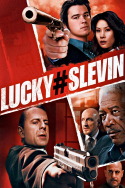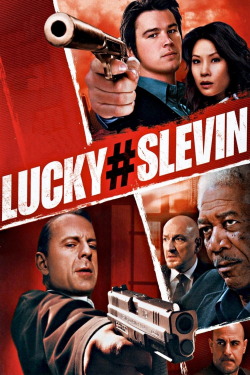
Review of Lucky Number Slevin (2006) by Moviemastereddy — 02 Apr 2016
A View to Many Kills.
If you're feeling depravity-deprived, if you haven't seen enough violent death in the past few weeks -- after all, it's been over a month since "The Hills Have Eyes" was released! -- relief is finally in sight.
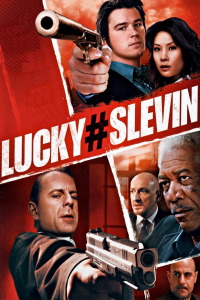
That's Paul McGuigan's "Lucky Number Slevin," which despite its nonsensical title turns out to be a slaughterfest dedicated to the proposition that killing the old way is best. It still kills that old way, via pistol, over and over and over and over. It may be the bloodiest film since "Sin City," and it's so bloody that eight people are graphically murdered before the star even appears.
That star is the scrawny, cute, innocent Josh Hartnett, as one poor schlemiel called Slevin, who appears a typical twenty-something failed-to-launch slacker in baggy T-shirt and raggedy pants, wool cap pulled low over eyes and ears. Is he a punk musician or a computer nerd-genius?
Well, actually neither: He's a guy who shows up in a buddy's New York apartment, which is the wrong place at exactly the wrong time. Suddenly two very violent gangstas arrive, beat the pep out of him and haul him before The Boss, played by the magisterial Morgan Freeman. Although Slevin protests, the boss isn't too interested in these protests and insists that he, amateur Slevin, is Nick, the actual renter of the apartment. And that since Nick owes him money, he, Slevin, must either pay it back (clearly impossible) or earn his way out of penury by performing a service. That service is a murder that is an act of retribution in the service of a larger tribal battle between The Boss and The Rabbi (Ben Kingsley).
Before this comes the movie's bloody preamble, which seems to have nothing to do with anything. It's the story, set 20 years in the past, of a young man who tried to hustle the mob by betting on a fixed horse race. For his hubris, he was paid in death, as were his wife and child (all three extinctions clinically documented). From that story, narrated at an airport by a crippled Bruce Willis to a completely different young man, the movie then leaps into the present, where we watch this morning's extinctions, also clinically documented, of a man getting into a car in a parking lot and a bookie and his henchmen being wiped out by an unseen expert in improvised weaponry (including a baseball!). Meanwhile, back at the airport, Willis snaps the neck of the boy he's been talking to like it's a swizzle stick in a slightly used martini glass. That extinction -- in fact, all of them -- are played as punch lines to a joke that everyone but the victim gets.
The movie has a jaunty, even merry tone for something so blood-soaked. It takes its editing rhythms from the clever Guy Ritchie of "Snatch" and "Lock, Stock and Two Smoking Barrels" fame (and not "Swept Away," with wifey Madonna, infamy). Like Ritchie's far superior works, it plays a lot of tricks with chronology, with point of view, with concealment and revelation.
It also bears a more than casual connection to "Wicker Park," which was also directed by McGuigan and also starred Hartnett. Many of the same mechanisms are deployed, so much so that this film could be called "Wicker Park With Berettas." That movie, if you are not among the seven or nine who saw it, was a contempo romance set in Chicago, where Hartnett played a young businessman who falls in love with a girl who then vanishes almost instantly, a mystery that becomes an obsession for him to solve.
Both films are built around the same structure, which begins with a cleverly filmed scenario in which we watch this and that happen, and take for granted we understand what we've seen. But that scenario is kind of the Rosetta stone of the story, and it is returned to over and over, and with each revisit it becomes more complex. Looking at it from other vantage points, we learn that what seemed innocent and spontaneous was neither; relationships emerge, coalitions are revealed, perpetrators, barely glimpsed in the original, are identified. In "Wicker Park" the cleverness and the gamesmanship were fun. Here they're only almost fun.
There's just too much death, it comes too quickly, it has no moral import, it becomes ultimately meaningless. It's not that hyper-violent movies are axiomatically a bad thing -- "The Wild Bunch," "The Godfather," "The Seven Samurai," even "Hamlet" and Orson Welles's "Macbeth" show the foolishness of that assertion. It's just that this particular example is so laden with shootings -- rarely gunfights, I should add; mostly quick executions of unarmed people who simply keel over when popped -- that it becomes somehow tedious. The young director is intoxicated with them, but out in the audience, we're beginning to squirm. Let's see some contests, some fights, some skill: No, we're just watching an execution-o-rama.
The saving grace is both Freeman and Kingsley are charismatic performers, each the master of a posse that reflects a specific ethnic heritage.
This review of Lucky Number Slevin (2006) was written by Moviemastereddy on 02 Apr 2016.
Lucky Number Slevin has generally received very positive reviews.
Was this review helpful?