Review of Lucky (2017) by Bertaut1 — 24 Sep 2018
A meditation on mortality.
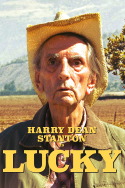
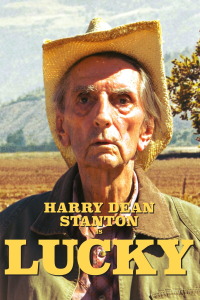
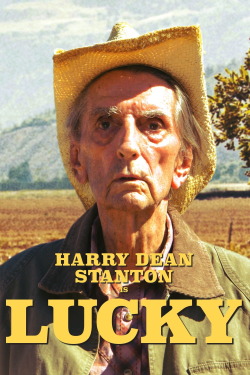
Lucky is the directorial debut of prolific actor John Carroll Lynch, but more noteworthy is that it features the last performance from the legendary Harry Dean Stanton, who was 90 at the time of shooting, and who died two weeks prior to the film's North American release. Written specifically for Stanton by Logan Sparks and Drago Sumonja, the film is a meditation on mortality, and is as much about Stanton himself as it is the eponymous character. Beginning like a quirky comedy populated by strange characters with gentle eccentricities, it later morphs into a more serious meditation on how a nonagenarian atheist with no family faces up to the fact that death is not that far away. Laid back and tender, moving entirely at its own measured pace, Lucky works primarily by way of presenting individual vignettes that add up to much more than the sum of their parts.
The film tells the story of Lucky (Stanton), a 90-year-old living in an unnamed backwater town on the edge of an Arizonan desert. An atheist who doesn't believe in an afterlife or the soul, never married, and with no children, his life is one of routine, spending his day interacting with the townsfolk; local diner owner Joe (Barry Shabaka Henley) and waitress Loretta (Yvonne Huff); shop-owner Bibi (Bertila Damas); bar-owner Elaine (Beth Grant), her husband Paulie (James Darren), and barman Vincent (Hugo Armstrong), along with Lucky's best friend, Howard (David Lynch). However, when he falls for no apparent reason one morning, the local doctor, Kneedler (Ed Begley Jr), tries to explain that at his age, the body simply starts to break down.
Lucky is a character-driven film, where the vagaries of a well-laid plot just don't factor into things. This is signalled in the slow and methodical opening sequence, which depicts Lucky ambling past boarded-up and dust covered shops, with the lethargic pace playing out on screen correlating with the lethargic pace of the editing (Lynch allows the characters plenty of room to breathe). This sequence also sets up the style and tone of the film; rather than a cause-and-effect narrative, Lucky is built upon a series of small idiosyncratic moments, often with only the barest amount of connective tissue between them. Neither does Lucky, nor any of the other characters, have a significant arc; he's essentially the same man when the film ends as he was when it began, which is, of course, the whole point.
One of the major themes is routine; Lucky's day is rigidly mapped out, to the point that if someone is sitting in his favourite diner seat, it puts him in a bad mood. In this sense, repetition is a major part of both his life and the film's structure. Another important theme is impermanence, which ties into Lucky's rejection of a never-ending life after death. Tied to this, the issue of mortality is brought up time and again, seen most clearly in Howard's dealings with life-insurance man Bobby (Ron Livingston), preparing for his own inevitable death. However, the five yoga exercises Lucky performs each morning are the Five Rites of Rejuvenation, so although he knows that life won't last forever, so too is he doing what he can to prolong it as much as possible. With this in mind, after he falls, the film shifts gears, changing from a pseudo-comic examination of a curmudgeonly old man into a subtle analysis of the inescapability of death and the transitory nature of existence.
Working together, the acting, the seemingly insignificant dialogue, the importance of routine, the crumbling town, the desert, all serve to create the whole, which conveys far more than any one aspect of the film could. This is not to say that individual scenes don't work, or are disposable, however. For example, several scenes contain achingly beautiful anecdotes; Lucky's story of accidentally killing a mockingbird as a child; Howard's narration of what he imagines President Roosevelt's birth must have been like; and, in a scene obviously paying homage to a very similar scene in The Straight Story (1999), Lucky and former marine Fred (Tom Skerritt) swapping heart-breaking stories of their time in the war (just like Lucky, Stanton was a cook on board the USS LST-970, which participated in the Battle of Okinawa).
If I was to find fault, although the film avoids sentimentality for the most part, it does become a little maudlin towards the end. Additionally, by its very nature, the narrative is very episodic, which creates a slight impression of disconnection. Also, the tone and design work to keep the audience at arm's length, preventing us from becoming too emotionally involved with Lucky himself, something which I'm not entirely sure served the film, or the character, very well.
However, these are relatively minor flaws in an otherwise excellent film, and in the end, this is a fitting swan song for an actor of Stanton's calibre.
This review of Lucky (2017) was written by Bertaut1 on 24 Sep 2018.
Lucky has generally received very positive reviews.
Was this review helpful?