Review of Luce (2019) by Bertaut1 — 19 Nov 2019
A slightly repetitive, but nonetheless fascinating societal drama that rewards concentration.
Adapted from the play of the same name by J.C. Lee, Luce was written for the screen by Lee and Julius Onah, and directed by Onah. Tackling all manner of issues, including race, class, gender, power, privilege, #MeToo, academic achievement, liberal elitism, revolutionary rhetoric, the importance of language in encoding societal/political power structures, it also works as a thriller about a young man who may, or may not, be a dangerous sociopath posing as the embodiment of the American Dream. Without question, it asks a lot of the audience, and it's by no means perfect, but, by and large, this is strong work.
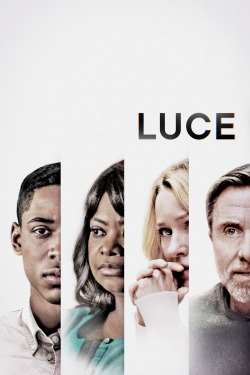
In Arlington, VA, 17-year-old Luce Edgar (Kelvin Harrison, Jr.) is the adopted son of Peter (Tim Roth) and Amy (Naomi Watts). Born in Eritrea, Luce spent the first seven years of his life as a child soldier. However, with the love of his adopted parents and a lot of therapy, he has grown into an exceptional young man; all-star athlete, captain of the debating team, all-round honour student. However, when his history teacher Harriet Wilson (Octavia Spencer) gives an assignment to write from the perspective of a revolutionary, Luce chooses Frantz Fanon, the Pan-Africanist writer who argued that colonialism could only be defeated by violence. Disturbed by Luce's apparent endorsement of Fanon's theories, Wilson searches his locker without his permission, finding powerful fireworks, and so sets out to convince the Edgars that their son may be dangerous.
In a film which takes in countless themes, one of the most prevalent is race, especially the notion of differences in black identity – both Wilson and Luce are black, but Luce is also an immigrant with a vastly different frame of socio-political reference. He is an immigrant, whilst she is a child of the 60s, with direct experience of the Civil Rights Movement. However, perhaps because of this, she subscribes to respectability politics, seeing all black people as sharing a common bond. Luce disagrees, arguing there's no such thing as a monolithic black identity, and refusing to conform to Wilson's conception of what a successful black student should be. To conform to preconceived and idealised notions would be to define himself on other peoples' terms.
And, of course, it's important not to forget that amidst all the ideological differences between Luce and Wilson, their initial conflict is a more tangible one – after writing a paper about violence, he's profiled in a way that a white student would not be. The fact that Wilson herself is black is irrelevant to this – she reads what he says about violence and she assumes he shares Fanon's sentiments, and hence could very well be dangerous.
One of the things the film does especially well is toy with audience expectations. Wilson, like much of society, seems to think of Luce in binary terms – he's either a bastion of what's possible in the land of dreams or he's violent and dangerous. Cinema audiences too are conditioned to think in such binaries – we want ambiguous characters such as Luce to ultimately be revealed as one thing or the other. However, Onah delights in complicating things at every turn – when a grinning Luce mentions fireworks to Wilson, is he threatening her or is it an innocent reference to the Fourth of July; when an amiable Luce meets Wilson and her drug-addict sister Rosemary (a stunning performance by Marsha Stephanie Blake) in a supermarket, is it a coincidence or did he follow them?
In terms of problems, the audience has to do a lot of the leg work, and it's something which will be immediately distasteful to some, especially those who demand rigid binaries and clear explanations from their narratives. Personally, I loved the inherent ambiguity, but I understand that some won't. The same is true of many of the themes, which tend to be raised in something of a phenomenological vacuum, exiting almost as hypotheticals rather than prescribed answers, and again asking the audience to connect some of the dots. The film also runs too long, with much of the dramatic tension slackening in the last act. It's also prone to repetition, and it features a few too many issues, several of which are taken virtually nowhere. A subplot involving a possible sexual assault at a party, for example, pays lip-service to #MeToo but does very little beyond that.
Nevertheless, I was impressed with Luce. What it says about the US's (in)ability to engage in meaningful dialogue regarding important socio-political topics isn't flattering, but it is compelling. Essentially a film about pressure, as exerted by parents, by schools, by teachers, by friends, by society, by oneself, it's at least partly an exposé on the bitter divisions inherent in Trump's America. It does spread itself a little thin and the ambiguity won't be to everyone's taste, but this is brave filmmaking with a lot on its mind.
This review of Luce (2019) was written by Bertaut1 on 19 Nov 2019.
Luce has generally received positive reviews.
Was this review helpful?