Review of Little Nemo: Adventures in Slumberland (1989) by Mel V — 19 Mar 2005
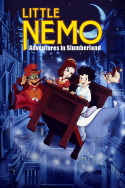
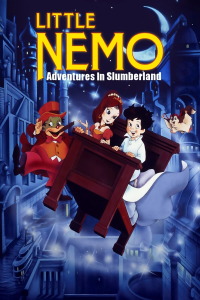
[i]Little Nemo: Adventures in Slumberland[/i], a joint Japanese-American animated adaptation of the Winsor McCay comic strip (first published in 1905 by the [i]New York Herald[/i]), was released in 1992 in the United States to negligible box office results. [i]Little Nemo: Adventures in Slumberland[/i] went into pre-production in 1982, with the short-lived involvement of Hayao Miyazaki ([i]Princess Mononoke[/i], [i]Spirited Away[/i]) and Isao Takahata ([i]Grave of the Fireflies[/i]). Masami Hata, Masanori Hata, and William T. Hurtz eventually shared co-directing credit on the final film. [i]Little Nemo[/i] was presumably considered a prestige project, given the involvement of Ray Bradbury, who receives a special story concept credit; Jean ?Moebius? Giraud (of [i]Heavy Metal[/i] fame) receives a concept credit; and Robert Towne ([i]Chinatown[/i] scribe and all-around ?script doctor?) receives a story consultant credit. Chris Columbus ([i]Young Sherlock Holmes[/i], [i]The Goonies[/i], [i]Gremlins[/i]) also receives a co-screenwriting credit. The end result, however, is an uneven, unfocused film, watchable only for the traditional, hand drawn animation and the sheer exuberance of the set pieces, most of which involve Little Nemo and his flying bed.
[i]Little Nemo: Adventures in Slumberland[/i] opens, appropriately enough, in Little Nemo?s bedroom, with Little Nemo comfortably asleep. His bedroom contains hanging airships, planes, and dirigibles (Miyazaki?s possible influence). As he sleeps, his bed levitates, carrying him outside, into the nighttime world of a sleeping late-Victorian town. Nemo awakens in mid-flight, as his flying bed floats over large puddles of water. Fear and anxiety turns to awe and pleasure, as the flying bed takes him higher into the sky, through and above the cloud cover. But, in a signal of things to come, his dream turns into a nightmare, with the clouds parting to reveal a post-apocalyptic cityscape, the bed plunges downward into the darkness, which, in turn, becomes a train tunnel. Nemo and his flying bed attempt to outrun a quickly gaining train. Nemo awakens. End prologue.
The following night, as Little Nemo slips into his dreams accompanied by his pet squirrel, Icarus, he receives a visitor, Professor Genius, who invites Nemo to Slumberland to meet the King of Dreams, Morpheus, and the king?s daughter, who wants Little Nemo as a playmate. Slumberland is apparently accessible only via a massive, colorful dirigible (another Miyazaki influence, perhaps). In Slumberland, where bland, pastel colors reign supreme, Nemo meets Morpheus, the King of Dreams, who, for no apparent reason, makes Little Nemo his heir apparent. Morpheus entrusts a magical gold key to Little Nemo that can open every room in Slumberland, with the exception of one door. Nemo also meets the king?s daughter, his once and future playmate, but more importantly, story wise, he meets Flip, an archetypal trickster character, a character who functions as a destabilizing force and a threat to the status quo. Flip appears multiple times during Little Nemo?s visit to Slumberland, easily convincing Nemo to join him on various misadventures. With little prodding, Nemo follows Flip?s advice, opening the door, breaking his promise to the king, and, of course, unleashing the nightmarish darkness that lurks behind the door.
In an effort to redeem himself, Little Nemo goes on the equally archetypal hero?s quest, vowing to save Slumberland (and a certain missing character), with the help of Professor Genius, the Princess, Flip, and the royal scepter. There, setbacks lead to setbacks, with Little Nemo forced to fight off attacks from the Nightmare King?s bat-like servants as he gets closer to the Nightmare King?s mountaintop fortress. The Nightmare King?s kingdom, with dark clouds hover perpetually overhead, and thick, black roots covering the ground, as well as the Nightmare King himself, echo the ?Night on Bald Mountain? sequence from Walt Disney?s [i]Fantasia[/i]. In shape and form, the Nightmare king also resembles the Lord of Darkness from Ridley Scott?s critically underappreciated [i]Legend[/i].
Story wise, [i]Little Nemo?s[/i] shortcomings are due to an overlong second act that takes place in Slumberland, including a long, superfluous interlude with the Princess, complete with a forgettable song or two. Although a character derived from Winsor McCay?s comic strip, here she serves little purposes, especially since the focus of the Slumberland sequence seems to be the relationship between Little Nemo and the King of Dreams, who makes him his heir apparent. More time should have been spent with those characters, making the King?s decision more believable. Additionally, with so much time spent in Slumberland, the Nightmare King and his kingdom are relegated to the third act, where the scriptwriters, in an obvious attempt to find a shortcut into the Nightmare King?s castle, insert a group of likeable, if bland, ?good? goblins. Little Nemo trusts them too easily, and the implicit possibility of betrayal or reversal by the new characters is sadly left unused. The screenwriters would have better served by introducing the malevolent Nightmare King earlier in the film, scheming and manipulating other characters into opening the gateway between the two worlds. Instead, the Nightmare King is introduced in the third act, making his entrance far less effective than it otherwise would have been. [i]Little Nemo?s[/i] problems also extend to the unimaginative character designs, the (barely) functional dialogue, and the unremarkable, flavorless, often intrusive songs by Robert and Richard Sherman.
But what about Ray Bradbury?s influence, you might ask? His influence seems to be limited to the opening and closing scenes that apparently draw their inspiration from Bradbury?s fantasy novel, [i]Something Wicked This Way Comes[/i]. Bradbury may have also influenced the addition of a circus, with its inherent promise of magic and wonder, in these scenes. The jolly circus ringmaster resembles no other than Father Christmas (later, Morpheus will take on the shape and face of the ringmaster, connecting Little Nemo?s dream world and the real world). Unfortunately, Bradbury's minimal impact on the storyline is only one of many shortcomings present in [i]Little Nemo: Adventures in Slumberland[/i], with the promising opening matched only by the third act set in the Nightmare Kingdom, and ultimately undermined by a flaccid, uninspired second act.
This review of Little Nemo: Adventures in Slumberland (1989) was written by Mel V on 19 Mar 2005.
Little Nemo: Adventures in Slumberland has generally received positive reviews.
Was this review helpful?