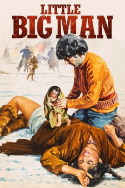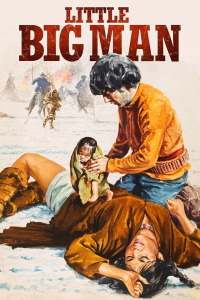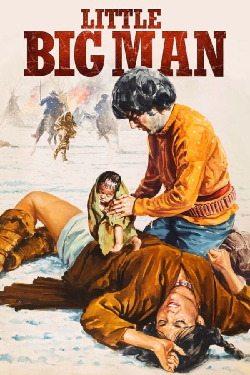
Review of Little Big Man (1970) by Dan M — 19 Jun 2014
"Little Big Nose"-I mean, "Little Rain Man"! Shoot, this is more like "Little Rain Dance Man"... or "Little Sun Dance Man", or whatever dance the Cheyenne tribe thought would actually work in bending the elements. Man, as crazy as the titular Little Big Nose's... or whatever's story is, him summoning the rain/sun gods wouldn't be all that relatively ludicrous, and he wasn't even born to the Cheyenne's. If this guy is lying about nothing else in his story, he's lying about being taken in by the Cheyenne after his family got killed, because I'm sure his parents were just trying to get rid of him for being such a big Jew in the Old West. Dustin Hoffman's family must not have drifted too far away from him, because Arthur Penn was so much that level of Jew that he probably was Hoffman's father, but the fact of the matter is that the Old West seemed to do a better job of driving out the Jews than it did getting driving out the Redskins. I joke, but it is weird how scarce Judaism was in the Old West, especially in comparison to whatever in the world the Cheyenne practiced, but now, they join forces to take on the whole "little big world" (I don't know if my saying that makes me want to play the video game of the same name, or play The Hives' "Hey Little World"), or at least tell a pretty good story. Well, that is accomplished, if nothing else, and yet, it sure takes its time to reach such an accomplishment.
As a relatively extensive fictitious biography, this film ought to be tight with its relatively mere runtime of just a minute shy of 140 minutes, but there's still something excessive, to a point of aimlessness that is exacerbated by directorial cold spells, of which there are only a few, but enough for there to be occasions of blandness which distance resonance. Resonance is further betrayed by, of all things, a certain hurrying in narrative structure, which is driven by a narration that doesn't simply objectify storytelling and betray potential subjective immersion value, but dashes over a lot of elements, sometimes with an awkwardness that challenges developmental depth and keeps the shifts in focus from smoothing out. This inconsistency in pacing, at the very least, convolutes the structure of this layered film which is both overblown and undercooked, to the point of some glaring focal inconsistency that is even more problematic than the tonal unevenness. Storytelling ambitiously dances between often over-the-top satire and weighty dramatics which defuse each other as they jar back and forth, leaving the humor to be contradicted by the seriousness, which is in turn diluted by the humor. As uneven as the tone is, there is at least a certain consistency of cheesiness, whether it be within a humor that is often cornily overwrought, - trying too hard to be sharp as satire - or within the dramatics which often devolve to melodramatics, trying too hard to be engrossing as a human epic. The film is overwhelmingly ambitious, and too often, it is simply overwhelming with its ambition, and no matter how firm inspiration stands, all of this bloating, rushing and inconsistency, broken by a consistency in overt fluff, seem to kind of hold the final product back. That being said, the film still rewards the patient by meeting ambition with inspiration, and even some artistry.
John Hammond's score's minimalism underplays musical value that is underplayed enough by many quiet spots, but it's almost psychedelic, in a manner which compliments the surrealism of the film just as Harry Stradling Jr.'s cinematography handsomely polishes already handsome art direction. Well, Angelo P. Graham's art direction isn't so much aesthetically appealing in its beauty, but in its being so distinguished, and doing much to sell the evolution of the 19th century, the sense of which, of course, plays a big role in selling the progression of the narrative. There is not much dramatic consequence to this film as an extensive study on the eccentric life and times of an unconventional man, but as a surrealistic portrait and satire on the distinctions between native tribes and God-fearing whites of America during the 19th century, over an extensive character piece, this story concept is promising, and done justice by highlights in storytelling. Calder Willingham's script is all over the place, but it's often well-rounded in it characterization, as well as colorful in the drawing of clever humor and dynamic set pieces, while Arthur Penn's direction augments the color with plenty of stylish and slick pacing which is tasteful enough to move at times. Alternating between superficial and overblown, storytelling here is flimsy, but captures a fusion of scope and intimacy which makes the pseudo-epic pretty compelling in its inspiration. The performances ice quite the colorful cake, with highlights that include the beautiful Faye Dunaway as a hypocritical and unpredictable woman of seduction, as well as Chief Dan George as a wise and good-hearted, if eccentric tribe chief and spiritual guide, and leading man Dustin Hoffman, whose charm and layering sell the confusion and, of course, the emotional sensitivities of a man torn between cultures. Emotional highlights are few and far between, but between these highlights, Hoffman truly mesmerizes in his changing so much in the titular Jack "Little Big Man" Crabb character, a spiritual being, a sinner, a stranger in strange lands, a family man, a mad man, and, of course, a good man, a compelling man who thrives on Hoffman's charisma, as surely as the film itself thrives on him as a character study that, through all of its many missteps, entertains and compels enough to make a rewarding western drama.
When it's time to go back in the ocean again (Well, I guess I'm playing The Hives, because "Hey Little World" is pretty fun for modern rock), uneven pacing, focus and tone, as well as overtly cheesy humor and some histrionic dramatics threaten to wash away reward value that is ultimately secured firmly enough by the nifty style, immersive art direction, sharp storytelling and strong acting - especially by Dustin Hoffman - which mold Arthur Penn's "Little Big Man" into a mighty compelling study of the eccentric culture clashes along the frontiers of the 19th century.
3/5 - Good.
This review of Little Big Man (1970) was written by Dan M on 19 Jun 2014.
Little Big Man has generally received very positive reviews.
Was this review helpful?