Review of Life of Pi (2012) by Salil V — 09 Oct 2014
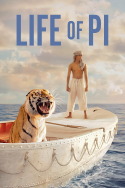
1. Above all else: don't lost hope. That is a sentence that rings true in this unlikely survivor story. Based on Yann Martel's novel Life of Pi, director Ang Lee takes the story of a young Indian boy who braves an ocean for 227 days and turns it into a visually stunning, spectacular story that falls just short of being as humanly touching as it sets out to be. Although the main character of the story is our unlikely hero who goes by the name of Pi (Suraj Sharma), the main character of the film is, unarguably, the stunningly beautiful and over-the-top visual effects. That is not to say the story takes a backseat to the visual nature of the film, the story, as witnessed by the success of the novel it is based on, has much to say against a beautiful backdrop.
2. Straight off the bat, Ang Lee and his production team let us know that we are in for one of the most visually beautiful films of 2012. The film opens with a cozy story about a city in former French-India called Pondicherry and Pi's early life within that city. In the beginning of the review I mentioned that this is a survivor's story but for the first 45 minutes of the film, viewers are given a "cute" story about Pi's upbringing. The first segment of the story is a description of Pi's early life. We are given stories of his name change from Piscine Molitor Patel to just Pi due to his fellow classmates teasing him by calling him "pissing". From this we are taken on Pi's personal spiritual journey. He starts off as a Hindu who fell in love with Jesus and then Islam due to its calming nature. Spirituality is indeed a very large theme in the film. As a character, Pi shows his adventurous traits when he sneaks into the back of his father's zoo but his playful attitude is extinguished when his father teaches him a very harsh lesson about "animals being just animals" whereas Pi protests that they have a soul. This moment in the film is one of the first pivotal scenes as the whole idea of an animal having a human soul is one of the main talking points of the second segment of the movie.
3. Near the 45 minute mark of the film, we see the most important scene in which Pi and his family's ship sinks into the ocean near Mariana's Trench. At this point is when the survivor aspect and the longest segment of the film begin. After the disaster, the sole survivors are Pi, Richard Parker (his tiger companion), an orang-utan, a hyena and an injured zebra. Besides Pi and Richard Parker, the other animals are done away with quite quickly and so begins the survivor's tale. Ang Lee knows that this is the part of the film that audiences are going to lap up since it is this part of the story viewers' love to experience. An unlikely character that overcomes his fears and survives in the face of total death. The visual effects at this part are milked to a point where they might be seen as gimmicky by the more attentive viewer. The beautiful scenes of the ocean looking as vast as outer space and especially one scene with a phosphorescent whale lunging out of the water makes for stunning scenes but adds little to the story.
4. Even though these scenes maybe intense and involving for the viewer, we are given short breaks in the form of an adult Pi, played by the masterful Irfan Khan, explaining the story to an author played by Rafe Spall. These breaks allow audiences to digest the chaotic ocean and the relationship between Richard Parker and Pi. Our hero is remarkably resourceful in his quest to survive by building a raft while maintaining his distant but central relationship with the tiger. Richard Parker serves to be Pi's company at sea and the film utilizes the relationship quite masterfully. We are not in for a sappy, tearful birth of a beautiful friendship between animal and human but rather a cautious journey which never allows the audience to forget that Richard Parker is a dangerous animal and Pi never shows an overt amount of sentimentality towards the animal. The theme of spirituality also makes important appearances during this segment of the film such as when Pi catches a fish and thanks Hindu Lord Vishnu for appearing in a form of this animal so he could stave of his and Richard Parker's hunger. While the spirituality running through this film is endearing, it does start turning into almost a parody when Pi screams to the skies to let God know that whatever comes he will still love him.
5. After his 227 day journey, Pi 's story enters the third and most disappointing segment of the film. At this point, he reaches the shores of Mexico during which Richard Parker leaves him very unceremoniously. Pi was destroyed by not gaining some sort of closure from his companion who displays Pi's father's initial point that animals are merely animals that do not have human souls. Pi gets picked up in his weakened state and is taken to a hospital where he has to recite a more believable story to a Japanese insurance company, changing all the animals that were on the boat into human characters such as his mother, the cook and the Buddhist sailor. The reason I say this segment is disappointing is that there is no visual representation of Pi's second story even if it could have a short montage. It felt cheap and awkwardly placed in a film with such visual grandeur. It's almost as if Ang Lee and his production team burned through the budget creating the splendours of the other two segments and could not work this part into the film.
6. As a comment on Suraj Sharma's acting, I do wish he had won some accolades for his performance. His interaction with a CG Richard Parker was incredible, really helping the audience believe that the tiger was real. It doesn't hurt that visually the tiger looked authentic. Besides his interaction with Richard Parker, he has incredibly poignant moments such as when he tells Richard Parker that both of them are dying. Additionally, Sharma being the only actor for the majority of the movie, he carries the film incredibly well without interacting with other human beings. The only flaw I find with the acting is in Rafe Spall. While listening to the adult Pi reciting the story, he usually had a confused look on his face as if he didn't know whether to laugh or cry. Being a minor character in the film, it can be overlooked.
7. To conclude, the most noticeable part of this production are the visual effects which carries the story. The scenes carry the story rather than the story carrying the scenes. This begs the question though, should we care? This film is a whole product visually; acting wise and even while the story isn't in the foreground it is still quite important. This film is meant to be experienced rather than just watched. Ang Lee set out to make a beautiful movie that would stun audiences and he succeeded in making an above average summer blockbuster packed with substance. I give this movie a B+.
This review of Life of Pi (2012) was written by Salil V on 09 Oct 2014.
Life of Pi has generally received very positive reviews.
Was this review helpful?