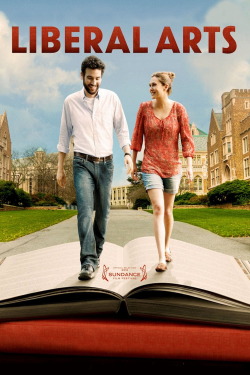
Review of Liberal Arts (2012) by Ben F — 05 Oct 2012
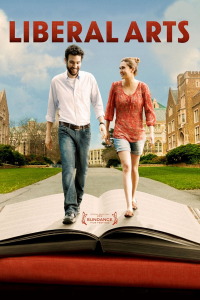
"Gooey man boy." That's what Professor Judith Fairfield calls her former student Jesse Fisher (Josh Radnor) toward the end of "Liberal Arts." It's a fairly apt diagnosis--Jesse, an NYC college admissions officer is little more than a thirty-five-year-old shell, who in the opening scene, tells a string of off-camera prospective students how wonderful the college's meal plan is. Taken at face value, this scene could be just another day in the office, but the forced charisma of Mr. Radnor's delivery signals the real problem--he is lost in life. How he escapes forms the rest of the film's story.
If you go see "Liberal Arts," you should be prepared to savor all of it--the movie is peppered with realistic conversations between believable characters who are genuinely charming. But you should expect to enjoy the beginning most of all. After a call from his favorite professor (Richard Jenkins), Jesse returns to his alma mater in Iowa for a retirement party. But he gets more than he bargained for when he meets Elizabeth (Elizabeth Olsen), a nineteen-year-old college sophomore for whom he makes a special connection.
Anyone who has had the experience of rapidly making a new friend will detect the authenticity in their first meetings. Most memorably, they take a rambling walk across her college campus, which ends with them sitting onstage in an empty, grey-black auditorium. In a movie filled with plenty of evocative images, this one might be the most compelling--Jesse and Elizabeth immersed in an intimate conversation about life and school ("Life happens," he tells her, which she translates into, "So I should be prepared for everything to suck?"), in an immense room that enhances their closeness rather than dwarfing it. It's as if their affection for one another is strong enough to compete with the granduer of the room.
Mr. Radnor, who also wrote and directed the film, clearly has a love for both this scene's elements--beautiful scenery (the school in Iowa, with its lush emerald lawns and almost gothic architecture is portrayed as a prototypical college idyll, under the lens of cinematographer Seamus Tierney) and frankly intellectual dialogue. That's the main constant in the film. Jesse says he loves college because it's the only place where you can really talk about ideas with people and the movie makes this point convincingly. In his encounters with students and professors, Jesse excitedly disscusses not only books and philosophy, but the actual pursuit of books and philosophy in itself. From vampires to existentialism, nearly everything is covered (most memorably by Zac Efron, who plays a delirious and mysterious wanderer).
While watching the film, I waited for this philosophical banter to become grating, but it never does--in the landscape that Mr. Radnor (in collaboration with editor Michael R. Miller) has created, it makes sense that the characters would communicate in terms of traded insight (just as it does in the films of Woody Allen and Christopher Nolan).
There's a downfall to cinematic insight, however. Just like anyone who medidates intently on the course of his life, Jesse works to find some kind of happy worldview with which he can be comfortable appreciating everything around him. Perhaps in the same spirit, Mr. Radnor polishes of the film a little too carefully. Jesse's relationship with Elizabeth, for example, escalates too quickly for them both--their age difference becomes insurmountable (intriguingly, the plunge downhill begins with a disscussion about "Twilight"). After such a close call, I kept hoping that we could see a little stain of uncertainty in Jesse's face as he moves on, but he tosses the experience off with a quip, complimenting his new girlfriend (Elizabeth Reaser) for being so "age appropriate.".
If Mr. Radnor's gaffes continue to be limited to being too eager to put an artificial "all's well that ends well" spin on life, he could soar even higher with his next film. As a director of actors he's flawless (Ms. Olsen's barely disguised nervousness when Elizabeth presents Jesse with a mixed classical CD is unforgetable, as is Mr. Jenkins' weary, calm resignation in the face of retirement) and his grasp of filmmaking grammer is nigh-impeccable (take note of a repeated shot of Jesse and Elizabeth strolling cross campus).
Nevertheless, he needs to be careful. Jesse's neatly unscathed emergence from the film's drama suggests that Mr. Radnor might need to reconsider his definition of both realism and entertainment. A happy ending should make a movie more enjoyable, but here it has the opposite effect--the idea that emotional trials are a complication to be quickly averted leaves you feeling oddly lonely.
So unlike those first conversations between Jesse and Elizabeth that seem to overflow with the very thing the film's hero says he loves about college: possibility.
****:).
This review of Liberal Arts (2012) was written by Ben F on 05 Oct 2012.
Liberal Arts has generally received positive reviews.
Was this review helpful?