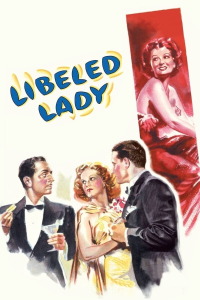
Review of Libeled Lady (1936) by Kevin M. W — 09 Jul 2011
Finally Solved When Someone Talks Sense.
Jean Harlow wanted to play the Myrna Loy role in this one. She felt that, because she was actually in a relationship with William Powell, she might possibly play the role of the woman who ends up with William Powell. Doubtless this should have spoiler warnings, but the movie is seventy-five years old and stars William Powell and Myrna Loy. And the thing is, audiences at the time looked at that latter and knew that they would end up together. This was the pair's fourth movie together, and they would go on to make eleven more. They were never romantically involved, but they fit together so wonderfully onscreen that it didn't matter. In the end, even Jean Harlow couldn't argue the point, and she couldn't argue that she was really more suited for the role she ended up in. From what I've seen, Jean Harlow did best at a woman who was grubbing her way up under her own strength, and that's definitely not the Myrna Loy role. It seldom was.
Harlow plays Gladys Benton, who is engaged to newspaperman Warren Haggerty (Spencer Tracy). Unfortunately, Haggerty's paper is caught up in a libel suit, having printed a story that Constance Allenbury (Loy) broke up a marriage. Alas for them, the story came from a source who wasn't even at the party where the events supposedly happened. Haggerty gets the bright idea that the best way to get the paper out from under the five million dollar suit is to set it up so that Connie really does break up someone's marriage, because no jury would then believe that she hadn't done it the first time. So they have to come up with a marriage for her to break up. Enter William Powell as the dashing, debonair Bill Chandler. Haggerty convinces Bill and Gladys to get married for the sake of letting Gladys discover the budding romance between Bill and Connie. Which will bud so the suit doesn't succeed. Though there is, of course, the initial trouble of getting Connie to go along with it--and then getting Gladys to go along with letting it end.
Gladys gets the short end of the stick on this one and knows it. You can't really blame her for being angry. When the libel suit first comes up, Haggerty considers it, in his own words, a reprieve from the governor; he looks at marriage as a punishment. As Gladys points out, the only time he's ever sent her flowers, he put Bill's name on them and tried to use it to build up the belief that the marriage was legitimate. Bill, as with most William Powell characters, is a really charming guy. He treats all women in a certain way, and that's much better than Haggerty treats anyone. Gladys may or may not really be falling in love with Bill, but she's certainly falling in love with being treated as someone important. Bill is gracious. Bill inquires after her feelings. Bill notices what she's wearing. And so forth. And Bill hasn't the least interest in her and is instead falling for someone else entirely, and Haggerty doesn't even ask to talk to her when he calls to find out how Bill is doing.
It's rather unusual to have a romantic comedy where the relationships are actually believable, but in many ways, I think we may actually have that here. It is easy to believe that a woman who's been mistreated the way Gladys is would go along with this kind of ludicrous idea. Bill seems willing to go along with quite a lot, and Haggerty is, as is pointed out repeatedly, more in love with his paper than with any human. And Connie follows a natural progression from distrustful to friendly to in love which makes sense given what we know of all the characters involved. Okay, the bit with her father (Walter Connolly) and the fishing is silly, but even there, Bill has made a careful study of something which he thinks will get him an in, and he follows up on it. Yes, the plot is in the end solved by two people talking, but at the same time, that's believable, too. After all, they're two people who were deliberately kept apart for the entire picture and would not have had the chance to talk, and the experiences were important to let them know what to say.
I don't quite know how this film got past the Code; it's the least believable aspect of the whole thing, and yet we must believe it, for it's so. Under the Code, Divorce Isn't Funny, but of course we all know the movie must end in a divorce to grant us the Happily Ever After payoff. The twist ending involves bigamy. Indeed, Gladys and Bill are willing to get married to further an end which isn't actually important to either of them personally, which isn't quite treating marriage as a sacred institution. It is actually made clear, if you know what to look for, that Bill and Gladys won't be having sex any time soon, and they did get married by a Justice of the Peace, but the hotel reservation for Gladys's Reno divorce was already made before the marriage ceremony. And while Gladys and Haggerty weren't having any sex, either, it would not have been entirely out of character if they had. Except inasmuch as that would have been Haggerty's cheating on the newspaper, and that wouldn't have happened, Code or no Code.
This review of Libeled Lady (1936) was written by Kevin M. W on 09 Jul 2011.
Libeled Lady has generally received very positive reviews.
Was this review helpful?