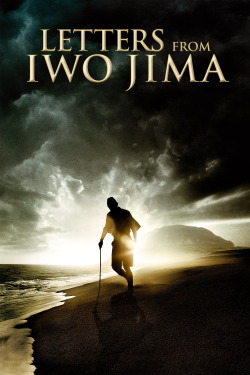
Review of Letters from Iwo Jima (2006) by Brandon S — 05 Jun 2011
Clint Eastwood's Japanese perspective of the battle of Iwo Jima is like a cloud. In shifting shades of foreboding and despondence, the film delivers an account of events with the action of a war epic, the detail of a documentary and the emotional impact of a drama. Collectively, the experience of the Japanese troops takes on many forms. Some characters, including the leader, Lt. General Tadamichi Kuribayashi (Ken Watanabe), are too complex to pin down firmly. Others, like the bumbling Saigo (Kazunari Ninomiya), are motivated only to return to their family and care nothing for the war or their superiors. From idealistic honor to bitter defeat to heartbroken fatalism, the spirit of the soldiers is given life decades after the war from the words they wrote on Iwo Jima. Using the troops' handwritten letters as a vehicle for his film, Eastwood attempts to focus his lens on the humanity of a battle that was inhuman.
Hopelessly outnumbered and outgunned, the Japanese forces on Iwo Jima were concerned less with how to win than with how to die. Once mainland Japan leadership established that no reinforcements, tanks or planes could be spared in the defense of Iwo Jima, Kuribayashi and his men knew that the battle was essentially a suicide mission. Eastwood shows in brutal detail that the Japanese code of honor led many troops to pull their grenade pins and hold the explosive charges against their chests with grisly results. Other soldiers engaged in banzai missions at the command of their leaders. While those offensive tactics were largely effective against the poorly trained Chinese forces Japan faced earlier in the war, the US military made short work of the charging Japanese soldiers. Still, Letters from Iwo Jima shows how the Japanese dug in to the island's rugged terrain to inflict maximum damage to the Americans.
At many points, the film dovetails with Flags of Our Fathers, Eastwood's sister production that portrays the war from the U.S. soldiers' perspective. In fact, both films were shot at the same time to make use of closely linked scenes. But where Flags of Our Fathers was mostly unsuccessful in establishing a strong emotional bond between the audience and the soldiers, Saigo was the key to the power of Letters from Iwo Jima. Through Saigo, the audience experienced not only the overall horror endured by Japanese forces, but also the moments of reckless chain of command. What the movie doesn't show is that Japan badly terrorized the people of China, the Philippines and other Asia/Pacific countries in the most inhuman ways imaginable. Iwo Jima was America's stepping stone - a key strategic base to eventually put a stop to Japan's war machine. And that is why the battle of Iwo Jima, in spite of its barren locale, was a critical front in the war and a worthy focal point in history.
The emotional power of Letters from Iwo Jima lies in its underlying message that Japanese soldiers and American soldiers were cut from the same cloth. When the Japanese forces take a wounded American prisoner, a letter from his mother is found in his pocket. General Kuribayashi translates the letter into Japanese as he reads it aloud to his men. In a moment of disarming honesty, one of the Japanese soldiers who previously demonized the Americans confides in Saigo that this letter is exactly what any of their mothers would write. The general even uses the words of the concerned American mother in his guiding his troops near the end.
When the letters of the Japanese troops are finally discovered and dug up by analysts studying the battle site, we hear a flood of voices earnestly reading the words. The sound of all the messages merging is overwhelming and Eastwood wants us to realize that each of the men who died defending Iwo Jima for Japan had a story and a family back home, just like the U.S. soldiers. The danger of this type of emotional message is the same danger Hollywood runs into whenever it shows the human side of inhuman battles and forces. Japan committed war crimes so horrific, China and the Philippines have yet to fully recover. It was in the shadow of this violence that America made the difficult decision to force Japan to surrender by using atomic bombs.
This review of Letters from Iwo Jima (2006) was written by Brandon S on 05 Jun 2011.
Letters from Iwo Jima has generally received very positive reviews.
Was this review helpful?