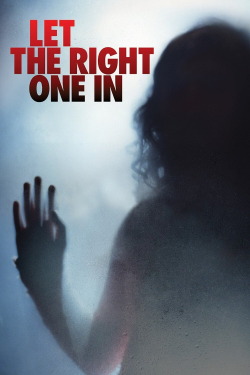
Review of Let the Right One In (2008) by Brian K — 13 Apr 2013
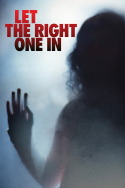
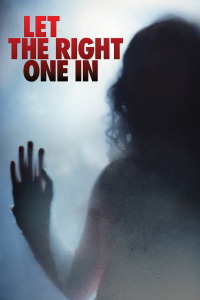
A very warm welcome to 'Let the Right One In', a film about a teenage vampire in love with a normal human. Sound familiar? Well, let me assure you that 'Let the Right One In' was written first, and it tells a more emotionally stirring and creatively compelling story than the retardedness that is 'Twilight'.
Oskar(Kare Hedebrant) is a young boy who enjoys cars, playing in the snow, and newspaper articles about disturbing murders, among other things. One night, while trying to piece together his Rubik's cube, he meets his new neighbor, Eli(Lina Leandersson), a young and mysterious girl. When she asks to borrow his Rubik's cube, he finds it the next day hidden in the snow, each side a solid color. He starts to notice strange things about her: A - she never comes out in the day B - she never eats C - she exudes a low growl whenever she sees blood D - she can't enter someone else's home without their spoken permission. Well, after some ghastly deaths, Oskar asks her: "Are you a vampire?" to which she replies, "Yes." Next question: "Are you dead?" to which she replies, "No. Can't you tell?" Hmmm, that's new.
Let's look at the difference between that change in vamirism, and 'Twilight's' version of vampirism. In 'Twilight', vampire traditions are changed for no other purpose than the fact that the plot demands it. Vampires have to be able to walk around during the day because Edward and his family, for no good reason at all, have to go to school. Why do they have to go to school? So that Edward can meet Bella. It's designed around the plot. If there's a plot point that's inconsistent, the rules have to drastically change with no other purpose than, "The Plot Demands It." Edward doesn't have to go to High School. Why would he enroll in High School and pay tuition to learn something he already knows? The usual excuse is so people won't think they're some strange hermit family. Well, people already think they're strange because of their pasty white skin and largely noticable eye liner. I know several teenagers who don't go to school. It's called home-schooling. But, no. Bella and Edward have to meet, the plot demands that, therefore Edward has to go to school, therefore vampires have to be able to walk around during the day.
Now, let's look at the change in vampirism rules made in this instance: When Oskar asks, "Are you dead?" Eli replies, "No. Can't you tell?" There is no plot point that needs to be covered up by that change in the rules. They changed that rule out of a creative character design. It's a symbolic representation of the love she feels for Oskar. Perhaps, even, she didn't mean it literally. More importantly than the actual reason for that piece of dialogue, however, is the fact that it makes you think about the reason for that piece of dialogue, something 'Twilight' never does.
This movie is psychologically stimulating. For instance: Is it a crime to kill someone if you have to? What if, incontrollably, you kill someone that you dislike or wanted dead in the first place? How would you react to killing that person? Eli believes that she is being humane by killing her victims before the venom causes them to become like her. Oskar doesn't know what to think. At first, he doesn't mind. Then, however, she sees her kill someone and becomes horribly frightened. However, by the end of the film, he has to choose whether to stay in school as the nerdy boy who gets beat up by the sadistic bully, or to run away with Eli.
Another difference to 'Twilight' is the fact that this film actually knows what subtlety is. I'm pretty sure that Edward and Bella tell each other, "I love you." at least six times through out the film, and it's in the most conventional way possible: "I love you, but I don't wanna hurt you." In 'Let the Right One In', the one and only time that Oskar and Eli tell each other they love another is at the very end of the movie, and it's in Morse Code. It's a sweeter, more vibrant, and more emotionally connected form of expression.
There are faults in this film, including two highly cheesy effects sequences; one is of a woman catching on fire, and another is of a group of cats attacking a vampire. Both these scenes were incredibly laughable, however the rest of the film is a triumph and a wonder, and if they're smart, they'll drop the 'Twilight' sequels, and make some more movies like this.
This review of Let the Right One In (2008) was written by Brian K on 13 Apr 2013.
Let the Right One In has generally received very positive reviews.
Was this review helpful?