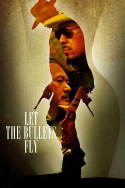
Review of Let the Bullets Fly (2010) by Shaun B — 12 Jul 2013
When China Was Wild.
China spent almost a century in great turmoil, from the Taiping Rebellion, the fall of the Qing, a failed republic, a decade of warlords, the second World War, and a brutal civil war, before being unified once again. The years of the warlords was probably the most chaotic politically, with very little clear idea of who controlled what. This time was roughly from 1919 to 1930. It is 1919, a year when people could buy themselves governorships over towns and entire districts, and parts of China resembled the American Wild West, that the story of Jiang Wen's Let the Bullets Fly takes place.
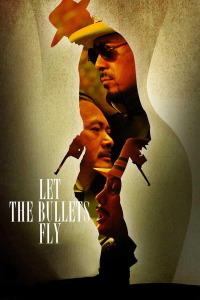
The premise of the film is how a honorable enough bandit leader can take the control of town away from the human and drug trafficking kingpin who runs it. Jiang Wen plays the bandit leader, Pockmarked Zhang. Zhang robs a train with a man on it named Ma Bangde, played by Ge You, an aspiring politician. Ma Bangde has bought himself a governorship and is on his way to collect. During the robbery Ma's counselor dies and Ma faced with Zhang who is looking for a rich governor. So, Ma lies saying he is the counselor, and that his dead counselor was really the governor to be, hoping Zhang will let him go. With that information, Zhang decides to use Ma's expertise to take on the governorship Ma was supposed to take over for himself. Upon arriving at the city Zhang is immediately pitted against the local crime boss, Master Huang, played by Chow Yun-fat. These two characters interacting is almost like John Wayne meeting Al Capone. They engage in a battle of wits and will for the life of the poor little place called Goose Town.
The movie moves fast, much like the time period it is set in. It is a witty cross between a gunslinging western and a prohibition era, Chicago gangster flick, all set in southern China. The interplay between Chow's character and Jiang's is amazing. It is similar to watching the Al Pacino and Robert De Niro exchange in Heat, only it lasts through the whole film and is amusingly clever. The characters are large personalities that engage in word play games with each other before, after, and during all the violence. A cord of humor runs through the entire piece that never feels forced or misplaced. A wonderful example of this is the constant referencing of Chinese history and myth in the film. As when Master Huang talks about gathering arrows with straw boats, a reference to a famous Three Kingdoms era strategist, Zhuge Liang. Of course, Huang's servant doesn't get the reference adding a comedic point in the film.
The film is not without substance however. One of the reasons I have become such a huge fan of Jiang Wen's work as a director is his talent of mixing elements of action, comedy, and drama, all in a very human way without the fake feeling that many films have, and all with a layer of morality holding it all together. While the jokes fire and the bullets fly there is clear message Jiang is pushing at the audience. Maybe Western movie goers might miss it, but the Chinese I am sure didn't. In a conversation between Ma Bangde and Zhang, Ma tells Zhang that a politician has to kowtow to the person with the money, in this case the drug lord Huang. Zhang tells Ma he became a bandit because his knees don't bend well, another reference to Chinese classicalism, namely The Outlaws of the Marsh. This conversation sets the tone of the feeling that many rebellious souls in China at this period felt and can easily be applied to modern politics as well. The May Fourth Movement, a very influential intellectual movement that criticized traditional Chinese culture and the power structure it supported was started in the year 1919, therefore I don't believe the films time setting was a coincidence. Nor is Zhang's past a coincidence either, as a person returning to China to find society in chaos is a theme for many Chinese historical figures. I believe that Jiang Wen is finding a light way to tie in heavy topics of Chinese history to engage modern Chinese. The movie shows people allowing themselves to be pushed around by the rich and powerful, all the while not understanding that they have given those people their wealth and power. Zhang is determined to have the town's people take back all that they have given Huang.
Much of the cast of this film is part of what is called the Sixth Generation, a group of actors and directors working through the mid-80's to present. These are some of the biggest names in Chinese cinema, making history for the industry and becoming internationally known. For example, Jiang Wen played a role in Zhang Yimou's Red Sorghum next to Gong Li. Ge You was the leading role in Zhang Yimou's To Live and Farewell My Concubine, again staring with Gong Li. While Chow Yun-fat comes from a different group of filmmakers in Hong Kong he is well know for his action movies with director John Woo, and of course, Crouching Tiger, Hidden Dragon. With talent to spare the cast makes these characters come to life in a bright, flashy and funny way. There are also surprisingly intense moments as well.
I have now watched this film a couple of times and have found many aspects to enjoy. I have watched the dinner scene with Jiang Wen, Chow Yun-fat, and Ge You several times and found it moves like a shell game with the innuendo being shuffled between the three actors. The dialogue always seems to have two meanings, like a classic Chinese poem, one side moving, the other questionable. I highly recommend this film to any true movie going fan. While this film is distinctively Chinese it will appeal to any one with head for dark, fast humor.
This review of Let the Bullets Fly (2010) was written by Shaun B on 12 Jul 2013.
Let the Bullets Fly has generally received positive reviews.
Was this review helpful?