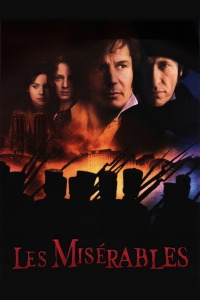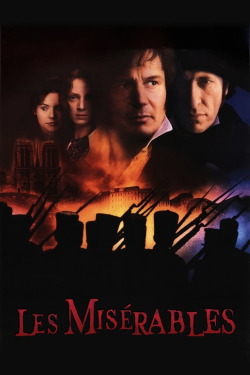
Review of Les Misérables (1998) by Aj V — 18 Sep 2011
The Kind of Thing D&D Alignment Arguments Are Made Of.
I'm a little wary about the casting announcements regarding the musical version, which is due out next Christmas. I will admit that I've never read the book, and I will further admit that the easiest way to get me to actually see a musical, as opposed to just listening to the score, is to actually make a movie out of it. So unless you include the Jumbo Cast Stage Version Anniversary-o-Rama (which I should have from the library eventually), I've never seen it, either. But I have, as you may have deduced, listen to it. I think Hugh Jackman will be a fine Jean Valjean; certainly he will be taking himself far less seriously than Liam Neeson does in the role here. He will probably also be taking himself less seriously than his costar, Russell Crowe. Who will probably be fine as the dour Inspector Javert, but I'm hesitant about the singing.
Jean Valjean broke a window to steal bread to feed his starving family, as we all know. He then tried to escape, and what with one thing and another, he served about twenty years for bread-theft. Upon release, he discovered what many others have--it's really hard to get a job if you're on parole. He steals a bishop's silver, as appeared in my eighth grade English textbook, and uses the money--and the trust the bishop gives by not ratting him out--to become a respectable man. He does this under an assumed name--that problem with the parole, of course. But that means breaking parole. Eventually, he becomes mayor of Montreuil-sur-Mer. Then, one Inspector Javert is assigned to his city. He tells him that one Jean Valjean is on trial that day as an escaped convict, for which he will receive life in prison. Valjean declares himself to free the innocent man. He manages to get away from Javert, and he and Cosette (eventually Claire Danes), daughter of the doomed Fantine (Uma Thurman), go to Paris where they will never be found. And then there's a student revolt.
Really, it's an extremely busy plot that may best be summed up as the conflict between Neutral Good and Lawful Evil. Javert, at the end, tells us that he has done his best to never break a rule. In contrast, Valjean broke all kinds of rules. He stole to feed his sister and her family. He tried to escape from prison to get back and take care of them. He stole from the bishop. He broke parole. He escaped again. And so forth. And every time he broke a rule, except for the bishop's silver, it was in the best interests of someone else. Javert doesn't care about anyone's best interests. Javert cares about the rule of law, and no other considerations matter. (This is where the argument comes in; he might be seen as Lawful Neutral in the right light.) The end of the story comes only when Javert himself realizes who the better man is; his inability to adjust to that reality is what forces things.
This movie focuses much less on the young lovers, Cosette and Marius (Hans Matheson), than does the musical. We do not see the Thénardiers in Paris; the only person cast as Éponine, Sylvie Koblizkova, was thirteen. Marius and the other revolutionaries are only there to force the story into the next level. Cosette must fall in love, because there must be a reason for her to want to break away from her father figure. The chaos of Paris in revolt is what makes Jean Valjean want to flee France altogether, not least because he discovers Javert is out in it somewhere. And after all, no one's going to pay Javert's salary just to chase one escaped convict around, so he's got to be doing something else to justify his wages. The cheeky Gavroche (Shane Hervey) is there to provide first comic relief and then pathos, though there's precious little of the former in the movie and far too much of the latter. However, he doesn't get more than about ten minutes of screentime, and the revolution seems more than a burden than a calling to Marius.
It's worth noting, because I don't think most people do, that this is not about [i]that[/i] French Revolution. This, in fact, has its climax more than forty years later and doesn't even get started until the downfall of Napoleon. Scarcely anyone in the story would be able to remember the original monarchy very well if at all; Valjean, probably, and probably Javert and the Thénardiers, not to mention various minor characters, but not Cosette. Not Marius. Not even Fantine, who was a young woman when her illegitimate daughter was born. The upper class was dreaming of a restoration of that monarchy, and the lower class was dreaming of a restoration of the better bits of the Republic. Probably not quite so much blood, though probably not everyone remembered that it wasn't just aristos who went to Madame La Guillotine. It is my certain belief that Terry Pratchett looked a little into the June Rebellion, the events surrounding the story's climax, when writing [i]Night Watch[/i]. Which is one of the best of the Discworld books and far better than this movie.
This review of Les Misérables (1998) was written by Aj V on 18 Sep 2011.
Les Misérables has generally received positive reviews.
Was this review helpful?