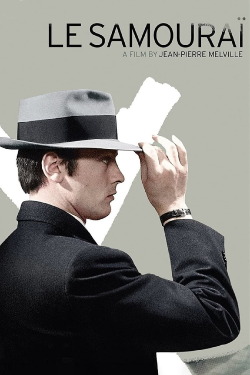
Review of Le Samouraï (1967) by Paul Z — 02 Mar 2009
We feel predisposed to admire someone who so doggedly stays within the firm boundaries of the code of ethics his lifestyle entails. But by the end, I am unsure of how to feel about such an approach to life. How does one maintain pride, honor and one's soul all at once? Where is the firm handshake between personally regimented principles and an innate understanding of right and wrong? I am choosing my words carefully because that is the only way to go about the dilemma, for that is how Jean- Pierre Melville goes about his carefully deliberated, tonally sensitive and vocally reticent film.
Jean-Pierre Melville's body of work consists almost entirely of cold and remote characters whose honor and reputation are more important to them than even their own survival. Yet, it is never characteristic of them to want to be remembered. Is this film's title character really even a samurai? Samurai did not agree to missions to kill simply for money. What they saw as fairness and ideals were inextricable. Alain Delon's Jef Costello resolves to know as little as possible of a given person he is hired to kill. What he sees as fair or ideal seems to be his earnestness to himself. A samurai was of a mind to die for his employer, and this one is his own boss. He does his job, he operates in top form, he has no beliefs, he is a professional, there is no romanticism or enjoyment in how he chooses to live.
The movie shows us how action can oppress suspense, how action is the ejaculation rather than the intercourse. The film's ingredients are as old as film itself. Melville loved 1930s Hollywood crime movies. There is nothing organic or new in his hard-boiled neo-noir save for its mere direction. He reduces and discards. He disregards fabricated action sequences and forged outcomes. He withdraws color from his images and exchange of dialogue between his characters.
For a crime thriller gunfire only rears its head three times. Melville competently braces suspense throughout the film mostly without it, supported by a haunting jazzy score, as technique and pitch are everything with this minimalist skeleton of a crime drama. Balanced on the lip of nonsense, or a kind of exaggerated pose of masculine cool, Melville's great film teases that manly zeal and glides into expressive, rhythmic verse just as we become most tense. So the inflexibly deadpan self-possession of Jef Costello is unflinchingly affected, even though Delon seems purely uninformed of his appearance, as he puts on white gloves for a killing and implies in one of the few scenes of dialogue that for him principle is only habit. Although, as we see him poised on his bed, the spring of a laconic flourish of cigarette smoke, like an imperturbably systematic physical agent, he is not just Delon. He is the pared-down kernel of cinema's lone guns for hire.
This review of Le Samouraï (1967) was written by Paul Z on 02 Mar 2009.
Le Samouraï has generally received very positive reviews.
Was this review helpful?