Review of Le Samouraï (1967) by Elvira B — 25 Dec 2009
Le Samourai is a masterpiece. Now that we got that out of the way, I suppose it's unnecessary to even say that it's a MUST watch and that it single-handedly outdoes most of the other French New Wave films I've seen so far.
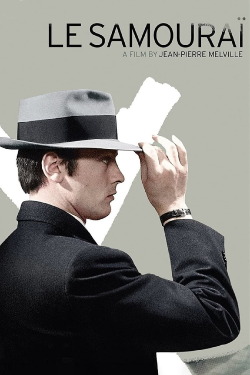
Jean Pierre Melville's film is a homage to the American noir: its stylings and its characters. And it's probably better than most of those films. It's hypnotizing in a way that truly transcends an explanation -everything is just right, every element falls into place harmoniously in every scene: set, lighting, score, cinematography. And I mean as harmoniously as such a dark film can allow. Most importantly, in Le Samourai the quality of the technical aspects and the precision of each montage is on par with the quality of the performances. Alain Delon is larger than life as Jef Costello.
Jef is a hired assassin who lives a life not different from that of a samourai... as Delon said once during an interview, he is a modern-day samourai. He's lonely -although it's unclear whether this is because he chose to shun society, or because he was shunned in account of his strange, reclusive nature-. Maybe he chooses to be alone. It is as though his job is his one motivation. He never expresses feeling. He is self-sufficient. He is helplessly committed to the twisted honor of his profession. Alain Delon's performance is stunning: there is always something behind his cold blue eyes, and we know it's there, but it's perfectly collected and repressed. His countenance never changes, only when it absolutely must, and then the impact of these changes is awe-inspiring. There is an aggressive masculinity to his role, but Delon himself is very feminine. He's an assassin, but he's beautiful. His screen presence is everything. Without that game of isolation and charisma, ugliness and beauty, Le Samourai wouldn't be nearly as remarkable. It's a film driven by one performance. One perfect performance, backed by a script very much in tune -although, at that, extraordinary- with the usual French approach to gangster films: one that goes beyond the plotting and the fedoras, into the minds of the criminals. Tortured men, driven by existential desperation rather than, or in equal measure as, greed.
The rest of the film's success is its styilization. When watching Le Samourai, you breathe mood -mood -mood. The cinematography is wonderful; Paris is seen in washed-out blues, beiges and whites. Every character is dressed and carries itself with flair. Every man blowing out cigarette smoke is perfectly framed, perfectly half-hidden in the dark, all movements perfectly orchestrated. The atmosphere is almost reverential towards the heaviness of the subject, and melancholy in accordance to the main character's self-constructed doom.
The final (and probably the most important) charm of Le Samourai is the character of Jef Costello himself. He has a compromise, based purely on principle, that would be unthinkable in an era in which people flee from committment. He has chosen a revolting line of work that he elevates with the odd dignity with which he performs every little task. He never gives up on solitude. He never bows to anyone. He believes the ethics of his profession are to be taken seriously.
...And he knows that he can't succeed in the modern world by acting that way. Principles, for whatever purpose, are out of date. He knows he's doomed to fail, and so do we, ever since the first shot. So the entire film is really how he walks towards his destiny, understanding that he can't escape it. And everything ends in the most beautiful and sad way possible.
Le Samourai is free for interpretation. Its content is just as ambiguous as it must be in order to stay within its poetic context. I could never stop praising it. Melville found the way to do what I suppose filmmakers all seek: create a film in which images, colors, gestures, decisions, what happens behind the faces of the characters, can convey a message, and tell a story. He doesn't need words, he doesn't make use of explanations. It's breathtaking. I can't recommend it enough.
This review of Le Samouraï (1967) was written by Elvira B on 25 Dec 2009.
Le Samouraï has generally received very positive reviews.
Was this review helpful?