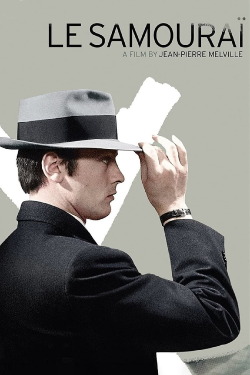
Review of Le Samouraï (1967) by Jesse B — 04 Oct 2008
I love Jean-Pierre Melville. Cited by many critics to have been one of the very first to usher in what we now look back upon and call, "the French [i]New Wave[/i]." Melville's narrative is also what could be seen as the inspiration of American 70's film making.
Today's topic, 1967's [i]Le Samourai[/i] is such a simple story about an assassin for hire who simply does what he is paid to do. Of course throughout the duration of the film, events take place which puts our assassin into jeopardy and further the story, yet does little to help the plot along. This is most likely due to the fact that this film has no real working plot, rather a few well placed McGuffen's which simply act as a means of living with this man's character and the interactions of his seedy under-life.
While watching the film one can instantly draw direct relation to other films which, as does this one, deal with the a lawlessness in both the underworld and the so-called legitimate police force sent to investigate the initial murder of the assassin's target. One such film that seems to be, in many ways, a mood-by-mood, grain-by-grain remake of [i]Le Samourai[/i], is the 1971 William Friedkin directed [i]"The French Connection". [/i]One of the best films of the '70's, [i]"the connection"[/i] is, indeed, French. The only real change is that the lawless man on the run is now played by a police officer instead of an assassin. But in this comparrison we find an interesting dichotomy, in a way. In the late '60's and 1970's, we find in the movie industry and pop culture of the day, a certain moral ambiguity to our heros, as well as our villains. By the time films like [i]"Bonny and Clyde", "The Godfather" [/i]and [i]"The French Connection" [/i]had been released to the public, America had changed dramatically from the sweet, picturesque homelives that had been portraid as the American face for so much of the post-WWII era coming to a screeching halt in the latter half of the '60's. We were angry and confused, as a people. Our heads of states and civil servants who were supposed to be looking out for the good of the people were looking, seemingly, to expanding their own influence and their pocketbooks. The people were "as mad as hell and they weren't going to take it anymore." Open protests and angry demonstrations were only part of the turmoil that ensued in this new world conflict, known to us Americans and the world as Vietnam. We needed an outlet and found it in just about everything. The counterculture, whose form in the '50's took that of a beatnick movement, was now transformed from love-happy hippies, to angry as hell podestrians whith signs lifted high and plenty on their mind. Of course -- going back to the original topic -- the French have always been ahead of us as far as art and film is concerned. So their fury was placed on film a good deal before our own and as everything the french do in film, it comes out as art. So naturally we Americans decided to hop on the band wagon. And while it is not correct to say that we "stole" everything from the French, French inspiration is deffinitely all around us.
This review of Le Samouraï (1967) was written by Jesse B on 04 Oct 2008.
Le Samouraï has generally received very positive reviews.
Was this review helpful?