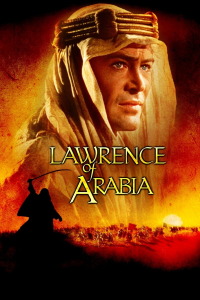
Review of Lawrence of Arabia (1962) by David C — 19 Feb 2014
The people who come to T.E. Lawrence's funeral at the beginning of David Lean's biopic to end all biopics set forth two interpretations of the man that this film grapples with over its almost 4-hour runtime. Some are there to mourn a hero, a man who seemed to embody British hardiness and courage in an age of empire and global war. These true believers had followed his exploits as a leader in the Arab uprising against Ottoman rule, and for them he was an exotic, dashing figure out of Oriental legend, but with blue eyes and blond hair. Others in the crowd at Lawrence's massive public funeral are there not to mourn him, but to mark the passing of a rude, irresponsible braggart. Many present claim to have known him, but the ones who knew him best seem to be the ones who like him least. With this dichotomy of opinion in mind, the film takes us through the key events in Lawrence's campaigns. It does not insist upon a particular interpretation, but neither does it try to remain merely (and impossibly) objective.
The depictions of Lawrence's treks across the desert have a majesty rarely equaled in the annals of cinema. If that sounds like the highest, most unreserved praise, it is supposed to. Lean holds long shots of endless sand and blinding blue skies until they become sublime. Other directors known for their landscapes, like John Ford and Peter Jackson, usually have the advantage of filming soaring mountain ranges or colorful canyons, but Lean and his 3-time Oscar-winning cinematographer Freddie Young take vistas and palettes that are almost minimalist and turn them into visions of raw beauty. The score by Maurice Jarre, also a 3-time Academy Award recipient (all of Jarre's and Young's Oscars were for their collaborations with Lean) does its part and more, bringing a weighty romanticism to each scene and mirroring Lawrence's own unbounded emotionality.
But of course the greatest and most indispensable element of the film is Peter O'Toole's performance as Lawrence. The young actor manages to present both Lawrences, the compelling and the off-putting, as a complete person, with an inner universe of ambition and fear and assuredness and madness that he wears on his sleeve but that still remains tantalizingly unknowable, the way historical figures' essential natures almost always are. O'Toole draws attention to himself seemingly without trying, even while sharing scenes with actors of such skill and presence as Omar Sharif, Alec Guinness, Anthony Quinn, and Claude Raines, to whom are given most of the script's juiciest one-liners.
I used to quibble with the sequence in which which Lawrence is taken captive by a Turkish commander during a nighttime sabotage mission and subjected to an implied threat of sexual abuse. I had always felt that it didn't quite fit; it suggested ideas that did not return for exploration later and that did not seem to have a lasting effect on Lawrence in spite of O'Toole's particularly tormented performance in the scene. I changed my mind about it when I learned, as many fans of the movie probably know well, that it is based closely on Lawrence's own public account of the incident. His private account, uncovered much later in a letter he wrote to a confidant, suggests that more happened than he was willing to admit, and O'Toole's heightened acting in this moment now seems perfectly consistent with the real Lawrence's tone in the letter. I now think that to go further with this scene, or to call it back later, would be to enter the realm of speculation, while to omit it would be to excise one of the most remarkable episodes in Lawrence's own writings.
The real Lawrence was an unreliable but fascinating narrator of his adventures, and the film adaptation of his life is exceptionally effective at creating a well-rounded portrait of the man. By the end, we cannot agree with the people at his funeral who see only the courageous and noble Lawrence. We have seen him at his most unstable, and have learned to question his motives and his sanity. In a moment of obvious but delicious irony, we have even seen him, his identity concealed, earn the enmity of one of the very men who would later speak highly of him. But all the same, we cannot dismiss him as easily as his detractors. His achievements are too spectacular, the life he lived too remarkable and even appealing not to elicit some degree of admiration. As for the movie itself, the degree of admiration warranted is unambiguously very, very high.
This review of Lawrence of Arabia (1962) was written by David C on 19 Feb 2014.
Lawrence of Arabia has generally received very positive reviews.
Was this review helpful?