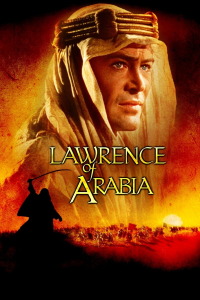
Review of Lawrence of Arabia (1962) by David E — 03 Jan 2011
"Look, sir, we can't just do nothing!" "Why not it's usually best." Utters General Allenby near the finale of the film, neatly formulating the struggle of the fictionalized T.E. Lawrence's dramatic journey. "Lawrence of Arabia" stands as a larger-than-life film not only in its majestic desert landscapes and logistically baffling battle sequences, but in the depths of Lawrence's psyche as well. A man truly not willing to allow destiny to be mandated to him, but will stop at nothing to "write it" himself. Yet the characters that surround Lawrence throughout the film are not shaped by such ambition; he stands as a truly "extraordinary man". But why?
The film's sets the stage with the death of Lawrence (O'Tootle), long after his heroic field days have ended. At his funeral attempts are made to explain the man with little success, much a tune to the news reel footage beginning "Citizen Kane". Was he military hero? A freedom fighter? A poet? Or something more? At this point we may simply be expecting a grandiose summary of heroic deeds and accomplishments, but the ambiguity definitely foreshadows something far more powerful; something far harder to understand. From this vantage point, we can slowly begin to see a masterpiece revealed.
The man Lawrence we begin to know at the start of the film is a man of passion. A deep rooted desire to bring freedom to the Arab tribes over the malicious Turkish rulers. His relentless desire to mend ancient blood feuds and break racial social norms is not simply the desire of Lawrence, but of young men throughout the ages. "With Major Lawrence, mercy is a passion", says Arab price Fiesal (Guinness) of Lawrence. Lawrence's disgust for the "civilized" cities and love for the desert are thus rooted in a romantic sense of youthful principles: "courage and hope for the future". In the desert there is nothing, so here, a new destiny can be shaped unhindered. Thus the Lawrence of the first act is a man of optimism, invulnerability, and possible naivety.
As act two opens we begin to get glimpses of a far different Lawrence. In a powerful shot, Lawrence proudly strides atop a captured train as the Bedouins chant his name. His shadow gliding high above them, white robes flowing in the wind. This is the world he has shaped; not by god, nor money, nor any aid. His ambition and his alone has led him here. And so he becomes blinded. Here begins his egotistically descent into borderline madness. The second act is full of similar scenes as Lawrence loses sight of everyone else in his new literally godlike stature. In another scene, Lawrence gleefully laughs as he pretends to be walking on water. His presumed invincibility does become his downfall though. As traumatizing experiences begin to pile up, Lawrence becomes a different man, the film takes a dramatic turn. Though the change is subtle, O'Toole's acting is superb, every grimace revealing such inner turmoil that cannot be put into words.
The final hour of the film bears a dark contrast to its former, as director David Lean delves into the harsher side of human nature. One not of hope, freedom, and peace, but of mistrust, greed, and corruption. What I also love about the ending is the final dialogue Lawrence has with his trusted ally, Sharif Ali (Sharif). It creates a debatable ambiguity: was Lawrence truly realizing the actual nature of human existence? A sad wisdom only attained by that of hardened old men? Or had his ego been simply been wounded too deeply to have any more hope? Crushed by circumstance? Both seem reasonable.
The ending also rightly summarises the struggle of the Arab people as a whole, even today. A people fractured by Western interference, be it Turks, British, or American, unable to unite by the very forces against them from without and from within. The clash of cultures is evident throughout the movie. As one people's imposed superiority over the other only fosters hatred in the other.
Visually the film is stunning. Masterfully shot in settings that at first glance seem to have no aesthetic quality. But the vast, sublime nature of the desert only add, not detract from a cinematic perspective. Though the desert may fuel Lawrence's original want of adventure, it also has a harsh unmerciful aspects eventually become held in contempt. Much like his final acceptance on life in general. A nihilistic tone ever so different to the destiny-shaping passions of Lawrence to start.
Some films must be understood in context of its era to be appreciated, taking in both its limitations and place in cinema history. "Lawrence of Arabia" is no such film. It stands alone, able to overwhelm and astonish, both then and now.
This review of Lawrence of Arabia (1962) was written by David E on 03 Jan 2011.
Lawrence of Arabia has generally received very positive reviews.
Was this review helpful?