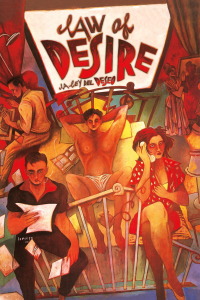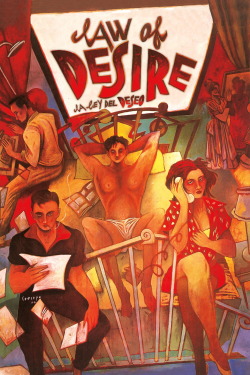
Review of Law of Desire (1987) by Jayden C — 12 Jun 2007
Pedro Almodovar?s Law of Desire is ostensibly a film about gay/lesbian/ transsexual relationships and the conflict derived there from, but upon closer inspection it is actually concerned with relationships in general, and more specifically with desire, obsession, and repetition. Almodovar himself ?repeatedly denies it is a film about homosexuality?: according to him ?it is purely incidental that the main characters are gay? (Smith 165).
The world represented in Law of Desire is one that most of us are probably not familiar with. It is a place where drugs and alcohol are used casually, mostly when people are happiest, and don?t seem to damage or disrupt lives. Tina states she jerked off in the chapel as a child and s/he can return to the seminary ?s/he attended in her/his youth as if it were perfectly natural? (Smith 168). The sexual relationship between a father and daughter/son that broke a family apart is accepted and not dwelt upon. The unconventional family unit is celebrated in a way, but more specifically it is hardly noticeable, as it simply appears to be normal. Almodovar has created a world in which the normal has been inverted and gay/lesbian/transsexual relationships and conflicts are simply relationships between people.
Almodovar uses visual devices as a metaphor for the obsessive or desirous nature of the characters and to heighten emotional significance or tension in a given scene. His close-up of Antonio?s lips illustrates his intense obsession with Pablo; the close-up on the record player, Pablo?s typing to a Spanish beat, and the viewing of Pablo through the typewriter as the camera resides inside the typewriter all represent Pablo?s obsession with creating his life through his work and the desire relegated to media. Almodovar heightens the tension and emotion, while emphasizing the nature of desire, in the scene in which Pablo crashes his car. He ingeniously places the camera inside Pablo?s head as we see into and out of his eyes, which are intercut with spinning wheels (like the spinning nature of his emotions, head, and therefore eyes), and his tears on the actual camera lense looking through the beautifully cracked windshield.
Even Almodovar?s title sequence queues the audience into the fact that the film will be obsessed with desire, repetition, and its representation through an artist, namely Pablo. The red blurry velvety light that emerges when the white crumpled paper title cards are repeatedly discarded represents the tenuous, blinding, and passionate nature of desire as it is inevitably realized at the last instant, just as the title card is destroyed and discarded. This is a visual metaphor for the nature of Pablo?s desire for the men in his life. Pablo is ?condemned to repetition of identical amorous adventures? as he ?can only realize his desire for them when both are dead? (Smith 197). Pablo's tragedy is one of muteness; he cannot articulate or realize his desires until it is too late.
The concept of repetition is emphasized by the interplay between Ada and Tina. Ada seems very innocent, but she is soon exposed to a fake love letter, a sadomasochist comic book, refers to herself as a junky, and wears her confirmation dress on the stage as she visually interludes over the image of Tina tearing her life apart. Ada cries what seem to be real tears as she ?struggles to mime the words of the song once more? in an odd juxtaposition of a young innocent girl?s and a sensuous woman?s voice. Ada is beginning to discover her sexual identity before our eyes and find it is a complex process, just as it was for Tina before her. ?Life and art are fatally confused for both character and (the) audience? within the film as Tina succumbs to what Pablo later calls overacting, because ?real life is just too real for the theatre? (Smith 193).
The layering of play within reality within film and the repetition of this layering and these relationships, further illustrates the law of desire and how it relates to Pablo?s obsessive nature. Pablo ?attempts to speak for the other characters? through his direction of them in his play and in his dictation of letters (Smith 197). Almodovar uses Pablo to critique representation in cinema, theater, and writing and turn them into something obsessed with desire and its pitfalls. Pablo is desirous of something just out of his reach as both his lovers disappear just as the realization that he loves them dawns upon him.
This review of Law of Desire (1987) was written by Jayden C on 12 Jun 2007.
Law of Desire has generally received positive reviews.
Was this review helpful?