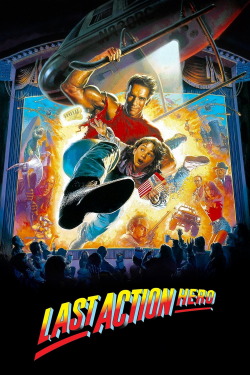
Review of Last Action Hero (1993) by Darik H — 14 Jan 2010
It's a fine line between postmodern self-awareness and shameless self-congratulations; Last Action Hero, the first really serious flop in Arnold Schwarzenegger's career, sometimes straddles this line, but more often than not comes down on the wrong side of it.
It can't quite reconcile the subversive flavor of the script with the traditionalist tendencies of its director and star- which creates the uncomfortable impression in the viewer that the film is undermining and ridiculing its own foundations- nor can it seem to settle on a tone or an audience.
Is it an action movie? A comedy? Is it for kids? Action lovers? Cinema enthusiasts? It's a violent and occasionally dark film, which would seem to imply a more mature audience, and yet one of the main characters is a child, who learns a lesson about the value of escapism and the necessary boundaries between reality and fantasy (in a very after-school special kind of way) that forms the backbone of the entire narrative.
Consequently, the movie alternates between moments of clever genre-bending satire and banal bits of slapstick, gratuitous violence, or juvenilia, making it hard to get a fix on- just when you've heightened your sensibilities for some clever fourth-wall breaking, Arnold mutters a line like "Boy, does this suck weinie, or what?" And with the overt emphasis on the established success of the Jack Slater films, coupled with the ending's "movies are magic" parting message, it's easy to regard Last Action Hero as nothing more than a two-hour puff piece on Schwarzenegger and his films.
Still, I do think that the premise is an intriguing one, and for a genre fan like myself, there's a lot to like in this movie- as long as you're willing to suffer its numerous, glaring faults.
The plot is suitably high-concept- Danny Madigan is a kid from a low-income, single-parent household in New York City, and he's addicted to movies- in particular the remorseless shoot-'em-up Schwarzenegger franchise, Jack Slater.
When Danny gets a chance to screen Slater IV before its release, he jumps at the chance; but when the owner of the theater hands him a magic ticket on movie night, Danny finds himself thrown headlong into the movie itself, where he meets his hero, Jack Slater, in the flesh.
While Danny tries to get his bearings in the movie world- repeatedly failing to prove to the incredulous Slater that they are in a movie- the film's villain, Benedict, learns of Danny's point of origin and steals the ticket, escaping into the real world.
Danny follows him through with Slater in tow, but they soon find that the real world is an unforgiving place for a fictional hero. And while Slater grapples with the implications of discovering that his whole life has been nothing but popular entertainment, Benedict starts making plans to use the ticket again, to much more devastating effect.
Schwarzenegger gets to play a fun part here- a blatant caricature of every maverick cop ever to grace the silver screen, blended with Schwarzenegger's own distinct on-screen persona to create a juggernaut of comically gritty invulnerability.
But since the movie is based in both the real and the cinematic worlds, Scwarzenegger's is a multiple-part: the character, Jack Slater, and the actor, Arnold Scwarzenegger (not to mention a hilarious bit featuring Scwarzenegger's Hamlet: "To be, or not to be? Not to be.
"). Ironically, the Slater character is the more dimensional of the two, as he grows and develops through the story, learning about the real world and trying to overcome the stereotype that the movies have foisted on him against his will (even though he hasn't really changed all that much by the end of the film); Schwarzenegger the actor only arrives in act three as a MacGuffin of sorts, and Arnold pokes fun at himself with his usual good humor as he plays pretty much a caricature of himself, the celebrity.
The funniest moment in the movie, short lived though it is, is when Jack Slater and Arnold Schwarzenegger run into each other at the premier of Slater IV- Scwarzenegger is such a Hollywood shill that Slater can't stand his real-world counterpart.
Unfortunately, neither Slater nor Schwarzenegger is really the main character- that would have to be Danny Manigan, played by the sometimes okay, usually incredibly annoying Austin O'Brien. If I had to point to one, single reason why this movie wasn't a success, I would point to this character (that, or the fact that it was released the week after Jurassic Park).
Action movies have a history of shoehorning in an audience identification character, the guy or girl who informs how you should be reacting to an action scene, usually by overreacting to it; in Danny Madigan's case, he's LITERALLY TELLING YOU HOW YOU SHOULD BE REACTING, pointing out the absurdity of the situations he finds himself in and detailing the cliches the film is supposed to be deconstructing.
With his repeated attempts to prove that they're in a movie, the character spoon-feeds us the satire that the creators didn't think the audience could get on their own- and yes, it sometimes works, but more often than not it feels like an insult to the viewer's intelligence.
As a Scwarzenegger foil, he also feels like a rehash (if not a half-assed plagiarism) of Edward Furlong's John Connor, but without the cynical edge that made Connor interesting in the first place; still, he works as an avatar of real-world preteens, particularly with his addiction to movies and his split-second attention span.
Thankfully more engaging is Charles Dance's villainous Mr. Benedict, another film caricature- the ruthless professional hitman with a British accent and a succession of glass eyes- who grows in the film, too; ironically, while Schwarzenegger's character becomes more grounded when he discovers the real world, Dance's becomes more extreme, slipping from a menacing but underplayed mastermind to an over-the-top madman when he realizes that, in the real world, the bad guys can actually win.
Better still is the other villain, Tom Noonan's twisted axe-murderer the Ripper, who dies at the end of Slater III (which we see at the beginning of the film); through some magic-ticket juggling on the part of Benedict, the Ripper returns at film's end to torment Jack by making him relive the end of III, with Danny as his hostage.
Noonan's face is clathered with make-up, so that he's practically unrecognizable; and though he's only in two or three scenes, he makes a great impression. The film is loaded with cameos and fun little parts, too, including F.
Murray Abraham as special agent John Practice (the subject of a running gag about him being "the guy who killed Mozart" in Amadeus) and, my personal favorite, Sir Ian McKellan as Bengt Ekerot's Death from The Seventh Seal.
The film is directed capably enough by action vet John McTiernan, but I feel that therein lies some of the problem; the whole movie is shot, lit, and paced like an action movie, which makes the visual transition to the movie world little more than a shift from rainy, crowded New York to bright, sunny California.
McTiernan could have emphasized the difference between films and reality better by shooting the real-world sequences in a grittier, less theatrical fashion- not neccessarily documentary-style, but a little looser, with maybe some higher-grain film stock.
These kinds of stylistic changes would be obvious now, but I suppose back in 1993 they would have been unprecedented, so I can't hold it against McTiernan, who still did a great job- not so much during the blatant comedy bits, but particularly during the action sequences, which are heightened even by action-movie standards (the opening sequence is like a love letter to eighties cop movies).
The script, as I mentioned, is clever and subversive, but it has its problems- for instance, the subplot that involves Jack's son and the end of Slater III. Slater is haunted by the memory of his son's death at the hands of the Ripper, but while they have a magic ticket- that Benedict uses to save the Ripper earlier in the film- they don't even give lip-service to the idea of saving Jack's son.
Sure, it would have been the obvious, Hollywood-ending thing to do, but it would also be only logical to save the kid, since they make such a big deal about him being dead and the memory torturing Slater- they could at least claim that, by pulling the Ripper out of Slater III, the boy survived because there was no one there to kill him.
There are other plot holes- things like the idea that if they kill Schwarzenegger, they kill Slater, which makes no sense because the movies already exist and the character's continuity isn't dependent on the actor anymore (maybe if they were SHOOTING Slater IV, this would be logical)- but if you can move past them, the story does kind of suck you in (until the gee-whiz ending has to go and spoil everything).
It's ironic that Last Action Hero was a box-office failure, because in a lot of ways it is the ultimate Schwarzenegger film. The story was a clever one, and the self-referrential humor was well ahead of its time (self-reflexivity being a big hit with critics in the post-Scream era of movies- Wes Craven's New Nightmare was a victim of this, too).
I can't help but feel that the reason the film did so badly was in part because of the negative feedback in pop culture generated by the crass comercialism of the 80's, said commercialism being the crux of Last Action Hero's absurdities (and a vital component in the film itself, unfortunately).
The fact that the film was what it was satirizing- an absurdly overblown action-adventure spectacle- and that its ending, pulling a 180 (har-har), seems not just to condone but to endorse the vapidity of its subject matter, was also a bit of an obstacle to it finding its audience; the kind of people who would have laughed most are the kind of people who wouldn't go to see a movie like this.
But Last Action Hero isn't a complete failure- it's still a fun bit of cinematic farce, informed by a comprehensive knowledge and love of films, action and otherwise. If you can call yourself a film lover, then you can find something to love in this film.
This review of Last Action Hero (1993) was written by Darik H on 14 Jan 2010.
Last Action Hero has generally received mixed reviews.
Was this review helpful?