Review of Larry Crowne (2011) by Shiira — 28 Jul 2011
In "Discounted Dreams", the investigative journalist, on assignment at a west coast community college, in his capacity as a monitor, observes a predominant show of indifference among the gathering students in a remedial math class towards the instructor, who is, judging by his unmodulated voice, equally disengaged, not seeming to care one bit that his lecture on the rudiments of algebra is being received as white noise.
Does it bother him, the auditor wants to know, that the students in the back-row were text-messaging, and worse, sleeping through his lecture on polynomials? Unapologetically, he answers in the negative.
"That's their situation," "their responsibility," claims the untrained abcedary(a transplanted biology teacher), who isn't going to lose any sleep over his 45% passing rate. The burn-out is only there to collect a paycheck.
At East Valley CC, the moviegoer catches Ms.Tainot in the midst of an existential crisis. On the first day of a new semester, resignation gets an early start, as the comparative literature major wonders aloud, "Do I make a difference?" It's a rhetorical question, of course, since the jaded educator knows she doesn't, not in a profession where at this level, half the students fail to graduate, so when Mercy counts only nine bodies in the room, there's no hiding her excitement over the morning class' prospective cancellation.
It's the first time she smiles. Mercedes Tainot is a bad teacher. And unbeknownst to "Larry Crowne", a bad wife, too. Since instructors at two-year campuses don't have a research component to their job description like their PhD colleagues, Mercy, unhindered by split loyalties, is really in no position to call her novelist husband lazy, when all she's expected to do is teach.
The screenplay, co-written by a female, skewers perception by vilifying the blocked writer for his Internet porn addiction, a relatively harmless transgression. Looking at their failed marriage objectively, without the illiberalism of hackneyed feminism, one could adjudge the slightly boozy wife as being unsupportive.
That's fine; that's the film's prerogative to paint men in such broad strokes, but what's sloppy, and sometimes unforgivable about this slight comedy is how little it knows about the inner-workings, and economic fate that befalls community colleges right now.
Foregoing authenticity, Larry Crowne, a victim of downsizing(and class warfare) at a big box store, enrolls in classes without taking the placement exam that is part and parcel for all incoming students.
Even worse, despite all the budget cuts that greatly affect student services and class availability, Larry gets all his first choices, as suggested by a counselor, whom you know is a Hollywood movie counselor, since in real life, most advisers are too busy to approach students in the hallway.
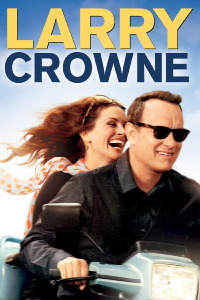
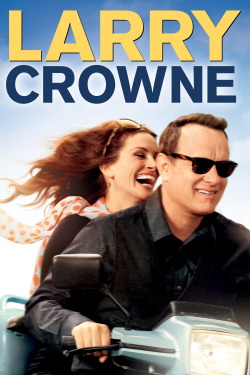
Also, questions like: What is Larry majoring in? or, "Does he want his old job back?" go unanswered. The film can't be bothered with details. Community college serves merely as a backdrop in order for Tom Hanks and Julia Roberts to meet-cute.
Like most students at these schools, the screenplay has no ambition. It settles for being a rom-com. If that's the case, a more interesting variation on the theme would have been to position Mercy as the cougar, but instead, "Larry Crowne" flits around with the oft-used trope of the older man(normally a professor) and young coed, when the pretty(old) woman mistakenly diagnoses the fast friends as a couple.
"Larry Crowne" gets one thing right about community colleges: the racial diversity. As a result, the film employs colorblind casting, assigning the role of the free spirit(the Zooey Deschanel type) to an African-American.
Talia is not stereotypically black; she's not a single mother on welfare, a high school dropout, paying the price for getting pregnant with every minute of her waking hours, especially when she rides the bus at night to her dead-end job across town, a grind so taxing, she can't stay awake to do homework and prepare for upcoming tests.
This hypothetical black girl, however, is no stereotype. This girl is real; her obstacles, a byproduct of inner-city life. As portrayed in the PBS doc, the black girl doesn't pass remedial math and will never be a vet tech.
Talia quits too; she opens up a boutique. "Larry Crowne" puts an optimistic spin on the high dropout rate, suggesting that students move on to become entrepreneurs. As for the boyfriend, by group snapping, the film coyly suggests that he's a former gangbanger by evoking "West Side Story"(the song "Cool"), when the Sharks(Puerto Rican like Dell) and Jets(working-class white like Larry) get set to rumble.
Here, the snapping is used as Larry's initiation into a gang of moped riders. It's not cute, just dishonest. Like the film's notion that the students learned something in Ms. Tainot's class. All she does is sit in the back, nursing her hangover.
This review of Larry Crowne (2011) was written by Shiira on 28 Jul 2011.
Larry Crowne has generally received mixed reviews.
Was this review helpful?