Review of La Vie en Rose (2007) by Filipeneto — 12 Dec 2020
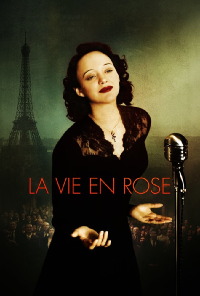
Edith Piaf is certainly one of the most unmistakable voices in 20th century music and one of the most successful and iconic singers in European music. Her life, in fact, deserved a film adaptation, but I think, after what I saw in this film, that it gives us a somewhat bleached and "sanctified" view of that singer. I can understand that the production wanted to avoid controversies or displeasing the artist's fans by revealing ugly or arguable moments in Piaf's life, but I think it would have been bold and interesting to do so.
In fact, Edith Piaf had a life full of dark and painful moments, which the film chooses to ignore or to relativize. She was born in a poor neighbourhood of Paris, in an unstructured family with connexions to North Africa (Edith's grandmother was a Berber): her mother was a coffee singer, her father was an acrobat and their marriage was the worst that it could be, with mutual betrayals and violence. The breakup led Piaf's mother to become a prostitute and leave her daughter with her negligent Berber mother, which led his father to take her to the brothel where her mother works while he himself goes to the First World War. In 1922, he comes back to take her, introducing her to the artistic life and, thus, having a strong influence on her life. It was her father's insistence on marriage that made Piaf walk away after several fights. Another topic that this film surprisingly addresses lightly is the hectic love life of Piaf, who at 17 went to live with her boyfriend and became a mother, fleeing almost immediately due to domestic violence, living in hiding and going to the justice for a custody dispute, which she lost (her daughter died a few years later). Wounded, perhaps more than we can imagine, Piaf never married or had children again, despite her several well-known boyfriends and lovers. Even more impressive is the fact that the film took a "leap" in time between 1938 and 1948, ignoring what the singer might have done during World War II and the German occupation of France. The omission is all the more serious as the fact that she had a dubious activity in this period, along with a brilliant artistic life, for which she was severely criticized by the French, even being accused of treason and of having collaborated with the Nazis. Piaf defended herself by saying that she actually collaborated, but with the French Resistance. Is it true? I honestly don't know and the film chose to leave the subject. But, even if we don't want to go that way, here we have an artist who knew hunger, misery, social degradation, family and domestic violence, the pain of losing a child and having a bad relationship with both parents. A life of tears and shadows that the film took very bad advantage of.
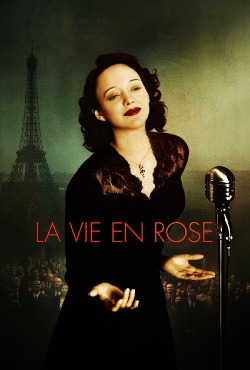
Despite this, we have to admire the extraordinary artistic quality of Marion Cotillard, who was truly able to embody Piaf. The actress is relatively unknown outside the French-speaking world and has made a solid but discreet career. Nevertheless, she was amazing in this film, and she deserved with all justice the Oscar for Best Actress that was given that year by the Academy. The film also features the discreet but effective participation of Gerard Depardieu, Emanuelle Seigner, Clotilde Courau and Pascal Greggory. Despite that, I didn't feel involved. There is something that completely fails in this film, which I think is Olivier Dahan's (director and screenwriter) inability to create an empathy between the main character and the audience. I think he leaned against the shadow of Piaf's institutional solidity and fell asleep, that is, he made the film for the French and for Piaf's fans, and he did not concern about other audiences for whom the singer means little, but who might want to see the film anyway.
Technically, it was a film that did what it needed to do, but without much shine. There is a lack of energy and charisma, which is reflected in a dull cinematography and an excessive duration of two and a half hours, in which the film drags on in an almost unjustifiable way. The sets are excellent, as are the costumes and makeup (the film also won the Oscar for Best Makeup, which means something) that, with their efforts, helped the actress Cotillard to look as much as possible with the real thing singer. The soundtrack, of course, is solidly based on several Piaf songs and accordion themes.
This review of La Vie en Rose (2007) was written by Filipeneto on 12 Dec 2020.
La Vie en Rose has generally received very positive reviews.
Was this review helpful?