Review of La Dolce Vita (1960) by Eric F — 13 Jun 2009
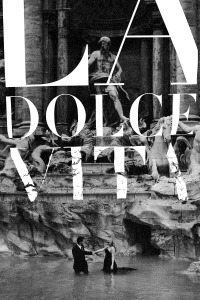
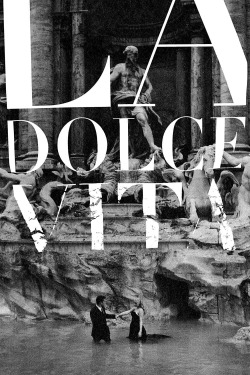
The statue of Christ suspended from a helicopter. A sad clown leading a group of balloons out of a room. A romantic conversation spoken through ventilation shafts. A buxom blonde bathing in the Trevi Fountain of Rome. It's not hard to see why "La Dolce Vita" was Fellini's real break out film, and one of his more famous pieces. Not only is it a splendid cautionary tale about a man incapable of committing to anything at all, but it contains some of the most memorable and fascinating episodes in the history of film.
"La Dolce Vita" follows the exploits of the self-destructive tabloid journalist Marcello Rubini (Marcello Mastroianni), a quasi-celebrity spending long nights amongst the colorful upper class of Rome. He's a gossip writer that strives to write a novel but can't bring himself to commit to such serious work. He's married to Emma (Yvonne Furneaux), every bit as self-loathing as he is, whose latest suicide attempt is an overdose of pills. The other women in his life include Maddalena (Anouk Aimee), a partner-in-crime thrill-seeker; Ninni (Adriana Moneta), a streetwalker who shows him and Maddalena her flooded loft; and Sylvia (Anita Ekberg), a seductive Hollywood starlet visiting Rome. Along the way, he also encounters his father (Annibale Ninchi), a traveling salesman who can't quite keep up with Marcello's nightlife, and Steiner (Alain Cuny), a wealthy intellectual friend he admires, but who warns him about the ugliness of a life of an "organized society where everything is calculated and perfected".
Most movies need to be seen in one sitting. They're so carefully constructed in their form that you can pinpoint the exact moment each act begins and ends. "La Dolce Vita", on the other hand, is purely episodic - a film that, while obviously best as a whole, does not follow a conventional arc, but rather a series of rises and falls. You could make a mini-series out of Rubini, with each episode dealing with an entirely new setting and his expansive set of accomplices.
"La Dolce Vita" is book-ended by a scene of Christ leaving Rome on a helicopter, and one of a prehistoric fish washed up on a beach. This warning signal illustrates the ugliness of the lives of Marcello's type and those that heedlessly worship them. The emptiness of a life without commitment in favor of shameless partying and unrelenting lustful endeavors. In it's final moments, we're told clearly that Rubini, although oblivious in his current state, has also failed to commit to his last chance at redemption. It's a heartbreaking scene, but a beautifully poetic illustration of Rubini's nature and his unavoidable downfall.
This review of La Dolce Vita (1960) was written by Eric F on 13 Jun 2009.
La Dolce Vita has generally received very positive reviews.
Was this review helpful?