Review of L.A. Confidential (1997) by Cameron J — 25 May 2013
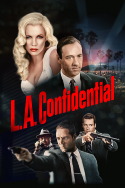
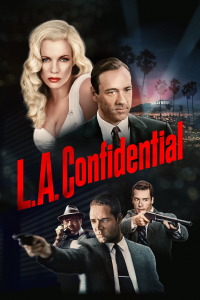
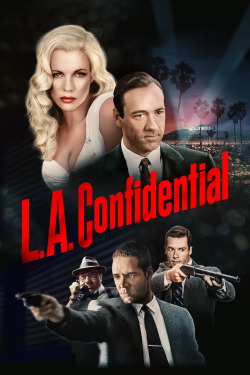
Hey, what happens in Vegas may stay in Vegas, but nothing is confidential in Los Angeles, or at least not domestically, and even then, I think it's safe that the rest of the world has something of an idea how evil Hollyweird, or at least the LAPD is. Man, the LAPD is so corrupt that one its better guys is Kevin Spacey, or at least I think that the Jack Vincennes character, as corrupt as he still is, is one of the better guy on LAPD, because I barely got to know him in this film. No, Vincennes isn't that underused in this film, but the point is that there is at least something confidential about this film, and that is the fact that Spacey isn't the real main lead in this film. Hey, it's not like top billing for a hard-edge, gritty neo-noir was going to go to Danny DeVito, but I emphasize this film's marketing tricks because I personally feel that they should have played up Russell Crowe's presence more, for although he wasn't the star he is now back in 1997, seeing his name first thing would leave me eager to see this film, just to see what Crowe's like as a brutal man of the law. I've heard of throwing the book at lawbreakers, but Crowe might actually huck a book at you, and if he's the kind of guy to keep up themes, it's probably gonna be a phone book, so they either needed to play his presence up more or Kim Basinger's. Granted, Basinger is all over just about every single piece of advertising for this film, even though her presence in this film is kind of uneven, but come on, how can you have possibly gotten enough of Kim Basinger in the '90s? Needless to say, Basinger's looks aren't the only good thing in this awesome little film, and yet, not even Basinger can mute your mind enough for you to ignore the flaws in this film.
In my opener, I joked about Kevin Spacey's not being the main "main" character, like the marketers say, and about Kim Basinger's being unevenly used, even though she's all over marketing ostensibly for the sake of sex appeal, but this film really does have a lot of characters of varying roles to juggle, and does so generally comfortably, yet all too often slips up and presents characters unevenly, to where the momentum of certain sides of the story is postponed for too long for your investment to stay all that firmly secured with every angle of this gritty character drama. Uneven character usage isn't too big of a problem, but it's big enough to throw off momentum, though not quite as much as the inconsistency within story structure pacing that is generally made up for with tight pacing in directorial atmosphere, but often hard to ignore, as it bloats the film with the occasional disengaging meandering, if not fat around the edges. I know it sounds like I'm stretching a bit to detect faults in the telling of this film's story, but that's only because, yeah, I kind of am, because although uneven character usage and pacing issues are problematic, they're not huge issues, or at least not when compared to an aspect that a film this smart should not have. As well-assured as this film is as a noir thriller, subtlety lapses on more than a few occasions, whether it be through such little things as a fall-flat piece of dialogue, or through a bit of atmospheric overbearingness that leaves certain dramatic beats to come off as almost histrionic, perhaps even generically formulaic. Either way, whether it be conventionalism that is emphasized by subtlety issues or simply the subtlety issues themselves, there's something kind of predictable about this film, and such predictability does serious damage to a generally excellent film, or at least reflects this film's merely being popcorn, not so much so that cleverness and artistic competence are rendered incapable of carrying the final product to bonafide excellence, but still limited enough in artistic weight for full potential be thinned out a bit. I wouldn't necessarily say that the film is what it is, seeing as how the film is, on the whole, done so well that it stands out as more than just a simple popcorn case, but there are natural shortcomings to this film of rich, but still somewhat limited weight, and with these limitations going emphasized by mishaps in storytelling, you end up with a final product that was never to be a bonafide masterpiece, and could easily slip out of genuine excellence. Needless to say, compensation for shortcomings, both natural and consequential, is abundant, as the final product is indeed an excellent piece of cinema that proves to be inspired enough to reward deeply as a gritty thriller of a neo-noir, or at least a clever homage to the stylish era in which this film is set.
On top of being an upstanding neo-noir effort by its own right, this film aims to pay homage to both the style of the 1950s, as a whole, and classic police noirs from around the era in which this film's story takes place, and while such an ambition proves questionable at times, - seeing as how the popcorn limiting of subtlety within classic noirs are translated here - on the whole, this film's thematic intentions are nifty and generally thoroughly well-explored, even when it comes to music, for although Jerry Goldsmith's trite score work emphasizes the overbearingness of the subtlety hiccups, this film's soundtrack is still bound to entertain time and again with many a traditional pop or jazz tune that proves to be comfortably effective as both distinguished entertainment and a major component to the selling of this era. The film's soundtrack does a colorful job of capturing the era, while proving to be enjoyable when taken on its own, and such a compliment can also be directed toward the film's production value, as production designer Jeannine Claudia Oppewall and costume designer Ruth Myers nail the look and style of 1950s Los Angeles immersively and handsomely, gracing the environment of most every scene with subtle, if not grand designs that transport you to the distinct era this film pays heartfelt tribute to. I'm not really saying that the film's design is stellar, but it is effective as a tranportive tribute to a stylish era with a lot of distinguished handsomeness that is accentuated by striking photographic tastes. Dante Spinotti's cinematography has dated a bit, and probably didn't make it too far back in '97 before it found its handsomeness forgotten in the awesome wake of something like "Titanic", something that most films of its time could most definitely not look like, so it's not like this film is stunningly well-shot, but it is indeed well-shot, keeping faithful to that distinguished type of noir visual style that plays with lighting in a handsomely gritty fashion that catches your eyes, and sometimes even your nerves. The film accels on a stylistic level, with fine production value, photographic handsomeness and, shoot, for that matter, technical proficiency that is anchored by Peter Honess' clever editing and Andy Nelson's, Anna Behlmer's and Kirk Francis' fine sound design, but if this film is to truly accel as a noir that is at all rewarding, much less excellent, it needs to understand how to work with its substance, which is rich enough in concept. Like I said, this film may be a more artistic popcorn film, but it is a bit of a popcorn film nonetheless, with only so much potential as a drama, though not so little that you can't still see the possibilities for an excellent film, as there is juice to this story as both an intricately layered detective thriller and a meaty character drama. No, the film was never to be mind-blowing, but its concept promises a reasonably upstanding film, and as sure as sunshine, deliverance is made, even when it comes to writing.
Curtis Hanson's and Brian Helgeland's script is by no means spotless, having its share of structure issues, and even the occasional weak moment of dialogue that does the often somewhat messily handled subtlety no favors, but on the whole, the written execution of a worthy story concept is itself worthy, with dialogue that meets every mild misstep with a series of colorfully witty snappers, and intricate plotting that generally does a fine job of both comfortably bonding dramatic depth and noir intensity, and structuring the mystery aspects behind this detective thriller with a tightness that fights back predictability about as much as it can, which is just enough for you to find yourself caught off-guard by more than a few thought-provoking, tension-raising twists and turns. If Hanson and Helgeland do nothing else well, it is characterization, whose full meatiness is shaken a bit by unevenness in character focus, yet still manages to draw enough juice out of this film's hefty character roster to define the characters as well-rounded, distinguished and memorable, as well as not just compelling because they're so well-portrayed. Of course, no matter how well Hanson and Helgeland do with the selling of the characters, there's no forgetting the forces who quite literally bring the characters to life, as most every member of this dynamic ensemble cast turns in a performance that is, to one extent or another, memorable, with the particularly unevenly used Danny DeVito often stealing some of your attention with a trademark charisma that is more or less outshined by the charisma of Kevin Spacey, whose humanly well-balanced portrayal of a corrupt celebrity of a cop who finds himself reflecting with regret on his forgetting why he became a man of justice in the first place is quite engaging, much like the performance of the beautiful Kim Basinger, who convinces as a seductively mysterious woman who wants recognition and respect through all of the lowdown deeds she much do to get by. The film boasts a pretty big supporting cast, and each member of it who is played up delivers, though not quite as much as our leads, with Guy Pearce proving to be charismatically and almost immersively convincing in his subtly layered portrayal of an intellectual detective whose having to do brutal things that contradict his codes and expectations will give him dark insight into his peers' and his own shakable humanity, while Russell Crowe really steals the show, delivering on both an utterly flawless American accent, and a subtly powerful presence that defines the depths of the Officer Wendell "Bud" White characters so immersively that Crowe all but becomes the committed justice seeker with a mysterious and dark past, and other demons that will leave him to gradually grow more unpredictable and dangerous as he begins to unravel a system he respected. A then-barely recognized Crowe's performance was revelatory at the time, and is outstanding by its own right, and Pearce's performance isn't too shabby either, so it's safe to say that this film is, at the very least, well-acted, and considering that we're dealing with a character drama, that gets things going a long way. Still, this film's strong acting isn't enough to secure the final product's excellence, so what truly does about as much as anything in defining the film's standing out as much more than a popcorn flick is, of course, the efforts of Curtis Hanson as director, for although Hanson's overambition mess with the balance of the final product, slick plays with atmosphere tighten up storytelling clip with brisk color that entertains more often than not, while many jolt to atmospheric weight that is, in fact, genuine, rather than unsubtly overbearing, grips and thrills, immersing you in the flow of this layered thriller and giving you a feel for the dynamicity of this richly intriguing noir. Certain areas throughout the film are stronger than others, but in bursts, rather than spades, the compelling kick of this film grows stronger and stronger as things progress, and while the final product comes close to falling just short of excellence, when you go the way of this film's leads by stepping back and investigating this case, you'll find that there is much more tightness than focal and pacing issues, much more inspiration than overambition, much more juice than natural shortcomings, and an effort that succeeds with flying colors as a gripping popcorn noir with engrossing artistic integrity.
To close this case, a little bit of uneven character focus and a fair bit of uneven plot structure pacing slow down momentum, while some issues in subtlety reflect natural shortcomings in story concept that all but drive the film just short of excellence, but don't drive hard enough, as the colorful soundtrack, excellent production designs and handsome cinematography tastefully sell you on attractively clever style, while a smart script, a fine collection of skilled onscreen performances, - the strongest of which arguably being by leads Guy Pearce and Russell Crowe - and an inspired offscreen performance by Curtis Hanson, as director, define the richly layered depth of juicy substance enough to immerse those willing to run with this ambitious effort, and make "L.A. Confidential" a thoroughly entertaining and intriguing neo-noir that cuts through shortcomings with enough will and competence to stand as not simply strong, but truly excellent.
3.5/5 - Excellent.
This review of L.A. Confidential (1997) was written by Cameron J on 25 May 2013.
L.A. Confidential has generally received very positive reviews.
Was this review helpful?