Review of Kundun (1997) by Aichatou H — 06 Oct 2016
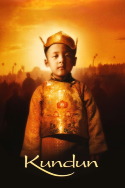
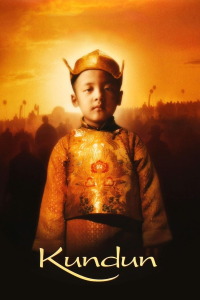
The movie, Kundun, starts out in a small village in Tibet. Here lives a Buddhist family with three children that are going about their daily life with a very demanding toddler. They get visitors that are Buddhist monks traveling and looking for a particular child. One of the monks notices how the youngest son of the family reacts when he sees the beads he is wearing. When given the test for the Dalia Lama, he chose all the correct items and is seen as the 14th Dalia Lama. The boy is taken to live with the monks so he can be trained to lead the people of Tibet. He grows up there with the monks while China increases pressure for Tibet to become part of China. One day, China decides to invade Tibet and enforce their rule over the people. The Dalia Lama has no choice but to flee Tibet, heading to India, on a very dangerous trip. He is exiled from Tibet to this day in fear that if he returns to Tibet he will killed. I think that the movie moved a little slow, though that could also be in part to the Buddhist belief in peace and calmness. Though it was slow to progress, it gave a good look at the life of the 14Th Dalia Lama and his struggle to keep the indemnity of Tibet. There were some interesting scenes, such as the sand mandala creation, the ritual ceremony in which Kundun's father was hacked into pieces and fed to vultures, and the point when the man who found the Dalia Lama was found dead in his jail cell.
This movie reveals many of the key concepts of Buddhism. They make mention of the Four Noble Truths, the Buddhist belief that nothing is permanent, and the fact that in Buddhism, nobody is above being taught. Even though Kundun was seen as a spirit, he was still raised and taught by teachers. He wasn't all-knowing. Also, a ritual in the Buddhist religion that has particularly interested me this semester is that of sand mandalas. In Kundun, a giant sand mandala was constructed. When Kundun's father was chopped up, it was done as a sky burial, a common ritual. The movie relates to how the world religions are seen as holding progress of the world back. The Chinese leader thought that Buddhism was a plague on the people of Tibet and needed to be removed from the government of the country. The people of the world have become more intelligent and think that religion is outdated with no place in a modern society. As we become more advanced we have lost focus on the importance of the teachings that all religions have passed down through the generations. We now put our faith and trust in finding our own answers to the problems we face. The Chinese in the film were only concerned with expanding the empire and becoming the dominant country in the region. The Chinese leader felt that Buddhism was in the way of his conquest for power and the communist rule that he inspired.
This review of Kundun (1997) was written by Aichatou H on 06 Oct 2016.
Kundun has generally received positive reviews.
Was this review helpful?