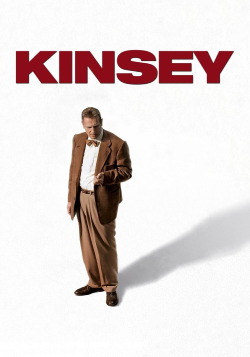
Review of Kinsey (2004) by Paul Z — 07 Oct 2009
When Dr. Alfred Kinsey's initial research of human sexual behavior was published in 1947, it was just about entirely conceded that masturbation would make you go blind or insane, that homosexuality was an acutely sporadic aberration, that most sex was within marriage and most married couples confined themselves to the missionary position. Kinsey interviewed thousands of Americans over a course of years, and gathered: Nearly everybody masturbates, 37% of men have had upwards of one homosexual experience, there is an exuberance of premarital and extramarital sex, and the approach of various couples brave well outside the accustomed male-superior position. Bill Condon's film is an integrally important study of Kinsey's views, idealism and where from which they grew. It begins by showing his material delicacy, such as his early entomological days.
It is absurd that Kinsey's detractors assert to this day that he brought about this behavior by his report, when in truth all he did was ascertain that these aspects were already facts of existence. There's dissension concerning his case history, his procedure and his statistics, but continuous academic work has corroborated his essential deducements. The decriminalization of homosexuality was a straightaway consequence of Kinsey's work (although there are still nine states where oral sex is against the law, even within a heterosexual marriage, which means if you're a gay couple caught doing it you can be doubly charged). Indeed, this film is the most accessible and fulfilling film about sex I might've ever seen.
Kinsey slept rarely, drove himself too hard and estranged associates. And having found that people are seldom solely straight or gay and stand somewhere between zero and six on his now famous scale, he found himself somewhere around three or four. The film's director, Bill Condon, who is gay, observes Kinsey's bisexuality with the sort of impartiality that Kinsey would have appreciated. "Everybody's sin is nobody's sin," Kinsey says. "And everybody's crime is nobody's crime at all." This very open and honest film, like Kinsey, is more concerned with what people do than why. Peter Sarsgaard, Timothy Hutton and Chris O'Donnell support the cast as young men who assist Kinsey in his work, are influenced by him, but might be too young and preoccupied with the mores of the times not to be confused, or even sometimes outraged. There is a chilling scene, skillfully constructed to sneak up on us, in which William Sadler plays an interview subject: What does one think in that time and place, hearing someone say that? How does one remain objective? Liam Neeson plays the title character as an eternal student, defined by his openness to experience and reverence for ancient learning. He shares the screen with Laura Linney, whose emotional moments are very real and complement Kinsey's seeming emotional immaturity. The film is actually quite an emotional experience, deep feelings and suffering revolving around the calm center of the storm that is the title character, who when all is said and done simply observes, "I have never seen a discontented tree." Lynn Redgrave moves me to weeping tears in her scene as an interview subject late in the movie. As Kinsey's down-home bible-belt parents, John Lithgow and Veronica Cartwright strike a heart-wrenching rapport, Cartwright the quiet, simplistically functional hausfrau and Lithgow the fire-and-brimstone chauvinist whose narrow mind prevents him from having any authentic connection to anyone; we can sense that Cartwright does see this, that her mind is not so narrow, but that it is no use in Lithgow's archaic house to voice it.
The fortitude of Condon's important and moving sexologic biopic is ultimately in the definition it brings to its title character. It is compelling to confront a total nonconformist, a person of brilliance and exorbitance. Intuitively paced and strongly casted, the movie seizes upon its times, and a political and moral mood of fear and repression. It is enlightening to note that as lately as 1959, the University of Illinois fired a professor for presuming to convey, in a letter to the student paper, that students assent to sleeping with each other before agreeing to get married. Now universities commonly provide consultation on safe sex and contraception. Naturally, there is opposition, now as then, but the contrast is that Kinsey redefined what is defined as normal sexual behavior.
This review of Kinsey (2004) was written by Paul Z on 07 Oct 2009.
Kinsey has generally received positive reviews.
Was this review helpful?