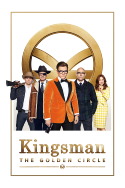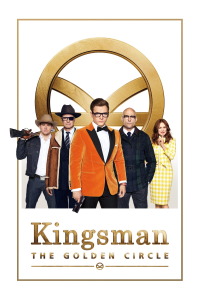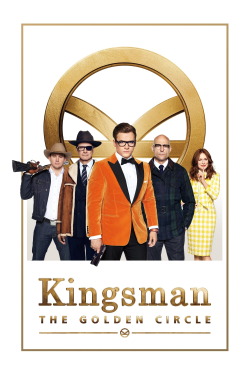
Review of Kingsman: The Golden Circle (2017) by K Nife C — 02 Dec 2017
As some of you may know, David Bowie passed away last year. Luc Besson decided to use Bowie's first major hit "Space Oddity" for the opening sequence of Valerian and the City of a Thousand Planets. It seemed a bit exploitative, maybe too on the nose, but it was at the very least topical since it was a montage of astronauts in space stations. In a similar fashion, Kingsman: The Golden Circle opens with "Let's Go Crazy" by the recently deceased Prince. Except, in this case, it's a song that has absolutely nothing to do with a poorly rendered CG fight between Taron Egerton and a man with a mechanical arm amidst a London car chase sans the fact that one might actually become mentally ill from watching this puerile turd.
Years ago, Kingsman: The Secret Service had been recommended to me from multiple sources. I've watched James Bond films since I was a very young child and am well aware of the spy-thriller genre. After seeing director Matthew Vaughn's first installment, I honestly didn't remember much about it besides a lisping Sam Jackson and a bunch of cheeky Bond references and tropes. It was an innocuous enough spy film that I suppose American audiences thought was a comedy because everyone talks in a funny accent or voice. I was nonplussed, but little did I know it was a setup for one of the worst movies of 2017.
The problem with the film doesn't lie in the action set pieces. If they weren't there the movie wouldn't exist, seeing as how there are no real characters. The "protagonist" is played by Egerton, another unit in the Josh Hutcherson/Jack Gleason line of Hollywood clones. He plays a chav who does chav thing, like curse and abuse women, then he dresses up like a big boy to be a spy. A classless baby man in a tuxedo is a great representation of the Kingsmen series thus far. It only vaguely resembles what it's imitating, and that imitation is only a thin veneer over what is essentially a juvenile power fantasy. It's not cheeky; it's just glib. As for the return of Colin Firth's character, many people remarked that this takes away all of the stakes if people are coming back from the dead. I say it's irrelevant considering all of them are nearly indistinguishable except by accent. They are only there in service to getting from one action sequence to the next, yet they're completely disposable as individuals. As evidenced by the sudden killing off of most of the first movie's supporting cast at the beginning, lose one generic character and another unremarkable stand-in spouting obscenities will spring up in their place.
Speaking of pop singers who are on the wrong side of the grave, Elton John grates on the nerves in an unnecessarily over-extended cameo that's somehow invaluable to the plot. Then there's Julianne Moore who should just fire her agent. In the past few years I've seen her in way more shitty films and roles than I've ever seen her in good. You can almost tell that the paycheck wasn't worth it from her performance, noticeably phoning in her ironically sweet yet evil villain. Last, but not least, it's Channing Tatum, again, with a hick accent, again, and someone sings a John Denver song, again. Which came out first, this or Logan Lucky?
I could get past all of this if it were all in good fun, but there are so many problems with the politics behind the film that The Golden Circle has made it on to my worst of the year list. It's really no surprise that a TV with Fox News pops up so often throughout the film. Obviously, there is the blatant misogyny that one would think would be handled ironically in a genre send-up like this, but it's so aberrant, so deliberate, so stylized, what's more so essential to various plot points that it's not funny and really off-putting. I won't really go into that as it's so ubiquitous, but what are truly the most egregious aspects of the film are the central conflict and its crass political subtext.
Moore's villainess controls the world's largest drug cartel and has laced every recreational drug with a toxin that eventually kills its users. She will release the antidote if her demands are met, primary of which is the stipulation that the United States has to end its War on Drugs. The President decides he wants to call her bluff, effectively killing all drug users and the drug trade. Both in this fictional world and in reality, this makes absolutely no sense. If Moore's demand is or isn't met in this hypothetical situation, she would be out of a job. At best, her formerly illegal drug empire would be taxed and federally regulated if she chose not to dissolve it. And, if everyone died, there wouldn't be any drug users left, and she'd be out of a job. And if she's doing it as a roundabout method of benefiting mankind, it flies in the face of every psychopathic thing she's done up to that point, not the least of which was poisoning hundreds of millions of people and feeding someone a burger made out of human meat.
Even in this fantastical version of America where the president is a reactionary dolt devoid of empathy for his constituents, that many people dying would wreck the economy and cripple the power of the federal government. I'm not going to give this movie the excuse that "it's all in good fun" or "it's just being irreverent". Director Matthew Vaughn brought up the War on Drugs but failed to account for a great many things in this scenario, and this is at the heart of my grievances with the film. America thrives off of the War on Drugs because our drug policies help maintain a high prison population. We have the highest per capita incarceration in the civilized world. The prison-industrial complex provides what is essentially a slave labor force. Those incarcerated are contracted for hard labor and cheap production, getting paid pennies per hour for doing so. If the War on Drugs came to an end, for-profit prisons, defense contractors, and many politicians would take a huge hit. In any case, this is not feasible.
When the average Joe is watching a film, they may be unaware of the context for movies like this, or they may not process it because film watching is a mostly passive act. Movies inform and shape our perceptions of the world, and the act of being entranced by what's happening onscreen opens us up to societal programming. It is a subtle, pervasive process that we take for granted on a day to day basis but that affects us on a subconscious level. This isn't pseudoscience. Just take a look at Nazi Germany, modern day North Korea, or any Transformers film. So when a hateful president and a murderous criminal both actively work in a movie to end the War on Drugs, all of that context about the prison-industrial complex and societal programming doesn't really trigger. Average Joe now has a subconscious aversion to and skepticism of there being an end to our current drug policy because these ridiculous, awful people want it to happen.
"C'mon, Steve," you say, "Aren't you overreacting a tad? After all, it's just a movie." Considering the film has garnered 400 million dollars so far and has been seen by millions of people - millions of impressionable, reactionary (and many uneducated) people - I don't think I'm overreacting at all by placing the movie in this context. Matthew Vaughn has no imperative to make a good, or thoughtful, or socially responsible film, but I earnestly wonder: what is the point of making art, especially mass-disseminated art, if it doesn't enrich our lives in some way? Kingsmen: The Golden Circle may bill itself as a love-letter to the good ol' days of action cinema, but it is an irresponsible, abhorrent throwback that disguises its awfulness with superficial fancy. And just like the use of that Prince song, the only sincerity felt from it is one of deeply cynical exploitation.
This review of Kingsman: The Golden Circle (2017) was written by K Nife C on 02 Dec 2017.
Kingsman: The Golden Circle has generally received positive reviews.
Was this review helpful?