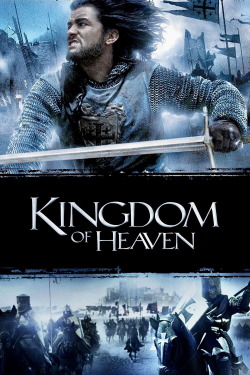
Review of Kingdom of Heaven (2005) by Filmclub — 27 Mar 2016
“Kingdom of Heaven” navigates through the minefield of the Crusades and, by extension, the contentious background of Christian-Muslim relations in ways both shrewd and calculated. Genuinely spectacular and historically quite respectable, Ridley Scott’s latest epic is at its strongest in conveying the savagery spawned by fanaticism, as well as in creating a convincing view of a late 12th century when East and West co-existed, then came to blows for neither the first nor last time. Dramatically, however, there is a vaguely programmatic feel to the drastic upward mobility of a simple French blacksmith to the ruling echelon of the Latin Kingdom.
The notion of basing a $140 million Hollywood production on the most calamitous episode in the joint history of the world’s most dominant religions — and at a time like this, no less — would run the gamut from unlikely to sheerest folly in the minds of cautious industry execs.
But Scott and screenwriter William Monahan have craftily solved most of the thorny problems by beginning their tale toward the end of the nearly century-long truce that followed the Crusaders’ bloody conquest of Jerusalem in 1099; correctly pinning the lion’s share of the blame for reigniting hostilities on a couple of rash Christian belligerents; making the Muslims look good in comparison by more thoroughly detailing Frankish deviltry and, perhaps most importantly, bestowing the most sympathetic characters with an anachronistic post-French Enlightenment humanistic attitude that, while not denying God, at least suggests a desire on their part to take an extended vacation from doing His fighting.
In this respect, pic may irritate traditionalist Christians more than it will Muslims, who can delight not only in the ending, but in the hugely noble, if one-dimensional, portrait of the legendary warrior Saladin, strikingly impersonated by Syrian actor Ghassan Massoud.
But once all the intricate historical needle-threading is said and done, it’s the story that counts. First-time scribe Monahan has done quite an adroit job merging fact with fiction, shifting and adjusting certain elements to streamline and augment the drama but never betraying the subject matter in a way that remotely recalls the Hollywood approach epitomized by Cecil B. DeMille’s laughably inauthentic 1935 epic “The Crusades.”.
There really was a Balian who led the doomed defense of Jerusalem in 1187, but he was not the ordinary bloke vaulted to lofty rank played here by Orlando Bloom. Brooding over his wife’s suicide after the death of their son, this Balian is shaken from sullenness by the arrival in rural France of imposing knight Godfrey of Ibelin (Liam Neeson), who informs the youth he’s his father and beckons him eastward.
Ruled by a wise Christian king, frail leper Baldwin IV (beautifully voiced by Edward Norton from behind a sculpted silver mask), the domain is further dominated by Baldwin’s comely sister, Princess Sibylla (Eva Green); her snaky husband Guy de Lusignan (Marton Csokas), and the latter’s warmongering cohort, Reynald of Chatillon (Brendan Gleeson).
Balian finds more natural allies in Tiberias (Jeremy Irons), a peace-minded and pragmatic military expert, and the Hospitaler (David Thewlis), a court counselor who has also seen enough fighting for one lifetime.
With all these colorful and intriguing characters circling around, the one in the center, Balian, looks bland by comparison. He seems uncomfortably like a reactor instead of an instigator, a consciously concocted Everyman designed for audience identification who has greatness thrust upon him.
Narrative contains significant gaps, notably in the romance, Balian’s adoption of his new home and especially in his rapid assimilation of military savvy. (Indeed, Scott is on record as saying his definitive cut of the film runs 220 minutes, a version he claims will be released on DVD.) Suddenly, after Reynald has outrageously provoked Saladin by attacking a Saracen caravan for no reason, it is Balian who warns in vain against Reynald and Guy’s ludicrous decision to take on Saladin’s army at the broiling Horns of Hattin, a miscalculation that made Jerusalem’s fall inevitable.
Scott is content with one-dimensional villains, and Gleeson and Csokas indulge him with bluster, glares and dismissive put-downs that are both delicious and far too easy.
With CGI work improving all the time, the mix of live and computerized elements creates numerous extraordinary canvases of virtually seamless quality. Harry Gregson-Williams’ score emphasizes the uniformly solemn tone of the proceedings while mixing in such diverse sounds as traditional and liturgical songs, Arabic and world music and, most surprisingly, bits from “The Crow,” “Blade II” and a piece by Jerry Goldsmith called “Valhalla.
This review of Kingdom of Heaven (2005) was written by Filmclub on 27 Mar 2016.
Kingdom of Heaven has generally received positive reviews.
Was this review helpful?