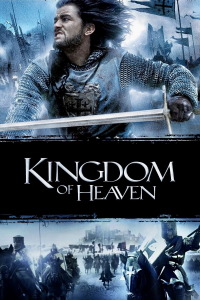
Review of Kingdom of Heaven (2005) by Cameron J — 29 Dec 2012
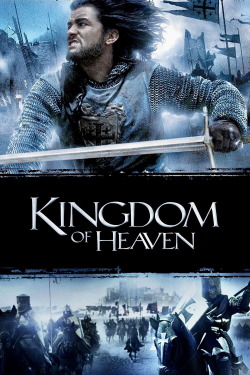
"Oh, it makes me wonder; and she's buying a kingdom of Heaven". Jeez, a stairway to Heaven sounds pricy enough, but we're talking about a whole kingdom, so if the chick Robert Plant is singing about is expecting to get what she came for, she's not going to need a word, she's going to need to do some negotiating that lasts about as long as this film's director's cut, which is, like, three days or something. Seriously though, I can think of a few people who would say that three hours of price negotiations couldn't be any more bland than this film, or at least this film's theatrical cut, and to those people, I say that, well, yeah, this film kind of is bland in some parts, being that it's a Ridley Scott film and all. Still, on the whole, this film is quite good, being yet another reasonably rewarding Ridley Scott portrait on how messed up the Middle East is. Scott presented war in "Black Hawk Down" and went on to present terrorism in "Body of Lies", and now, he's reminding us that, even in the 12th century, the Middle East just couldn't catch a break, or at least I don't think that it couldn't, because as fictionalized as this film is, I don't know what to believe anymore. So yeah, at this point, I think that it's safe to say that we shouldn't look to Ridley Scott for historical accuracy, as sure as we shouldn't look at him for directorial performances that meet a film's full potential. Don't get me wrong, as I said, this film is a good one, and yet, the crusade that is this film isn't always all that smooth.
If I can be completely honest, I only know this film's director's cut, which restores almost an hour of a material, and, according to the critics, with it, more evenness, depth and overall comfort in flow, which I reckon just goes to show you how there's not editing out mistakes as glaring as those usually made by Ridley Scott, because although this film's director's cut and, possibly, theatrical cut are strong, there is no version of this film that is less than messy, particularly when it comes to pacing. This film's subject matter is sweeping and, in concept, commands a sprawling length, so I can see how the mere not even two-and-a-half-hour theatrical cut gets sloppy something fierce, partially because I find that the well over three-hour-long director's cut can't even escape unevenness in pacing, which often slows down, sometimes near-significantly, with a somewhat dully dry atmosphere and bland bloating with excess material, if not all-out total nothingness, before quickly shifting into an awkward hurrying that leaves plotting to trot along heavy-handedly and call more to attention a certain even more problematic form of unevenness: that of a structural nature. What does quite a bit in making this film a rewarding one, in spite of directorial shortcomings, is William Monahan's script, which isn't exactly flawless, but is still certainly stronger than Ridley Scott's storytelling, though not so much so that the value of the worthy structuring within Monahan's script isn't somewhat obscured by Scott's undercutting directorial execution, which all too often leaves the sweeping diversity within Monahan's story structuring to come off as iconsistencies that throw off momentum and awkwardly shift focus, leaving behind certain characters and subplots - including key ones - to slowly but surely drift from your memory and investment, if not simply make a forced exit that leaves loose ends, thus creating considerable and consistent focal unevenness that, of course, results in convolution and investment dilution. Needless to say, this investment dilution goes further intensified by at least one aspect that is consistent over most every key character and plot area: exposition issues, because although flesh-out is on paper and in performances enough to get you adequately associated with key components to this well-concieved story, Scott, even in the reportedly significantly more expository director's cut, fails to flesh out his characters as firmly as he should, often unsubtly forcing motivations upon them. The result of Scott's characterization issues is, of course, emotional distance, which isn't too significant, but just considerable enough to often bland up atmosphere as disengaging and unable to fully capture the weight that it's substance should have, yet doesn't quite recieve as much as it should, not necessarily because of scripting issues, but your usual lack of subtlety and delicacy within Scott's direction. I appreciate Ridley Scott's ambitions and contributions as a filmmaker, and recognize his techical proficiency and undeniably strong tastes in productions that are, outside of storytelling, so well-composed that they often drown out their shortcomings and ultimately stand as, if nothing else, quite good, but really, if you ask me, Scott is a mediocre storyteller if there ever was one, being not necessarily bad, but so underwhelming that he squanders the full potential of many of his ambitious efforts, no matter how promising or otherwise well-structured, such as this film, which goes plagued to nearly no end by Scott's uneven and often, as usual, blandly distanced storytelling, until the final product ultimately comes out short of potential. However, with that said, the final product also comes out short of total underwhelmingness, having many a blanding storytelling problem that does injustice to the film's full potential, though not to where the final product doesn't emerge as ultimately rewarding, thanks to such strong aspects outside of directorial storytelling as, of course, visual style.
Ridley Scott's directorial handling of substance is all too often problematic, yet if there's nothing else that's consistently, not just commendable, but remarkable about Scott's directorial tastes, then it is style, which has been present and strong in nearly every Ridley Scott film, including this one, whose sweeping scope goes captured slickly by cinematographer John Mathieson's fine sense of grand scale, while both areas of raw grit and areas of crisp radiance within environment go lushly brought to life by Mathieson's distinctly well-defined attention to detail in coloring and lighting, thus making for a film that is rich with dynamic and stunning visuals in most every scene, and a broad scope that captures epic sweep grippingly. At the very least, the film is an exceptional stylistic piece that rarely, if ever abates at delivering handsome artistic value, matched only by upstanding production value, as Arthur Max returns as Ridley Scott's production designer almost, if not decidedly at his best, joining costume designer Janty Yates in delivering on dazzlingly lavish designs that don't simply help in defining the era and environment of this film's world, and the people who populate it, but prove to be attractively intricate, dynamic and, in their own certain way, stylish, supplementing this film's blockbuster status, though not quite as much as the action sequences that also go supplemented by the grand production designs. True, Scott gets a bit carried away with this film's action, as he almost always does, having Dody Dorn edit certain close combat sequences frenetically, while incorporating more than a few gratuitously considerable extremes to violence, but on the whole, Scott delivers on thrillingly dynamic and generally well-staged action set pieces, both tensely tightly minimalist and sometimes near-awe-inspiringly sweeping, complimented by such upstanding technical aspects as the aforementioned slick photography and exceptional production designs, as well as thumpingly immersive sound design and cleverly seamless visual effect supplementation, thus making for a blockbuster that lives up to, if nothing else, its promises of grand action. What the film lacks in substance it all but makes up for in undeniable technical proficiency that livens up an uneven film with consistent assurance, much like the soundtrack, which, I must say, is truly excellent, with library music that is unique, colorful, dynamic, yet cleverly consistent in theme, and altogether quite well-selected, and original score work that is very well composed by Harry Gregson-Williams and very well performed by Gavyn Wright and the London Session Orchestra, having a distinct yet richly diverse style that boasts sweep and depth, when not simply a graceful color, thus making for fine musicality that breathes quite a bit of life into what effective atmosphere there is in this film. Still, while this film's artistry carries the final product quite a ways, a good production and good tunes can only do so much to drive a film to a rewarding sate, thus it rests in the hands of substance to ensure this film's success as, at the very least, genuinely good, and on that level, Ridley Scott makes too many hiccups as directorial storyteller for this film to meet full potential, yet cannot fully overshadow the value within what is done right in this film, even in concept, as this legendary historical tale is an intriguing one that is rich with dramatic possibilities that go generally quite well-explored, certainly not by Scott, but by screenwriter William Monahan, whose intentional fictious touches prove to be reasonably organic, supplementing pre-existing intriguing mythology with Monahan's own intriguing mythology, and going into crafting an interesting story concept that, in execution, goes colored up by dialogue that ranges from decent to surprisingly rather memorably strong, and brought to life by story structuring that is improvable, yet generally firm and meaty, even with the considerable undercutting messiness within Ridley Scott's storytelling execution of Monahan's, at least in the director's cut, clearly worthy script, which stands behind a better, perhaps even exceptional film that Scott betrays with his problematic storytelling abilities, though not so much so that you can't appreciate the worthy efforts of Monahan, or the worthy efforts of Scott's performers. Leading man Orlando Bloom has been recieving quite a bit of heat, being deemed a charismaless lead by many, and really, while I won't go so far as to call Bloom a bore, he doesn't have too much to do as Balian of Ibelin, nor does he have a whole lot of charisma, yet he has just enough charm to get you by and finds occasions in which he truly does convince as a strong lead when he most needs to be, while the acting department in the rest of the film goes kept alive by consistently charismatic supporters, none of whom have a whole lot to do, yet make up for that with engagement value that fleshes out characters more than Scott does, with certain standouts including the lovely Eva Green, who makes her reportedly broadened role in the director's cut count with believability as a humanly flawed royal, and even with the occasional piece of effective emotional range, while Edward Norton, well, steals the show, firmly reminding us both of a truly masterful actor's mark's being the ability to not simply pretend to be someone else, but to truly become someone else, and of his being one of the greatest actors alive, having only so much material to work with and only so much screentime, but making every second count by truly becoming King Baldwin IV of Jerusalem, effortlessly cutting through such superficial obscurities of his presence as a mask and an accent over his usually distinct voice, and capturing the pure essence of Baldwin IV, complete with a presence of royal power and nobility, broken up by human vulnerability that goes into crafting a layered, mysterious force who compels every time he steps into the scene as the final product of Norton's engrossingly effortless transformation. I truly wish I could say that this film is, as a whole, as compelling as something like Norton's all too brief performance, yet what is done right in the final product is all but impossible to ignore, for although this film stands to be more (Ha-ha, I rhymed), it's style and valuable concepts get it by as a mediocrely-directed, yet miraculously nevertheless rewarding epic.
To conclude this crusade, Ridley Scott, as storyteller, squanders much of this film's vast potential, as always, keeping pacing often rather blandly uneven, and presenting much of the story structure's dynamicity as inconsistencies that convolute the film's focus and call more to attention a lack of exposition that goes into creating something of an emotional distance that could have ruined this film as underwhelming, but doesn't, because as flawed as Scott's storytelling is, John Mathieson delivers on stunning cinematography, matched by Janty Yates's lavish costume design and Arthur Max's stellar production designs, all of which go into livening up thrilling action, which in turn, alongside fine library music selections and Harry Gregson-Williams' fabulous score work, livens up a strong story concept, brought to life by a generally strong script by William Monahan and a charismatic cast, - from which Edward Norton briefly stands out - thus leaving "Kingdom of Heaven" to stand as a considerably flawed should-be borderline masterpiece that is still, outside of directorial storytelling, well-composed enough to entertain, compel and ultimately reward as a fictionalized study on the 12th century Crusades.
3/5 - Good.
This review of Kingdom of Heaven (2005) was written by Cameron J on 29 Dec 2012.
Kingdom of Heaven has generally received positive reviews.
Was this review helpful?