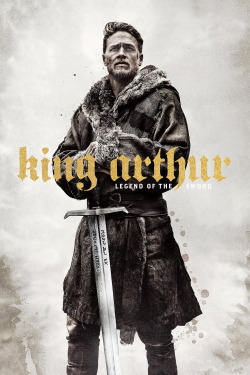
Review of King Arthur: Legend of the Sword (2017) by Joshua B — 10 Aug 2017
It's not legendary, is it madcap? Yes, of course.
Curious question: Is it possible to determine the full amount in which the legend of Arthur of Brittany has been portrayed (independent in expression) in any audiovisual media? The answer would be an authentic indeterminacy. Edwin S. Porter's "Parfisal" had no idea of the narrative phenomenon that was going to cause time after its release in 1904; naive and audacious, this silent film only adapted Richard Wagner's opera, with which Wagner gave a twist to the homonymous poem of Wolfram von Eschenbach where chivalry contest, sorcery, love, passion, and legacy made their covering letter in both film and theater. Epic-medieval-knightly adventures have known how to ration their elixir of immortality, since a decade and half a century later, the London tales located in the full expanse from the 10th century to the 15th century, erroneously, they simulate possessing the essential vigor for-with an exaggerated positivism-creating a saga ala "Avengers in the medieval London", owned by Warner Bros., in the middle of the Millennium era, of course, hitting the nail on the head with the chosen filmmaker for modernizing the Celtic story. He sins due to his creativity by basing on the sharp literary sword with too much freedom, falling into his deep-rooted directional record, arousing a swirl of varied mixes that offer a new King Arthur face.
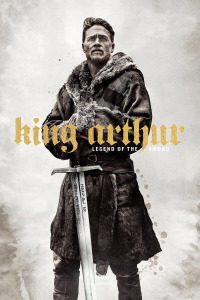
A young cherubic Arthur, a famous character in the European literature, is forced to witness the extermination of not only his realm but his own nuclear family, adding with irony, a stab in the back by his uncle Vortigern (Jude Law). Brought up among bosoms of lust, dearth and Love, Charlie Hunnam ("Sons of Anarchy" - "Crimson Peak") grows between rustic London alleys with knocks and shocks, for according to the leonine legend and the extravagant narrative thread written by ten hands, redefine his philosophy of life and accept what destiny holds: to become the ideal monarch in both war and peace. And yeah!, despite big freedom, Excalibur is to be present, what would King Arthur do without what makes him King Arthur? (Of course, eliding Merlin's absence).
Being a cornerstone of the medieval literature expansion, the story has been one of the most influential and prominent in the film world, interpretations that fall into the hands and minds of dissimilar filmmakers who have infused it, for better or worse, their distinctive signature using the annals of the character, which is rumored, it's fictitious. Guy Ritchie, a British director of features as ingrained as iterative who was trend years ago with his second motion picture "Snatch", getting to win over Warner Bros. Company in order to hold him responsible for a big-size revamp with a budget of USD 175 million. The director must had been performed a whopping feat so that it would allow him to have such a budget amount, which, at first glance, reached a deadlock on the special effects. That Ritchie who made it on her own to the early twentieth century with his fast-paced, and comic-even hyper-style, which required the spectator enough attention not to be lost in the whirlwind of stop-and-go stories both via flashbacks and flash- forwards, suffocates the opportunity with an unusual medley of genres and ideas, though their risky elections are welcomed, don't end up to set completely, such as the "Ritchinian" opening attributed to the childhood of the main role where it isn't perceived fluency, doesn't generate interest and visibly shows an embarrassing appearance, revealing the fatigue of the director to keep his touch with every work, something that doesn't impact the same way anymore. In addition to the above, new innovations ranging from top angles increasing and focusing the visual field as if it was a video game, the inclusion of views in the first person or even the application of a street and urban accent to an epic chase through London passages, a cinema breaking traditionalism but never becomes truly suggestive.
Visually speaking, "King Arthur" raises interesting re-inventions, in which are the required elements so that it doesn't feel foreign to the base story altogether. It's clear that visual effects make us dizzy and, in certain periods, spoil the image in its entirety, however, only a few are the found true flaws in the shots of colossal elephants ruining empires, a kingdom as vast as dreary, enchanted waters by a god and his penitents, among others. In a nutshell, the film receives a dark and pessimistic tone, a technique that would have worked in the first half of the feature film, where the protagonist is immersed in confusion and searching for himself, however, the opacity is there from beginning to end, reducing the aggressiveness of the images with dull colors in excess.
With the help of some marketing posters and certain advertising videos, can be detected who deals with the weight of the story: Charlie Hunnam and Jude Law. The first one looks pretty good with sloppy clothes and blonde hair of Arturo, his acting is credible and the style he endows the character is enjoyable, even despite the stereotyped outline of his role, one very adept at the edition of Joseph Campbell "The Hero's Journey". Emphasizing his rigorous body workout, which cannot be ignored in projects like these, Hunnam has the minimums for, in an unlikely future, taking charge of the King Arthur franchise. As for Law, his performances are always excellent, and although this one is not enough, perhaps because of the lack of understanding about the magnitude of the role, he executes suitably perverse insanity, treachery, and greed of a king chosen by mistake.
Projecting the viewer a film hybrid that only finds its point of glory in selected visuals that can be categorized as visionaries and sequences of struggle and annihilation executed with flair, of course, embellishing them with a delightful soundtrack at the hands of Daniel Pemberton; Charlie Hunnam and Guy Ritchie achieve being a different summer movie, on their own merit, alas, leaving on the way, more and more quickly, the considerable expectations they had. A feature film ending up just like mythological "Sword in the Stone", embedded in its rough mold.
This review of King Arthur: Legend of the Sword (2017) was written by Joshua B on 10 Aug 2017.
King Arthur: Legend of the Sword has generally received positive reviews.
Was this review helpful?