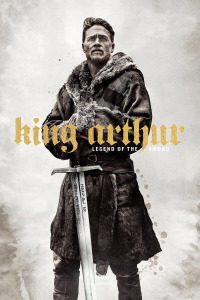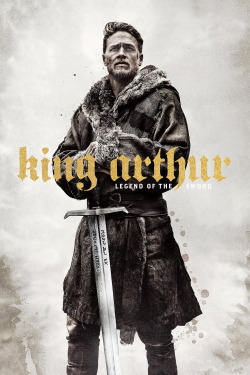
Review of King Arthur: Legend of the Sword (2017) by Spangle — 24 Sep 2017
For the first time in his career, Guy Ritchie is likely happy he directed Swept Away because without its existence, King Arthur: Legend of the Sword would have firmly established itself as Ritchie's worst effort in his career. Entering in the illustrious pantheon of bad films that bomb after being intended to start a franchise, King Arthur: Legend of the Sword is everything that is wrong about blockbusters today. Cliche and riding the hero's journey too closely, the film's special effects ridden action, frantic cutting (even beyond Ritchie's norm), and awkward injections of "humor" during tense or thrilling moments, the film is a hodge-podge of everything that studios believe audiences want. Unfortunately, as is often the case in these failed franchise starters, it turns out that audiences do not want to watch an incomprehensible, poorly edited, poorly acted, and exceedingly dull film.
The tragic part about King Arthur: Legend of the Sword is that it starts off pretty well. With his castle under attack, King Uther Pendragon (Eric Bana) defends his people by using Excalibur to decisively cut through the invaders' forces and kill their leader. Unfortunately, he did not count on his brother Vortigern (Jude Law) having turned on him. Sacrificing his to become more powerful, Vortigern kills Uther and tries to take Excalibur, but Uther turns into a stone with the sword in his back. Setting up the legend of the sword with his son Arthur drifting off in a boat and being found by a group of women Moses-style, being destined to pull that sword out of him and liberate England from Vortigern. Though he is unwilling and tries to throw away his destiny (the classic cut-and-paste scene of the Lady of the Lake rising with the sword to give it back to Arthur that is in every King Arthur movie apparently), this destiny is not one he can run from unless he is willing to see Britain descend into darkness. Becoming the man who will liberate his people (Moses again), this prophet who is persecuted by the King (Moses again, but also Jesus to some degree) must rise to the occasion via the Hero's Journey to save England. Though cliched to a fault, the story is nonetheless one that can become gripping with Ritchie's occasionally sharp script delivering the fantastical journey and thrills necessary for a King Arthur film.
Unfortunately, shortly after the film's strong opening, things begin to go awry. In other words, Guy Ritchie takes over. Known for his rapid cutting, Ritchie seems to forget he has already cut 15,000 times before unleashing another round of 15,000 shots of Charlie Hunnam's face on the world. Immediately after the credits, he shows Arthur growing up from a young boy to a man with intensive training and odd encounters in his brothel home. Rapidly skimming through time, the headache-inducing sequence tragically sets the tone for a film that puts a premium on rapid cuts and slow-mo action instead of story. So brief, distracting, and inconsequential, this particular montage would have been better if replaced by a "20 years later..." bumper before just cutting to Arthur being a ripped Englishman set to encounter his destiny.
Reliant upon these rapid cuts throughout, Ritchie - as expected - uses it frequently as characters tell a story to somebody who was not there - such as Arthur giving an account of his whereabouts to a police officer with Ritchie flipping through the flashback and the present day with the flashback often matching Charlie Hunnam's every it of dialogue - or to toss in flashbacks and foreshadowing about Arthur's destiny, but where the film truly lacks with this rapid cutting are in action scenes. Rendering them nonsensical and often incomprehensible, Ritchie tries desperately to cover up the poor special effects with this flashy editing style, but it unfortunately has the opposite impact. Instead, these flashy cuts only serve to highlight the often poor special effects that are found in this film, especially as Arthur duels with officers towards the end. Cutting, pausing, slowing things down, and spinning the camera in a circle around the action, Ritchie tries every trick in his arsenal to make the scene look good but does nothing more than confuse and nauseate. Furthermore, it is a clear attempt to manipulate the audience into feeling tension and thrills during the action - especially as Arthur and his friends run from the cops with Ritchie rapidly cutting, using an extreme close-up with a handheld camera, and sprinkling in shaky cam into the scene - as even Ritchie can see that the film is not all that original. Trying to inject originality and beat back claims of predictability with these drawn-out and "stylish" action scenes, Ritchie only manages to further highlight his film's hollow nature. This half-hearted attack at style over substance only serves to prove this as he relies upon it like a crutch to make up for the film's thin writing and run-of-the-mill approach to Arthurian legend.
This review of King Arthur: Legend of the Sword (2017) was written by Spangle on 24 Sep 2017.
King Arthur: Legend of the Sword has generally received positive reviews.
Was this review helpful?