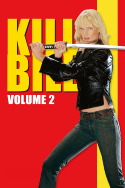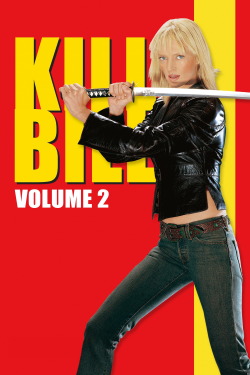
Review of Kill Bill: Vol. 2 (2004) by Jiggers T — 10 Feb 2013
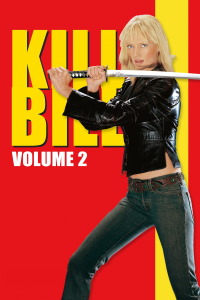
No commenting on individual reviews anymore, huh? Well, I was bored so I thought I'd respond a bit to a very wrong-headed review from the New Yorker about this movie. Oh, that review is very wrong. The reviewer doesn't seem to understand that Quentin Tarantino is not TRYING to fetishize violence, who does? He's making an homage to the movies that he loves, to movies whose engines of thought are limited to a kind of structure that allows and disallows things the reviewer has problems with. He says the child, when her mother is murdered (Vivica Fox) in the beginning of the movie, should be bawling on the floor, completely emotionally destroyed. If that child were to act distraught, the reviewer points out, this would go on to solve most of our societal problems with violence, out of hand. A few tears, some very emotional trauma, and it's no longer a problem. What the reviewer fails to realize is that the mode and means of the movies Tarantino is honoring did not allow that. Everyone in these movies, as far as I can determine from the code of Tarantino's movie, is cool as a cat. These characters realize that people die, it's the way of their world. It's sort of a secret society which these professional killers inhabit, it's a bubble of reality that exists outside of normal society. Perhaps, also, Tarantino was trying to point out that both Beatrix's child, and Fox's character's child, are so young they don't understand what happened or the meaning of death and life. The philosophical discussion that Bill has about Bibi and the goldfish at the end of the second movie explicates this point quite well. Perhaps Tarantino is asking his audience to believe in what he is doing a little bit, as in asking us to put off disbelief for a bit while he makes a point about life and death. And after all, isn't this discussion of life and death interesting? Isn't Tarantino alluding to the conflict between Bill and Beatrix? Isn't there some character discussion here that makes the final conclusion all the more thrilling? Isn't it made clear that THIS is the means and mode, the code Tarantino has adapted for this movie, and won't be broken so that we can all feel a little better about life and death, so that a quick point about violence perpetrated by America in the middle east can be made on the fly? Why does the director have to change how his movie is made, in fact the structure of his script, so that a point may be made about how violence is naughty? Perhaps the critic should spend time critiquing the movie based on the movie's own selected code? Perhaps we should not put our own 'thing' on things, so to speak. Perhaps we should have faith in the director to create a world in which we may escape to, and expect him to be consistent in how he develops and explains this world?
In essence, I don't understand the plight the New Yorker critic is putting on Tarantino's movie here. If he wants the movie to be one thing rather than another, why doesn't he make his OWN movie? He thinks it's all sickly violence, and it's all disturbing, however I don't see a review in this. It would be much more fair to say that, perhaps, Tarantino does not spend enough time painting the landscape of his world; it would require stronger characterization for the reviewer to suspend disbelief about the violence of said movie, for example.
Tarantino, while an excellent director when it comes to style, and images, cannot be said to be quite the same caliber as Sergio Leone. Leone could build a broad, well painted world with substance to spare and very realized characters. I would have liked to see more intricate details of character attributed to Bill, Beatrix, and mostly all of the original gang of characters. Tarantino shows us their menacingness, but not their likes or loves, their hopes or dreams, their deepest character. Tarantino's characters are skin deep, simply images of beauty or violence who commit the most atrocious acts without a thought or care. Someone in a review on this site said Beatrix's jumpsuit was an allusion to Bruce Lee. Bruce Lee had a philosophy that described well why he fought and where the line was and how far he would go to reach the ends he desired. It has also been pointed out the similarities between Beatrix and Bruce Lee or Clint Eastwood. Neither of these actors portrayed characters who used swords, though. One was with fists and the other was with a gun. Beatrix does not use anything but a sword (or martial arts). A sword is much more personal than a gun. The New Yorker reviewer does not like gun violence, he is implying, because that is the kind of violence most common in movies (and in America and in wars). Tarantino's weapon of choice isn't just a pull of the trigger, it's penetrating flesh in the most personal, meaningful way. There's something more delicate in using a sword to kill, or fists, than a gun. Tarantino's violence is not dumbed down button pushers, but philosophical martial artists. The reviewer would have spent his time better dissecting a Stallone movie, or one of Tarantino's earlier movies, though I doubt he would have found the dumbed down violence he is looking for there, either.
Anyways, I'm just thinking out loud. I may have made some contradictions, which I think speaks about just how good, and just how much substance there IS in this movie. I didn't like Kill Bill Vol. 1 way back in the day, but now after having watched it a bazillion times I'd rank it among the ten best movies of the 2000s, it's basically a sort of masterpiece. Just because there is a lot of blood doesn't mean it's a B-movie.
This review of Kill Bill: Vol. 2 (2004) was written by Jiggers T on 10 Feb 2013.
Kill Bill: Vol. 2 has generally received very positive reviews.
Was this review helpful?