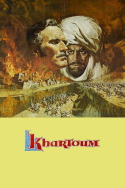
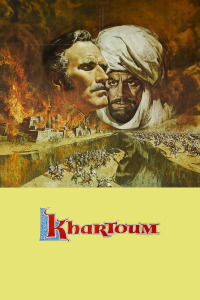
Review of Khartoum (1966) by Allan C — 06 Jun 2012
It took almost ten years after "Gettysburg" to make "Gods and Generals", six days shy of sixteen years after "Return of the Jedi" to get started on the "Star Wars" prequels and twenty-seven years after "The Four Feathers" for them to make this. Granted, this isn't really a prequel to "The Four Feathers", regardless of how Wikipedia makes it seem under the article of "Feathers", but eitherway, the point is that it sure takes them a long time to make prequels, though in this case, I can forgive that, not because this film really isn't related to "The Four Feathers", outside of the fact that it's about the real-life British general at the beginning of the dramatized "Feathers", but because they probably never had any intention of making this, it's just that, in the '60s, they were digging for any epic for Charlton Heston to be in, because he just had to have his fix, including the scrapped ones. I can just see Heston walking into a film studio, scratching himself and crying, begging for another epic to be in, and then they just dig out some idea they had for a prequel to "The Four Feathers". Evidently, whatever kind of addiction that is causes something similar to meth mouth, which would explain Heston's crazy jaw; it certainly appears to cause some kind of breathing problems, because he was heaving like crazy in a lot of his films, or at least that's my excuse for his overacting in a lot of dated performances. Something that certainly hasn't dated is Laurence Olivier's ability to bypass his being so absurdly white and play a different race quite convincingly. Well, in all fairness, after he went black for "Othello" mere months before this film came out, an Islamic messiah should be a walk in the park, but eitherway, the point is that Olivier delivers once again, and with all of my talk about Heston becoming dates as a hit-or-miss actor, this is decidedly one of his hits. Still, as much as Heston surprises and Olivier fulfills predictions, neither are constant in shocking enough to completely jolt the audience out of a degree of boredome.
As I'll touch more upon later, this film hasn't quite recieved the attention it deserves for being very sophisticated on a level found ahead of its time, among intriguing dramas of today's sensibilites, and yet, as good as that is, it all stands as problematic, because, I don't know about y'all, but good and sophisticated dramas nowadays tend not to be the most exciting films in the world. Well, sure enough, with this film's sophistication comes dryness, and much of it, perhaps not to a terribly intense degree, yet still thoroughly enough to where the film often finds itself limping as it drenches the atmosphere with too much sobering meditation, leaving it to dull down in some spots. That steam loss is further intensified by, well, yeah, you guessed it: repetition. Speaking of repetition, I bring that flaw up a lot, yet justifiably every time, and this time is not exception, for although the film is far from monotonous, it does begin to tread familiar ground, making only so much progress in intrigue for a fair couple of periods in time. Neither the film's slowness or repetition are terribly intense, yet they remain presence enough to leave the final product to run on an ever-diluting amount of juice until it actually reaches a sharp point. Of course, once the film reaches that point, it really strikes at you with surprising force that really keeps you going. Still, although the film boasts certain points that are considerably more engrossing than other, it's not like the film isn't consistently enjoyable, being kept going by quite a bit.
Frank Cordell's score is grand and diverse, capturing the sweep and spirit of the film with grace, while the nifty and dynamic production designs construct the world in a buyable and immersive fashion, made all the more gripping by Edward Scaife's handsome, broadly-scoped cinematography. The film's fine visual and audible touches make the film engaging, especially when they all unite to a single point amidst the action sequences, of which there are only so many, yet each one is grand and intense, with thrills that may not be as sharp as they were for their time, yet remain gripping, even to this day. Still, even with all of the film's fine style, as I said, much of this film is dry and sophisticated, aspects that dull down the film, though not terribly, as the script really is fairly intelligent, boasting no terribly sharp lines or anything, yet much intelligence, as well as depth and intrigue within both the politics and humanity of the story, without feeling forceful in any way, and for that, credit not only goes out to Robert Ardrey's screenplay, but also Basil Dearden's direction, as he is able to draw much depth from this film, though not without the help of some talented performers, particularly the people we're really coming to see. Laurence Olivier is surprisingly rather underused as Muhammad Ahmad, yet for every scene in which he's present, he steals the show, being virtually unrecognizable, not just because they caked him in makeup or because he's putting on a strong accent, but because he gives off such a transformative aura of the strength and humanity that made Ahmad such a strong force as a leader, making him a strikingly complex, yet mysterious antagonist for the limited time he's on. Olivier certainly delivers a strong performance, as expected, while leading man Charlton Heston really catches us off guard. Much of Heston's performances have become dated, and with the role of General Charles Gordon requesting acting challenges from an English accent to subtle yet palpable layers upon presence, I'm sure even some of your less cynical Charlton Heston viewers would expect him to slip up, yet Heston puts that English blood to good use, doing a surprisingly pretty descent job at the accent, complimented by a sparklingly charismatic capturing of that good old fashion English nobility and charm. However, as the depth of Gordon exposes itself, Heston surprises yet again with a subtle, yet, at points, intense aura of vulnerability and reflection that's very sobering and very insightful, giving us a very sobering view of the humanity within the notorious general to break up a very engaging view of the strength within Gordon, making him a powerful lead presence strong enough to carry this ultimately rewarding piece of drama and sophistication.
In conclusion, the film collapses into much slowness, sometimes even dullness, being pulled down by many a point of dryness within the tone, as well as a degree of repetition, yet it's easy to power through these faults, thanks to fine style, as well as Robert Ardrey's fine script script, with intelligence and depth brought to life quite sharply by director Basil Dearden and a strong cast, headed by a predictably transformative and effective Laurence Olivier and a surprisingly deep, heavily layered, when not simply charismatic Charlton Heston, ultimately leaving "Khartoum" a fascinatingly sophisticated and rewardingly compelling mini-epic.
3/5 - Good.
This review of Khartoum (1966) was written by Allan C on 06 Jun 2012.
Khartoum has generally received positive reviews.
Was this review helpful?